Origin
A few days ago, I saw an article on the QuantumBit WeChat public account titled "This bizarrely creative Couplet AI has everyone going crazy." I found it quite interesting. More importantly, the author organized and released the dataset, so I decided to try it myself.
Implementation
"Writing couplets" can be viewed as a sentence generation task, which can be accomplished using seq2seq, similar to what I wrote in my previous post "Playing with Keras: Automatic Title Generation with seq2seq", just by slightly modifying the input. The method used in the aforementioned article was also seq2seq, which seems to be the standard approach.
Analysis
However, if we think about it further, we find that compared to general sentence generation tasks, "writing couplets" is much more regular: 1. The upper and lower lines have the same number of characters; 2. Almost every character in the upper line has a corresponding relationship with the lower line. Thus, writing couplets can be directly viewed as a sequence labeling task, similar to the approach used for word segmentation or Named Entity Recognition (NER). This is the starting point of this article.
Speaking of which, this article doesn’t actually have much technical complexity. Sequence labeling is already a very common task, far simpler than general seq2seq. Sequence labeling refers to inputting a sequence of vectors and then outputting another sequence of vectors of the same length, and finally classifying "every frame" of this sequence. Related concepts can be further explored in the article "Brief Introduction to Conditional Random Fields (CRF) with Pure Keras Implementation".
Model
In this article, I will introduce the model while writing the code. For readers who need to further understand the underlying basic knowledge, you can also refer to: "[Chinese Word Segmentation Series] 4. seq2seq Character Labeling Based on Bidirectional LSTM", "[Chinese Word Segmentation Series] 6. Chinese Word Segmentation Based on Fully Convolutional Networks", and "Poetry Robot Based on CNN and VAE: Random Poetry Generation".
The model code we use is as follows:
x_in = Input(shape=(None,))
x = x_in
x = Embedding(len(chars)+1, char_size)(x)
x = Dropout(0.25)(x)

x = gated_resnet(x)
x = gated_resnet(x)
x = gated_resnet(x)
x = gated_resnet(x)
x = gated_resnet(x)
x = gated_resnet(x)

x = Dense(len(chars)+1, activation='softmax')(x)

model = Model(x_in, x)
model.compile(loss='sparse_categorical_crossentropy',
              optimizer='adam')
Where gated_resnet is the gated convolution module I
defined (this module was also introduced in the article "DGCNN: A CNN-based Reading
Comprehension Question Answering Model"):
def gated_resnet(x, ksize=3):
    # Gated Convolution + Residual
    x_dim = K.int_shape(x)[-1]
    xo = Conv1D(x_dim*2, ksize, padding='same')(x)
    return Lambda(lambda x: x[0] * K.sigmoid(x[1][..., :x_dim]) \
                            + x[1][..., x_dim:] * K.sigmoid(-x[1][..., :x_dim]))([x, xo])
And that’s it!
That’s all there is to it; the rest is just data preprocessing. Of
course, readers can also try replacing gated_resnet with a
standard bidirectional LSTM, but in my experiments, I found that the
bidirectional LSTM did not perform as well as gated_resnet,
and the LSTM is also relatively slower, so the LSTM was abandoned
here.
Results
The training dataset comes from: https://github.com/wb14123/couplet-dataset. Thanks to the author for organizing it.
Complete Code:
https://github.com/bojone/seq2seq/blob/master/couplet_by_seq_tagging.py
Training Process:
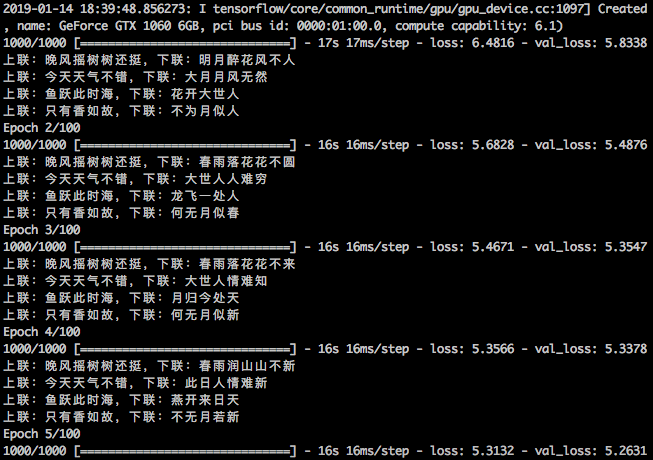
Partial Results:
Upper line: The evening breeze shakes the trees, yet they stand firm
Lower line: The night rain taps the flowers, making them more fragrantUpper line: The weather is nice today
Lower line: Yesterday’s human feelings were unclearUpper line: Fish leap in the sea at this moment
Lower line: Birds chirp on what day for peopleUpper line: Only the fragrance remains as before
Lower line: Not without the moon appearing as newUpper line: Scientific Space
Lower line: Civilization Great Middle
It seems to have some flavor. Note that "The evening breeze shakes the trees, yet they stand firm" is an upper line from the training set; the standard lower line is "Morning dew moistens the flowers, making them redder," while the model gave "The night rain taps the flowers, making them more fragrant." This shows that the model is not simply memorizing the training set but has a certain level of understanding; I even feel that the lower line produced by the model is more vivid.
Overall, the basic character correspondence seems achievable, but it lacks a sense of overall cohesion. The overall effect is not as good as the two versions below, but as a small toy, it should be satisfactory.
Wang Bin’s AI Couplets: https://ai.binwang.me/couplet/
Microsoft Couplets: https://duilian.msra.cn/default.htm
Conclusion
Finally, there isn’t much to summarize. I simply felt that writing couplets should be considered a sequence labeling task, so I wanted to try it with a sequence labeling model, and the results felt okay. Of course, to do better, adjustments to the model are needed, such as considering the introduction of Attention, etc. Then, during decoding, more prior knowledge needs to be introduced to ensure the results meet the requirements of couplets. These are left for interested readers to continue.
When reposting, please include the original address of this article: https://kexue.fm/archives/6270
For more detailed reposting matters, please refer to: "Scientific Space FAQ"