In the previous article, we derived the equation of motion for a one-dimensional spring: m\frac{\partial^2 X}{\partial t^2}=k\frac{\partial^2 X}{\partial \xi^2} And we obtained the general solution: X=F(u)+H(v)=F(\xi+\beta t)+H(\xi-\beta t) Or: X(\xi,t)=\frac{1}{2}\left[X_0(\xi+\beta t)+X_0(\xi-\beta t)\right]+\frac{1}{2\beta}\int_{\xi-\beta t}^{\xi+\beta t} X_1 (s)ds At the end of that article, it was mentioned that this solution has some issues. Now, let us analyze it in detail.
The Divine Finger Technique
Let us use an example to demonstrate the solution above. Suppose the initial state is: \xi = \begin{cases} 0, & x < 0 \\ \sin x, & x \in [0, \frac{\pi}{2}] \\ 1, & x > 0 \end{cases} Solving for x gives: x = \arcsin \xi Substituting this into the general solution expression: X(\xi,t)=\frac{1}{2}[\arcsin(\xi+\beta t)+\arcsin(\xi-\beta t)] Everything seems fine, but there is indeed an impropriety in the above solution. Note that the value of \xi ranges from 0 to 1. For instance, if we consider \xi=1 and t>0, then \xi+\beta t > 1. At this point, \arcsin(\xi+\beta t) is no longer a real number! How can such a situation arise from a perfectly good general solution?
The reason is that when we replaced the summation with an integral over \xi, we actually used a hidden assumption: continuity!
In other words, we assumed that if the initial state x_i is to the left of x_{i+1}, then after some time of motion, x_i will still be to the left of x_{i+1}. This is not necessarily true. For example, let’s consider a spring with only two objects, with the initial state as follows:
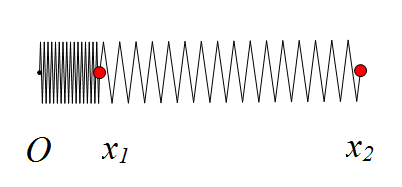
In this case, one end x_1 is held tight, while the other end x_2 is pulled away. As long as the distance from x_2 to x_1 is long enough—that is, far exceeding the original length—then after release, x_1 moves to the right and x_2 moves to the left. In our assumption, they are point masses and there is no concept of collision. Furthermore, in our equations, the two particles are only connected by a potential energy proportional to the square of the distance, rather than being pulled by a physical spring. Therefore, it is possible for x_2 to end up on the left and x_1 on the right, with the two moving further apart over a period of time. This violates the continuity assumption. The situation is similar in the case of infinitely many particles.
Thus, overall, the "general solution" we obtained is actually only suitable for describing motion within the region 0 < \xi+\beta t < 1 and 0 < \xi-\beta t < 1. Once outside this region, modifications are required. As for how to modify it, I am still reflecting on that.
When reprinting, please include the original address of this article: https://kexue.fm/archives/2434
For more detailed reprinting matters, please refer to: Scientific Space FAQ