Translated by DeepSeek V4 Pro. Translations can be inaccurate, please refer to the original post for important stuff.
Jianlin SuAugust 6, 2009#59
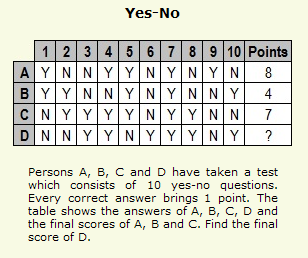
A, B, C, and D four people answer 10 Yes/No questions. One point is
awarded for each correct answer. The answers of the four people and the
scores of A, B, and C are shown in the figure. What is D’s score?
(Additional note: no points are deducted for wrong answers here.)
In fact, this problem itself has already
reduced the difficulty to a very low level, so I recommend everyone to
think about it.
If you really don’t have the heart to think
about it, you can look at the answer directly (not
recommended).
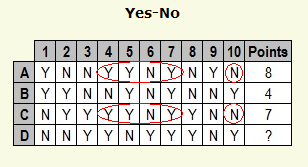
A missed two questions, and C missed three questions, which means A
and C have at least (10-2-3=5)
identical answers that are correct. We find that in the data listed by A
and C, there are exactly 5 identical answers, so these five answers must
be the correct answers.
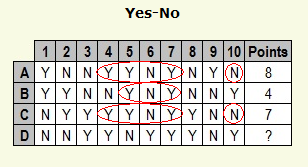
Since we already know the correct answers to 5 questions, we can
conclude that among the 4 questions B got right, 3 have already been
determined.
Now we can assume any of the remaining
answers in B is correct, and then the rest are wrong; then compare with
the data of A and C to see if we can get 8 and 7 correct questions
respectively. After testing, the first question of B is correct.
In addition, other answers will appear, meaning B is not necessarily
correct on the first question. After final testing, there are three
possibilities for the answer key:
Y N Y Y Y N Y Y Y
N N N N Y Y N Y Y Y
N N N Y Y Y N Y N Y N
Answer: No matter what, the result
is that D gets 5 points.