Translated by DeepSeek V4 Pro. Translations can be inaccurate, please refer to the original post for important stuff.
Su JianlinAugust 6, 2009#58
It
has been a long time since I translated an article; I have been a bit
lazy lately... However, I cannot always be lazy and need to exercise my
skills. Today, I translated an article about “Cosmological Models.” The
original text is from New
Scientist. It turns out that the universe is very similar to the
snacks we usually eat...
Doughnuts, potato chips, bugles,
peanuts, apples—are these the universe in your mind? Let’s see them
together!
Five Snacks That Are Shaped Like the Universe by Michael Marshall
It is one of the most famous
questions in science—what is the shape of the
universe? Since Ptolemy, many physicists have imagined
the universe as a sphere, but this may not be the correct answer.
Scientists have proposed many other models of the universe, all of which
have something in common: they can be compared to popular snacks in
daily life. So, please open a bag of your favorite snack now and join us
on this journey of food-based theoretical physics.
Doughnut This hypothesis suggests that the universe
might be like a torus—or a ring—and has developed into various forms
over the decades. One resulting hypothesis suggests that the universe is
like a single band, much like a giant Möbius strip.
Our universe might be floating in a toroidal space. The explanation
from string theory is that our universe is a three-dimensional space
existing within a “brane” in a higher-dimensional space. One model shows
that the universe once contained various branes with up to 8 dimensions,
floating in a nine-dimensional space, where each dimension could loop
back like a doughnut. Today, other “branes” in the higher-dimensional
space may have disappeared together, leaving only our universe to
survive.
Potato Chip Is space flat? If so, two parallel beams of
light will always remain parallel; if space is curved, these two beams
will either diverge or intersect. One hypothesis proposes that space is
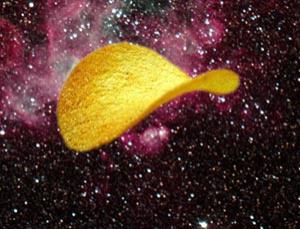
curved, like the potato chips we eat. At the center of a “potato chip,”
the surface curves both upwards and downwards simultaneously (see
figure). Theoretically, every point in the universe should be like
this—in mathematical language, space is negatively curved.
If this is true, it could explain why time always flows forward and
why the universe expands at such a high speed. So far, there is indeed
evidence suggesting that the universe is flat rather than “potato
chip-shaped,” but the issue has not yet been fully resolved.
Peanut The Big Bang approximately 14 billion years ago
created the universe. The universe was born from an infinitely small
point, exploded and expanded in all directions, and then gradually
cooled down. However, this process might not have been uniform, as
magnetic fields in the early universe could have caused different rates
of expansion in different directions.
If this is the case, our universe would be an ellipsoidal shape, like
an olive or a peanut (Physical Review Letters, vol 97, p
131302).
Bugle First, an apology to our non-American readers:
In the United States, Bugles are a very popular corn snack, shaped like
a cone, similar to a horn or a bugle.(Translator’s note: You can check the English
Wikipedia)
A universe shaped like a bugle might seem surprising, but it could
explain some puzzling data from the cosmic microwave background
radiation—the relic radiation left over from the Big Bang.
The cosmic microwave background radiation has many “hot spots” and
“cold spots,” but none have stabilized at a certain level. On the
surface, this situation should not occur. However, a bugle-shaped
universe provides a simple explanation: within 380,000 years after the
Big Bang, there was not enough space in a bugle-shaped universe to form
large-scale radiation spots.
Apple Although we do not associate an apple with the
shape of the universe when we see one, this healthy food can help us
understand the hidden dimensions of the universe.
Some major physical theories (such as string theory) predict that our
universe is a multi-dimensional universe, with more dimensions than we
currently understand. We live in a four-dimensional space, which
includes length, width, height, and time. But there may be more
dimensions—each tightly curled up so small that it is difficult for us
to perceive them.
Some physicists have tentatively proposed that the universe should be
apple-shaped to help explain why there are only three meager types of
fundamental particles in the universe.
For example, we have discovered three different types of neutrinos.
However, it is possible that there is only one type of neutrino, and the
“different” ones we see are because they took different routes through
hidden dimensions, ultimately appearing as different types. Because an
apple has both concave and convex parts, particles can take three
different routes of motion, which might explain why three types are
observed.
English Original:
Five snacks that are shaped like the universe
by Michael Marshall
It’s one of the biggest questions of science: what shape is the
universe? From Ptolemy onwards, physicists thought of the cosmos as a
sphere, but this may not be correct.
Many alternative shapes have been proposed. And they have something
in common: all can be described with reference to popular snack foods.
So prise open a bag of your favourite munchie, and join us on a journey
through food-based theoretical physics.
Ring doughnut
The idea that the universe might be shaped like a torus – or ring
doughnut – has been around for many decades in various forms.
One variation proposes that the doughnut has a single twist – like a
Möbius strip that has been inflated.
Our universe may even be floating around inside a torus-shaped space.
In one interpretation of string theory, our universe is a
three-dimensional region of space called a “brane” floating in
higher-dimensional space.
One model suggests that the cosmos once included various branes with
up to eight dimensions, floating about in a nine-dimensional space with
each dimension circling back on itself like a doughnut. The
high-dimension branes may have smashed together and evaporated, whereas
our universe survived.
Pringle
Is space flat? If it is, then light beams that set off parallel to each
other should keep travelling in parallel forever. If it is curved, then
the beams will either drift apart or come together.
One possibility is that space is curved like a Pringle. At the centre
of a Pringle, the surface curves up and down at the same time (see
diagram). In theory, every point in our universe could be like that – in
mathematical language, space could be negatively curved.
If this is true, it could explain why time only moves forwards, and
possibly why the universe is expanding so fast.
So far, the evidence suggests that the universe really is flat, and
not Pringle-shaped, but the question is not settled.
Peanut
Around 14 billion years ago, the universe formed in the big bang.
Starting from an infinitely tiny speck, it exploded in all directions,
gradually cooling as it did so.
Yet it may not have spread out evenly. Magnetic fields spanning the
early universe could have caused the universe to expand more in one
direction than others.
If so, this would mean that our universe is an ellipsoid like a
peanut or olive (Physical Review Letters, vol 97, p 131302).
Bugle
Apologies to our non-American readers: Bugles are a popular corn snack
in the US, and are cone-shaped like the horns of trumpets or bugles.
A universe shaped like a Bugle may sound odd, but it could help
explain some puzzling observations of the cosmic microwave background
radiation: the relic radiation left over from the big bang.
The CMB radiation has many hot and cold spots in it, but none above a
certain size. On the face of it, there is no reason why this should be
so. But a Bugle-shaped universe offers a simple explanation: at the time
the spots formed 380,000 years after the big bang, there would not have
been enough room for large spots to grow within the Bugle shape.
Apple
Although apples are not a shape that could describe our universe as we
see it, this healthier snack could help us understand our universe’s
hidden dimensions.
Several of the big theories in physics, like string theory, predict
that our universe has more dimensions than humans are aware of. We live
in a four-dimensional universe, moving in length, breadth, height and
time. But there may be many other dimensions – each of them curled up so
tightly they are too small for us to perceive them.
Some physicists have tentatively suggested that they should be
apple-shaped, because that shape helps explain why the universe’s
fundamental particles come in threes.
For example, we observe three types of neutrino. But it is possible
that there is only one type of neutrino, and the three varieties we see
are the result of neutrinos taking different routes through the hidden
dimensions. Because apple shapes are both concave and convex, there are
three types of route the particles could take, potentially explaining
the three observed types.