Explanation:
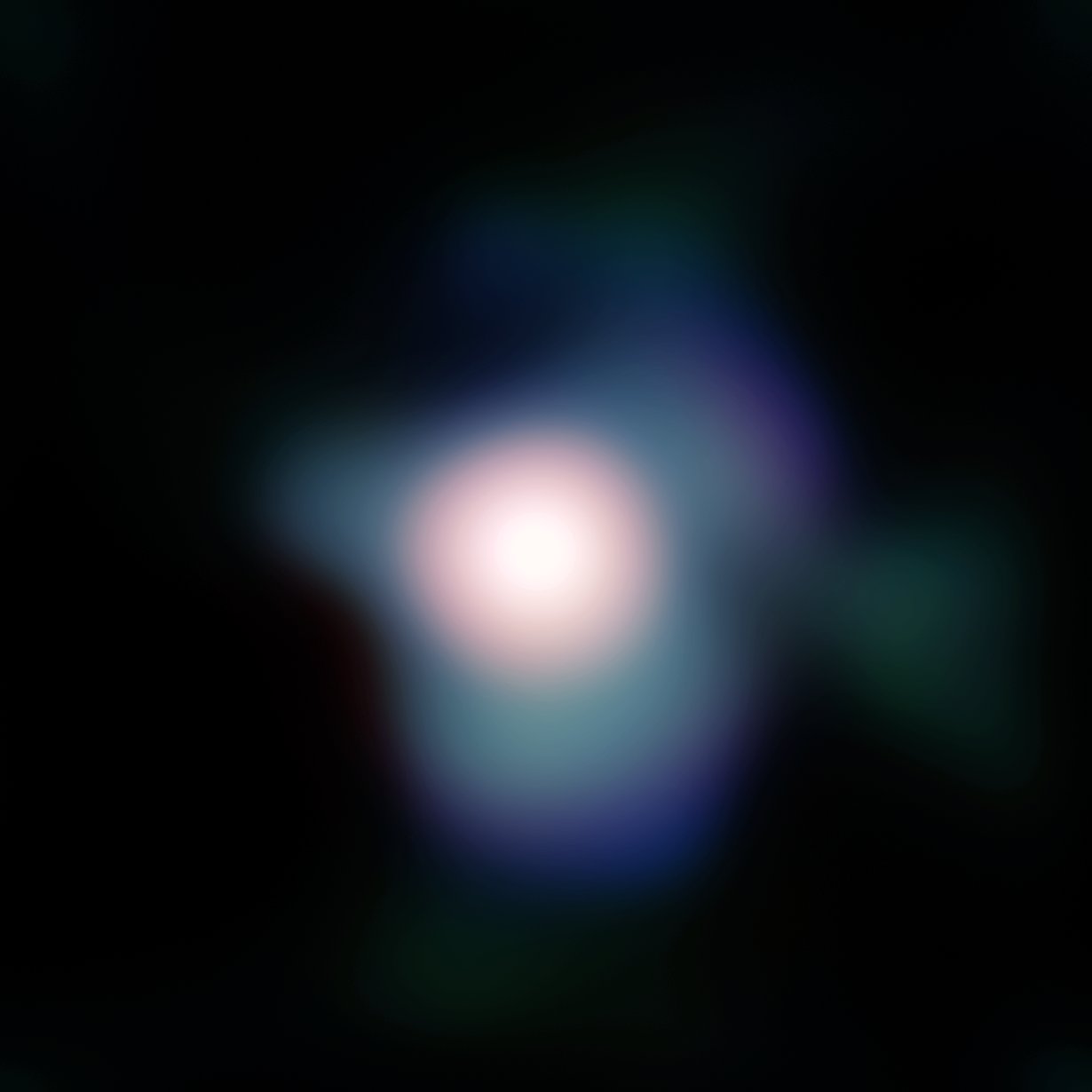
Currently, the largest and clearest image of Betelgeuse shows that this giant star is slowly evaporating.
Betelgeuse, also known as \alpha Orionis, is one of the largest and brightest known stars. It is an orange star in Orion visible to the naked eye, belonging to the red supergiant class. It is the 12th brightest star in the sky and forms the Winter Triangle with Sirius in Canis Major and Procyon in Canis Minor. Although it is the \alpha star of Orion, \beta Orionis (Rigel) is actually brighter.
In the last 15 years, Betelgeuse has shrunk by 15%. Some astronomers believe it might transform into a supernova “before our eyes”. A more blunt way to put it: the old fellow is about to explode!
It was previously thought that Betelgeuse was 430 light-years from Earth, but measurements last year confirmed it is 640 light-years away. According to the rule of “nearer is larger, farther is smaller”, the estimate of its size had to be adjusted accordingly. Thus, its diameter data changed from 3.7 Astronomical Units (AU) to 5.5 AU. That is to say, if our Sun were replaced by Betelgeuse, its diameter would reach the orbit of Jupiter. It is clear that Betelgeuse’s diameter is much larger than the Sun’s. Since volume is proportional to the cube of the diameter, it is not surprising that Betelgeuse’s volume is hundreds of millions of times that of the Sun.
For its size, its age of 8.5 million years is considered quite old, and it might explode as a supernova within the next 1,000 years. If it erupts, it will be the brightest supernova ever recorded.
Reference: http://blog.sina.com.cn/s/blog_4b2b7de20100e7bq.html
NASA Website: http://antwrp.gsfc.nasa.gov/apod/astropix.html
When reposting, please include the address of this article: https://kexue.fm/archives/57
For more detailed reposting matters, please refer to: Scientific Space FAQ