In the article “Cool Papers Update: Simple Construction of a Site Search System”, we introduced the newly added site search system for Cool Papers. The purpose of a search system is, naturally, to help users quickly find the papers they need. However, efficiently retrieving results that are valuable to oneself is not a simple task; it often requires certain skills, such as accurately refining keywords.
This is where the value of algorithms comes in. Some steps that are tedious for humans to perform are quite simple for algorithms. Therefore, in the following sections, we will introduce several new attempts to improve the efficiency of searching and filtering papers on Cool Papers through algorithms.
Related Papers
The technology behind the site search is a Full-text Search Engine. Simply put, this is a search algorithm based on keyword matching, and its similarity metric is BM25.
Since keywords are at the core, we can put some effort into them. Consequently, we extracted 10 keywords for each paper based on its title and abstract to serve as a compressed representation of the paper. The first use of these keywords is to pass them into the site search to find papers related to that specific paper. This is the principle behind the newly added “[REL]” button for each paper.

Simple tests indicate that this approach can indeed recall a certain amount of related literature. However, since the current keyword extraction algorithm is only TF-IDF, the results are not yet perfect. We will make do with it for now, treating it as leaving room for future optimization.
Historical Word Cloud
The second use of paper keywords is to aggregate all the keywords from papers a user has clicked on to form a word cloud, which can serve as a description of the user’s paper preferences. If readers have been using Cool Papers to browse papers recently, this word cloud should already have reached a modest scale, as word cloud statistics were quietly launched some time ago. You can now see it by clicking “More” at the bottom of the homepage (under the “Track” section):
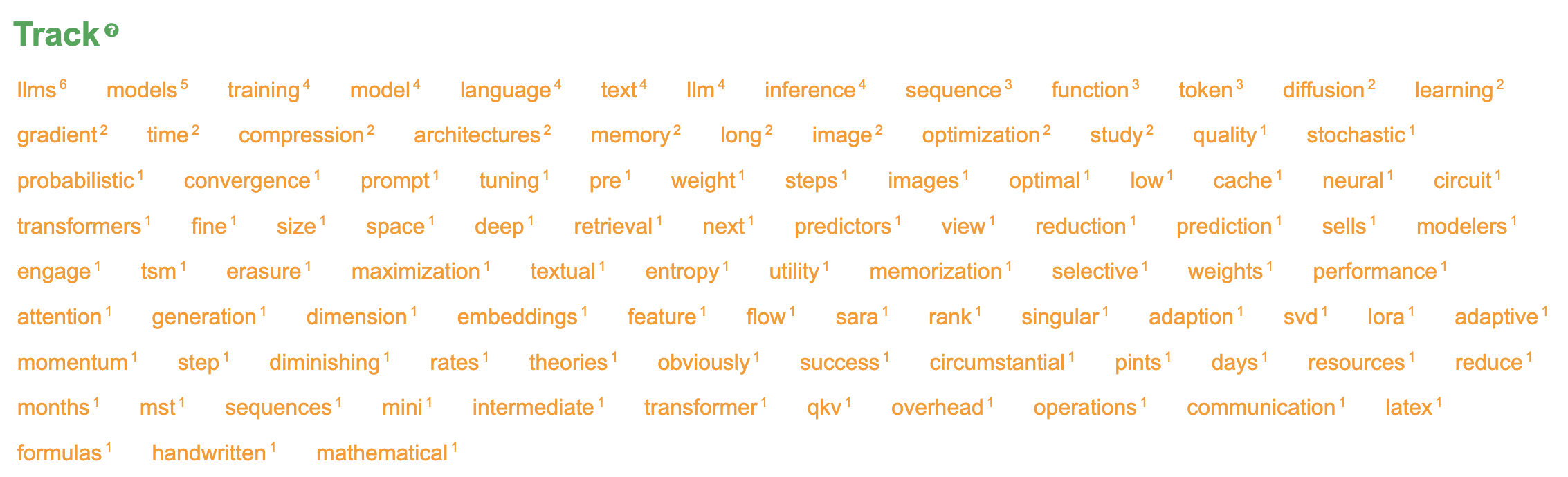
In addition to describing user preferences, word cloud statistics may potentially be used in the future for customized services such as related paper recommendations. This will depend on subsequent development. Please stay tuned, and suggestions are always welcome.
Preference Ranking
As we have emphasized many times before, Cool Papers primarily focuses on “skimming through papers.” However, the number of new papers added daily is still a bit overwhelming for some readers; they do not have the time or energy to go through the entire list. Therefore, we previously provided an option to sort by star count, allowing readers to choose only the papers that are relatively popular.
However, the star count only represents the overall preference of the entire reader base; it does not necessarily align with an individual reader’s personal preferences. Thus, this time we have added personal preference ranking. Similarly, by clicking the “More” button on the homepage, you can see the “Prefer” section, where you can set the keywords you want to follow. Of course, you can also leave it blank; if left blank, the website will default to selecting the top 20 keywords from your historical word cloud as your preferences.
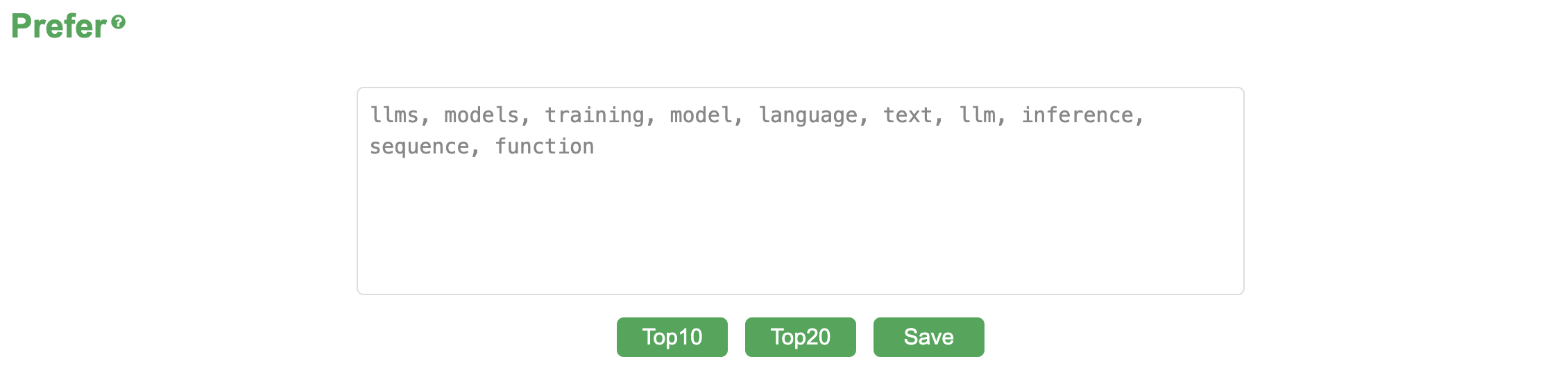
After setting preference keywords, you will see two symbols, “\star” and “\heartsuit”, at the top of the list page. They represent “Sort by Star Count” and “Sort by User Preference,” respectively. Clicking them triggers the sorting:
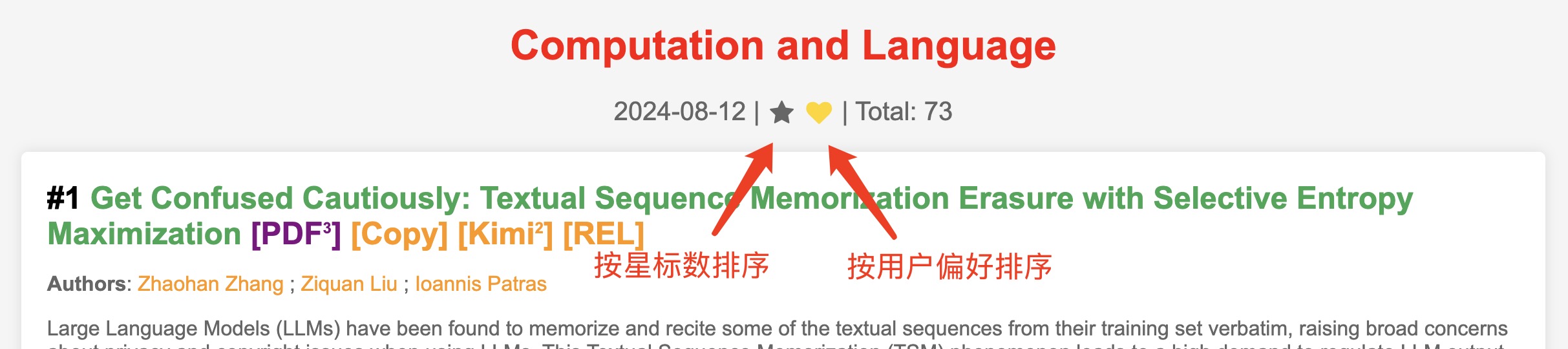
The principle of this sorting is still based on the site search: it uses the user’s preference keywords as a query, limits the search scope, and then returns the ranked search results.
Summary
This article introduced several new features incorporated into Cool Papers, including related paper search, word cloud statistics, and user preference ranking, all aimed at improving the efficiency of browsing papers. It is important to state that the aforementioned user preference data and other statistics are stored locally in the user’s browser; Cool Papers does not collect this data.
Original address: https://kexue.fm/archives/10311
For more details on reposting, please refer to: Scientific Space FAQ