If a household uses a single water heater for centralized hot water supply, we often need to let the cold water run for a while before hot water arrives. If the wait time is long, it significantly affects the user experience. The so-called “Zero Cold Water” technology is essentially a way to drain the cold water in the hot water pipes in advance to achieve an (almost) instantaneous hot water effect. In fact, Zero Cold Water is not a high-end technology, but it has not yet been widely popularized in homes, possibly due to outdated concepts or misunderstandings. However, as people’s requirements for quality of life increase, Zero Cold Water is indeed becoming more popular.
This article provides a simple analysis of the implementation principles of Zero Cold Water technology, including the advantages and disadvantages of various solutions and reference ideas for DIY implementation.
Before We Start
At the beginning of this article, it is necessary to correct a common misconception: Zero Cold Water is not about saving money; it is about improving the quality of life. If your primary mindset is to save money, then you can skip the rest of this content, as Zero Cold Water technology will have no value for you.
(Most) Zero Cold Water technologies do save water, but saving water does not mean saving money. The additional investment for Zero Cold Water is usually much higher than the saved water costs. A simple calculation proves this: assume each shower requires running cold water for one minute. I measured that my hot water pipe outputs 8 liters per minute. Assuming a family of four, that is 32 liters of water wasted per day. At a rate of 3 RMB per ton, the daily water cost is 0.096 RMB, which is about 35 RMB per year. Currently, the lowest-priced Zero Cold Water accessories cost around 700 RMB per set. The price difference between a Zero Cold Water heater and a standard one of the same brand and configuration is also around this level or more. Thus, the extra investment for Zero Cold Water is enough to cover water costs for 700 / 35 = 20 years. This does not even account for the extra energy (gas or electricity) consumed by Zero Cold Water. Therefore, saving money through water conservation is unrealistic.
So, Zero Cold Water technology does not save money. You could say it is for conserving water resources, or more accurately, for improving the living experience—mainly reducing the time we wait for hot water, especially in cold winters. Shivering for a minute or two while waiting for hot water is not only uncomfortable and a waste of time but also makes one prone to catching a cold.
Technical Analysis
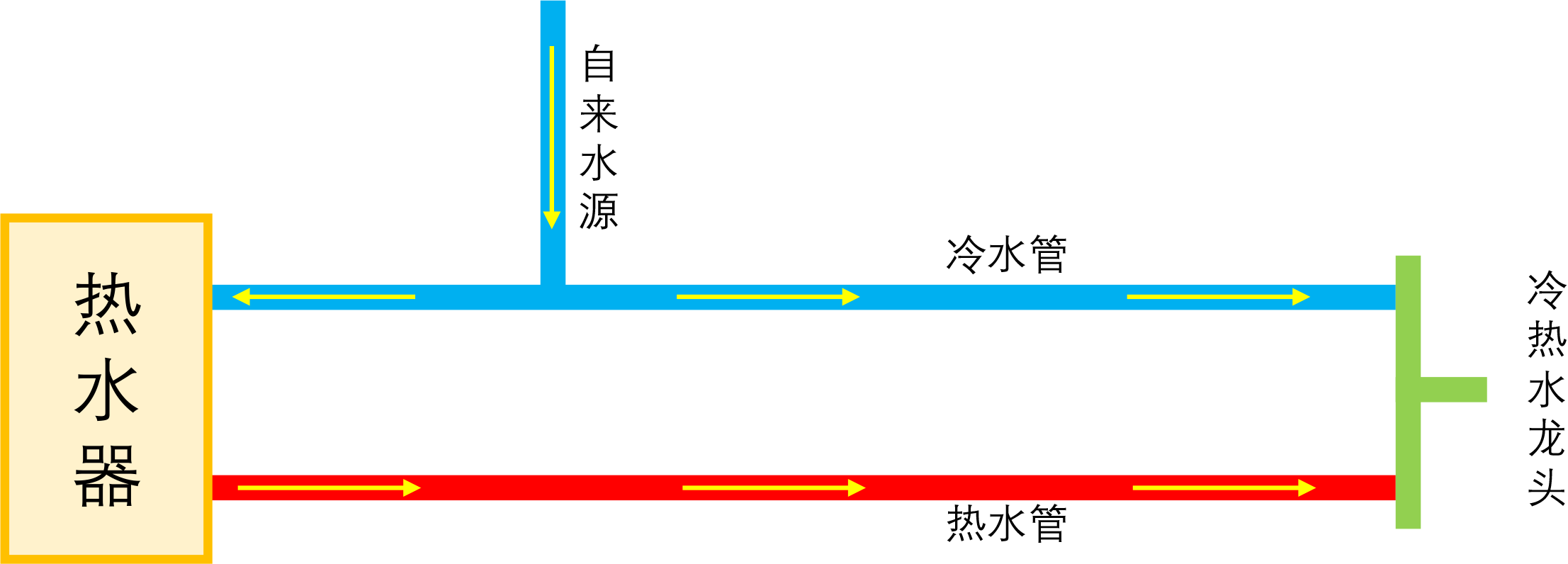
For simplicity, let’s first simplify the problem by assuming there is only one hot water outlet in the house. The water circuit can be simplified as shown below:
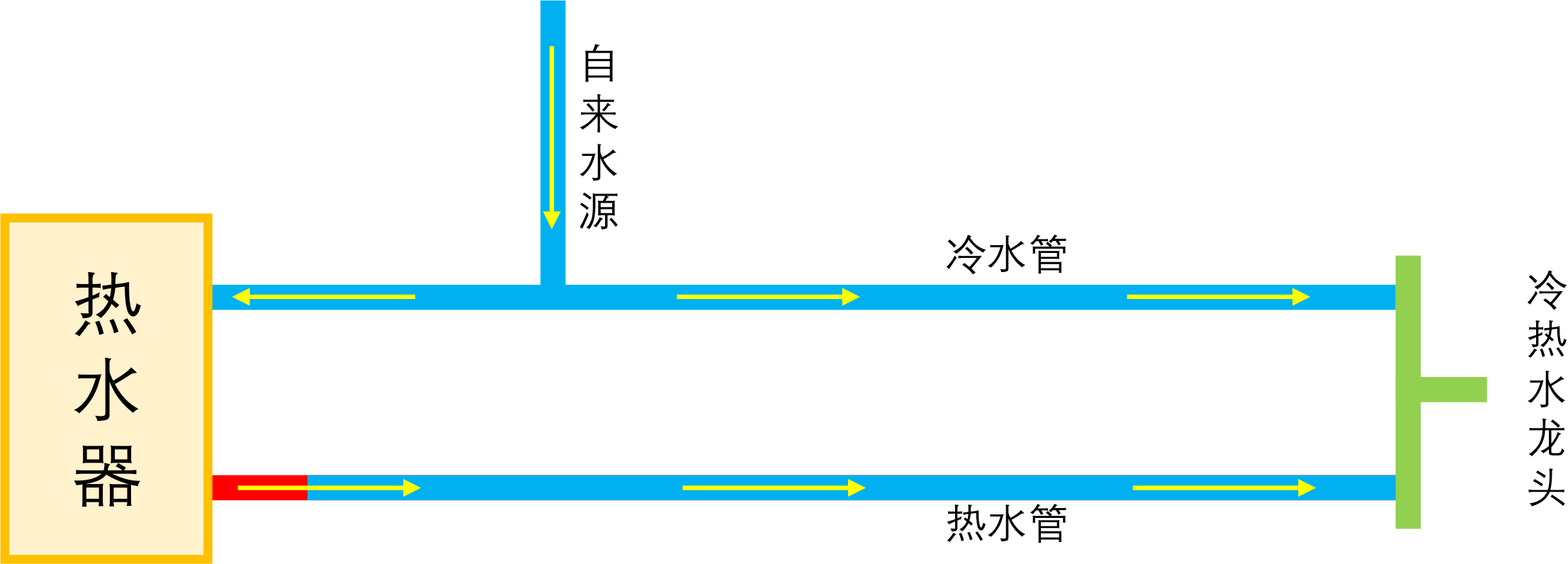
After a long period of non-use, the water in the hot water pipe cools down to room temperature, as shown below:
As mentioned at the start, Zero Cold Water is about finding a way to drain the cold water in the hot water pipe in advance. The first question to solve is: where should it be drained? There are three main answers, analyzed below.
Return Pipe
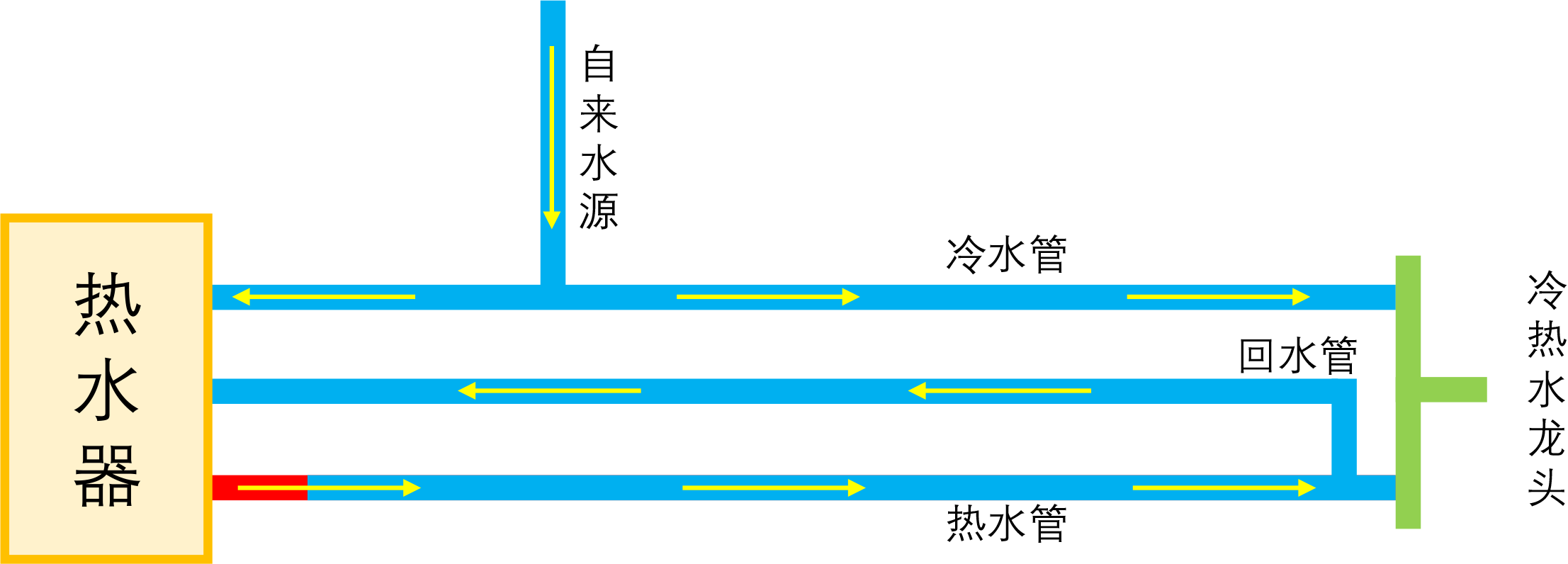
As shown in the figure below, a return pipe is essentially a “copy and paste” of the hot water pipe, connected at the water outlet. If you buy a ready-made Zero Cold Water heater, it usually comes with a return pipe interface. You connect the hot water pipe, cold water pipe, and return pipe to their respective interfaces. The hot water pipe and return pipe form a small loop, allowing the cold water in the hot water pipe to be recycled back.
If you are DIYing with an existing non-Zero Cold Water heater, there is no return pipe interface. We can connect the return pipe to the cold water pipe at the heater end. However, water will not circulate on its own, so we need a booster pump (also called a circulation pump or return pump) to push it. This pump can be installed at the start of the hot water pipe or the end of the return pipe:
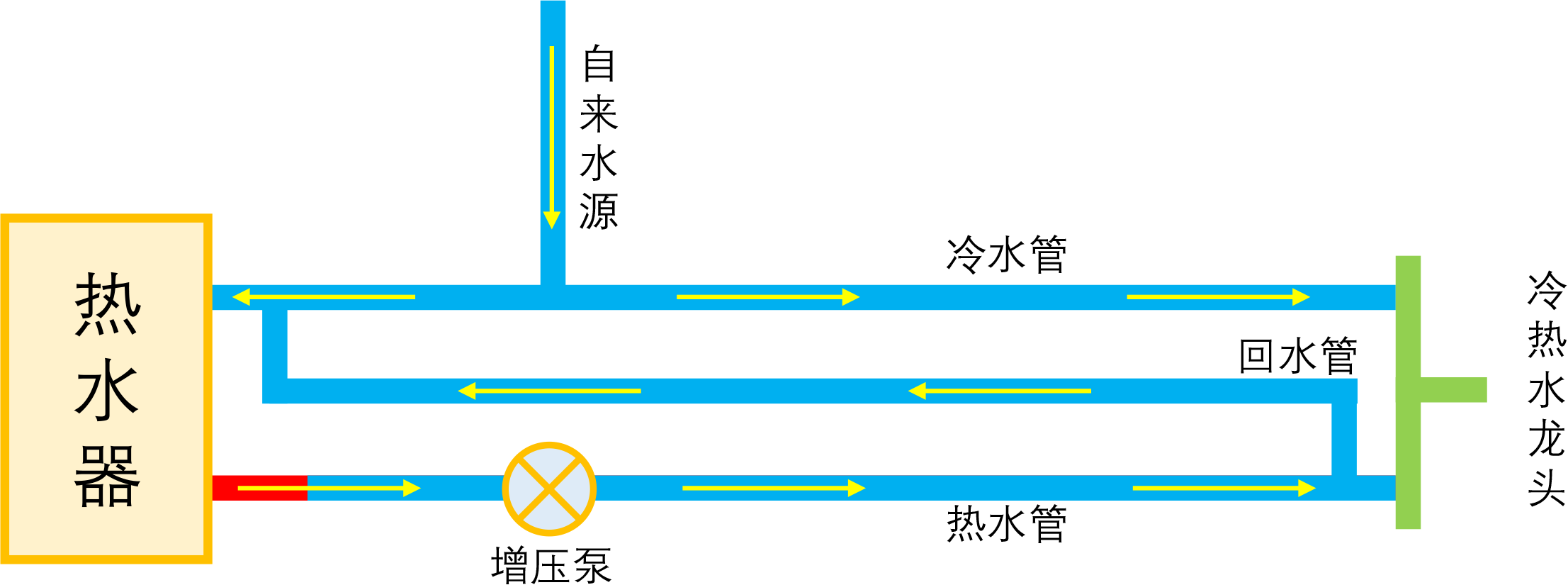
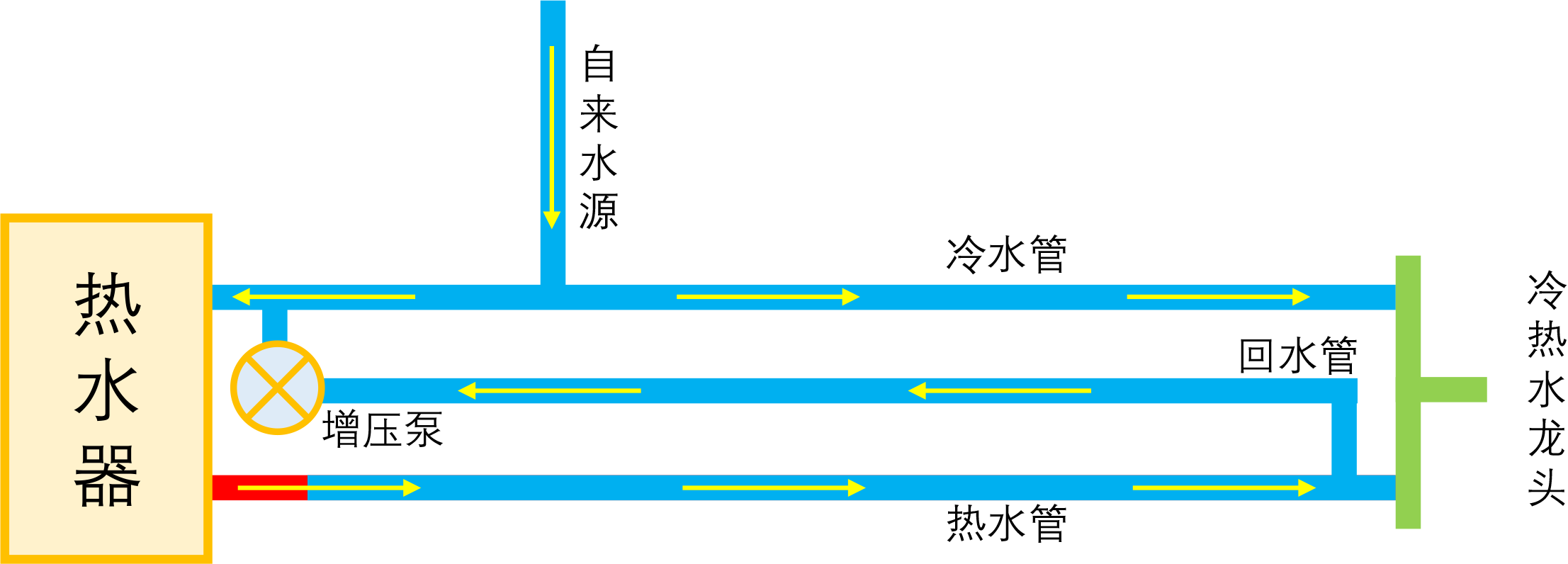
In fact, Zero Cold Water heaters mostly just have the booster pump built-in. Once the pump starts, it pushes the cold water in the hot water pipe toward the return pipe, forming a water cycle. Eventually, the entire hot water pipe and return pipe will be filled with hot water:
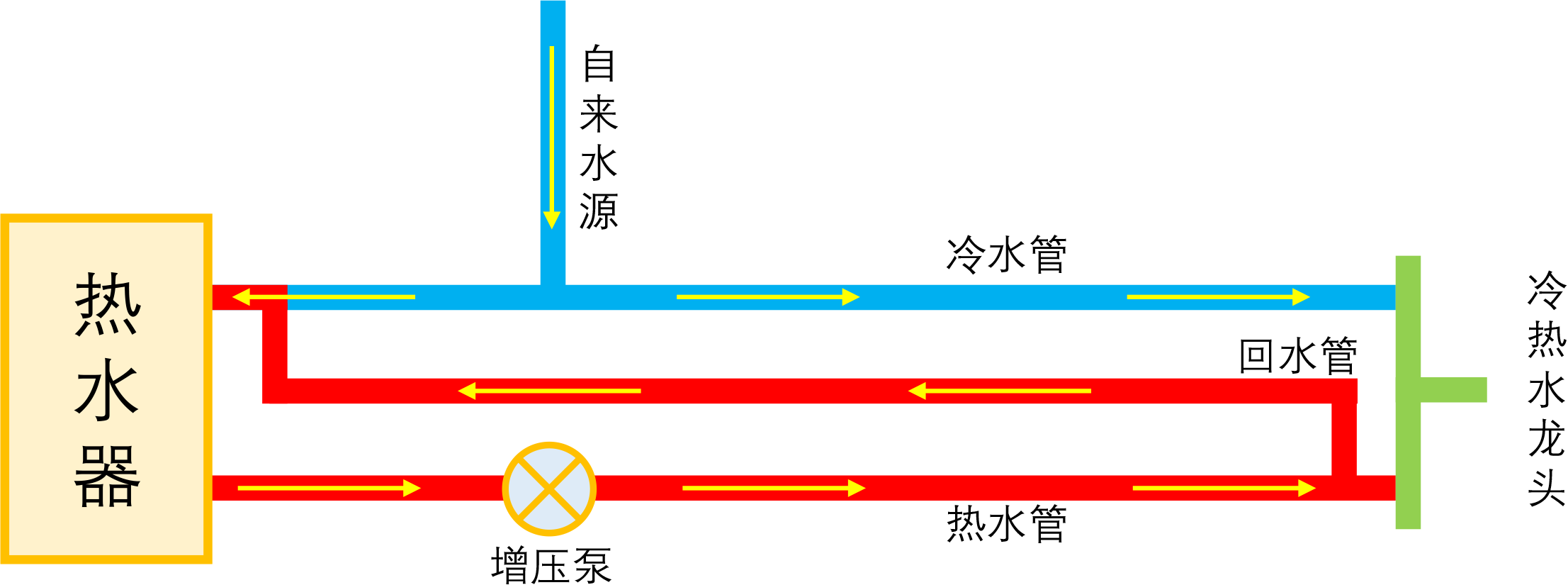
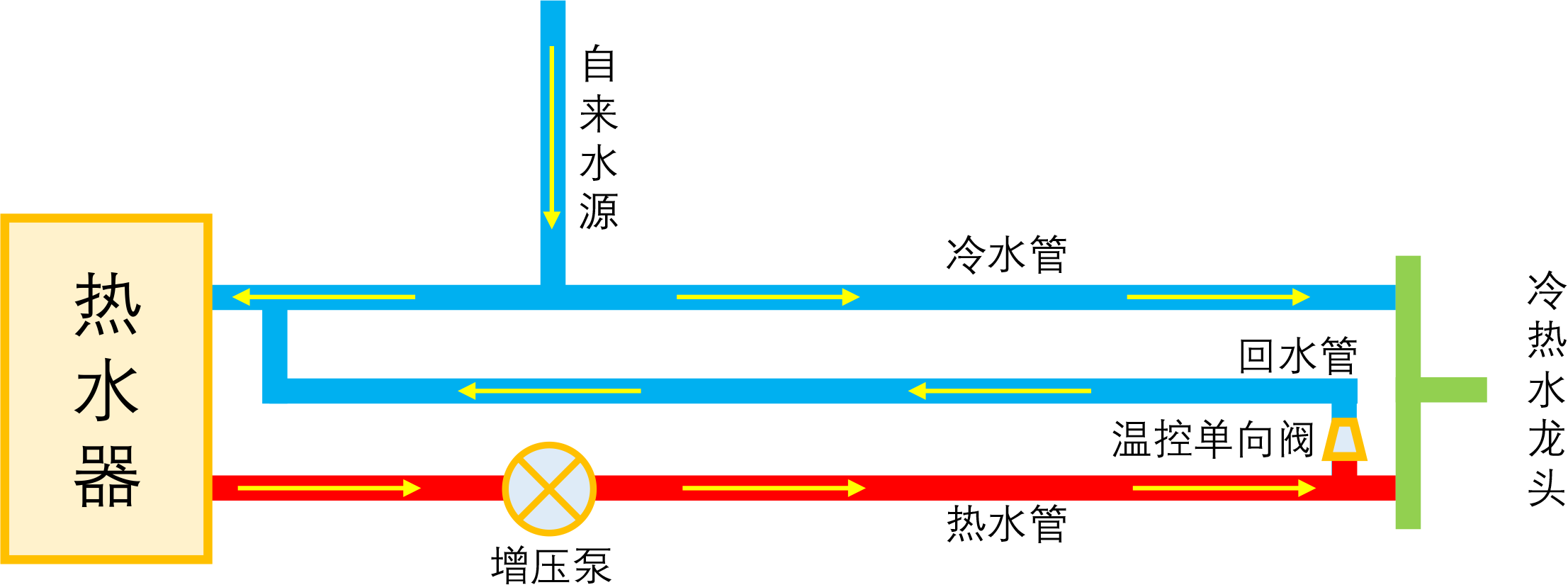
Obviously, the hot water in the return pipe serves no purpose. Although we emphasize that Zero Cold Water is for experience rather than saving money, it is still good to save some gas/electricity if it doesn’t affect the experience. An improvement here is to find a way to only heat the water in the hot water pipe and not the return pipe. A simple method is to add a timer to the booster pump, setting it to run just long enough to heat the hot water pipe, but this duration is hard to control. A smarter method is to add a temperature-controlled check valve (where water flows from the long side to the short side of the trapezoid and closes when the temperature reaches a set value) at the junction of the hot and return pipes:
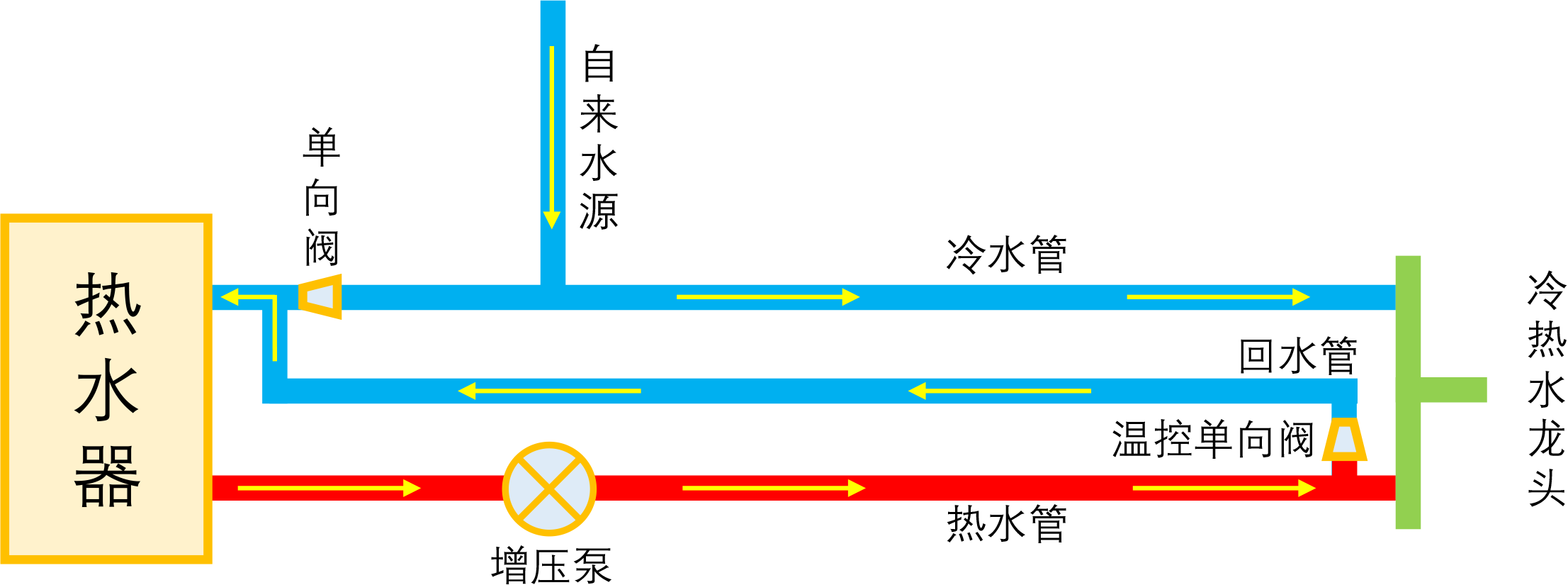
Finally, to prevent water from the return pipe from flowing into the cold water pipe (which might cause parts of the cold water pipe to get hot or trigger the heater when using cold water), another check valve (non-temperature controlled) can be added at the connection between the return and cold water pipes:
This concludes the analysis for a single outlet. In reality, homes have multiple hot water outlets. We can arrange the piping in several structures to ensure every outlet gets hot water quickly:
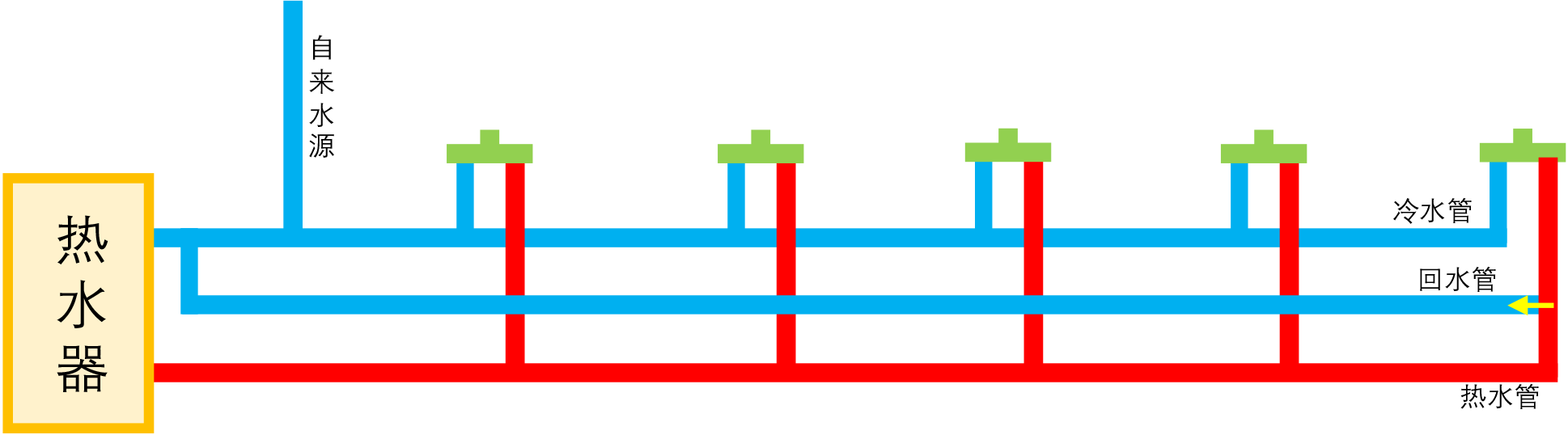
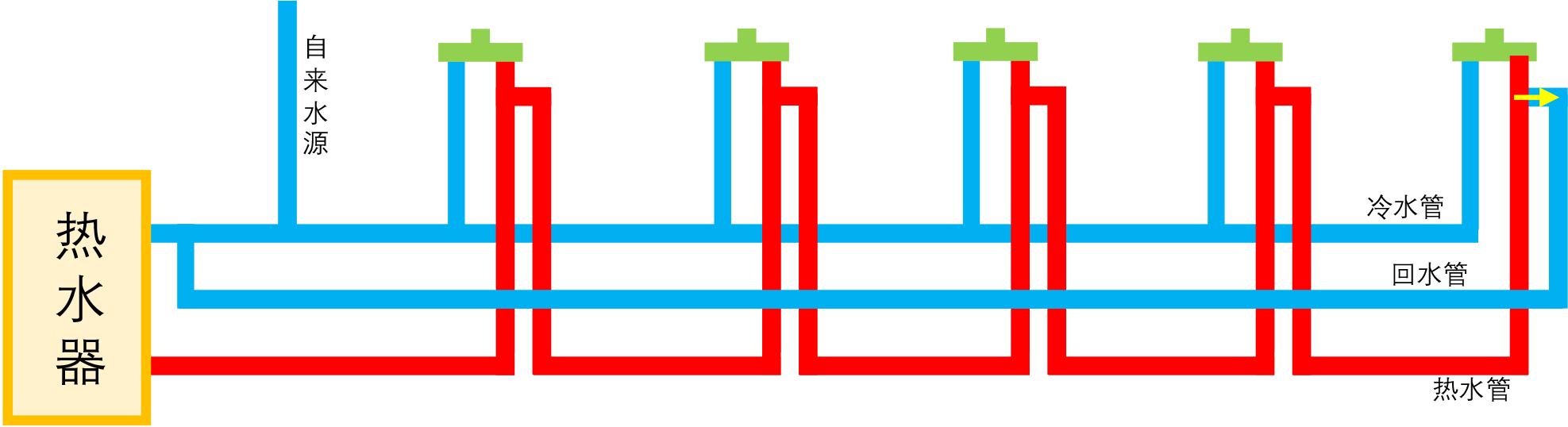
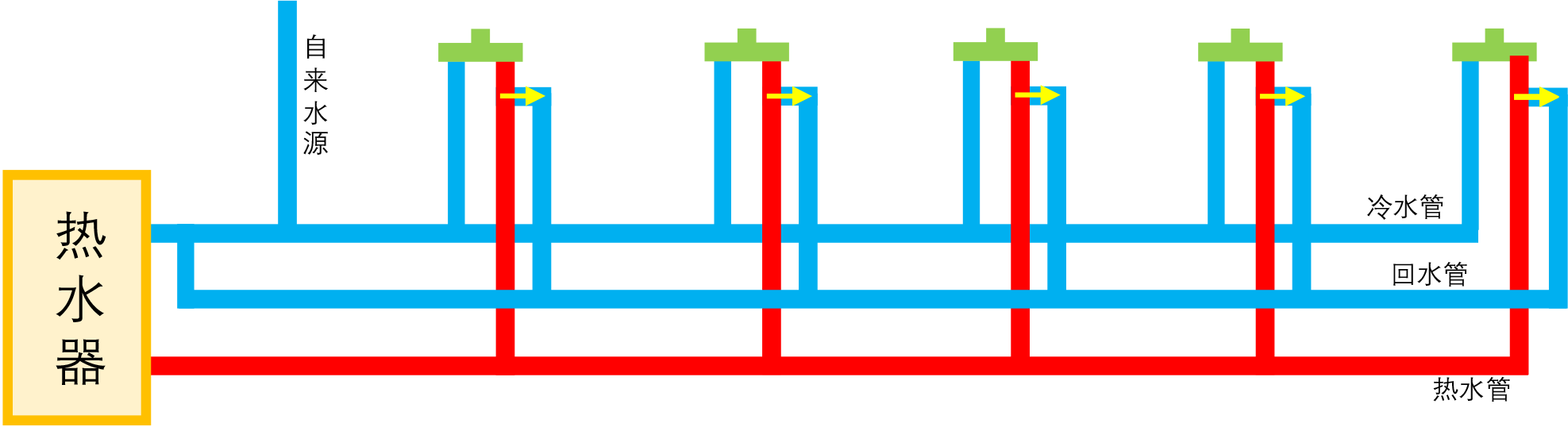
Cold Water Pipe
If your home was not pre-fitted with a return pipe during renovation, the above solutions are unavailable. In this case, a clever idea is to “drain into the cold water pipe” by connecting the hot and cold water pipes at the outlet via a check valve:
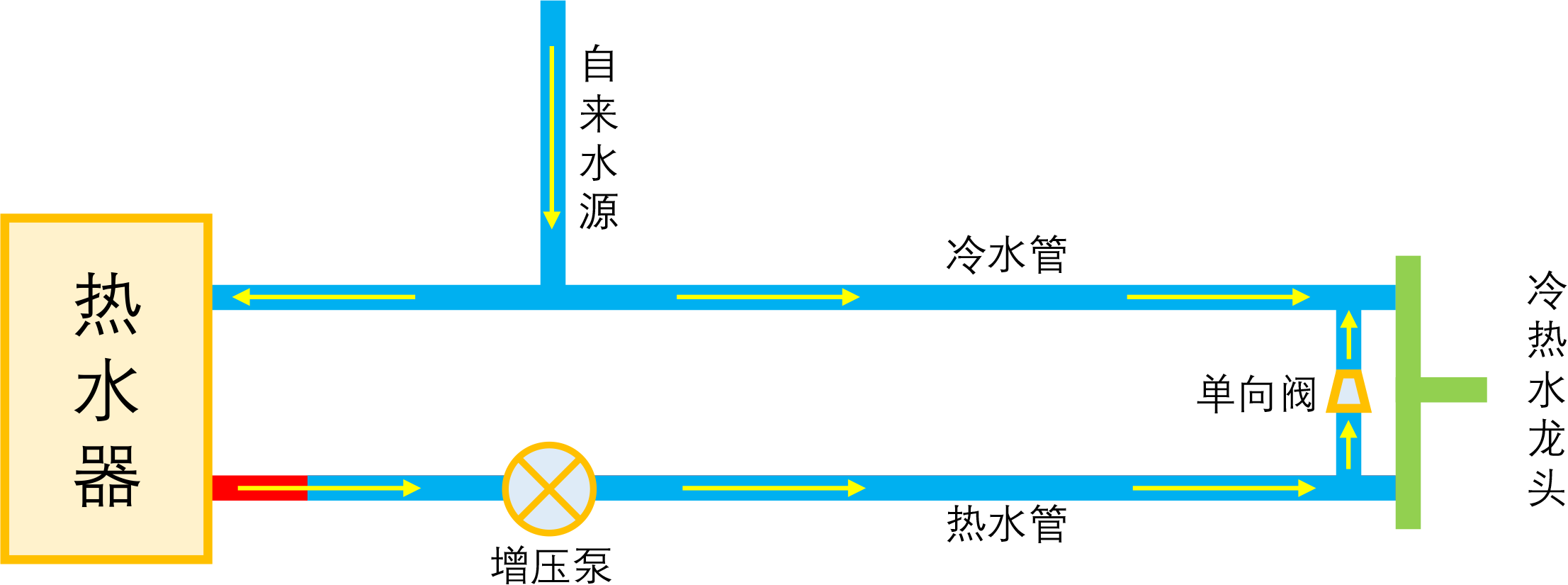
Most Zero Cold Water heaters on the market that claim to work without a return pipe use this solution. It works, but it introduces two problems. First, the check valve allows hot water to flow into the cold water pipe, meaning using cold water might trigger the heater, leading to the infamous “hot water flushing the toilet” phenomenon. While this is mostly a waste of energy, a more serious issue is that the entire cold water pipe might become hot during circulation:
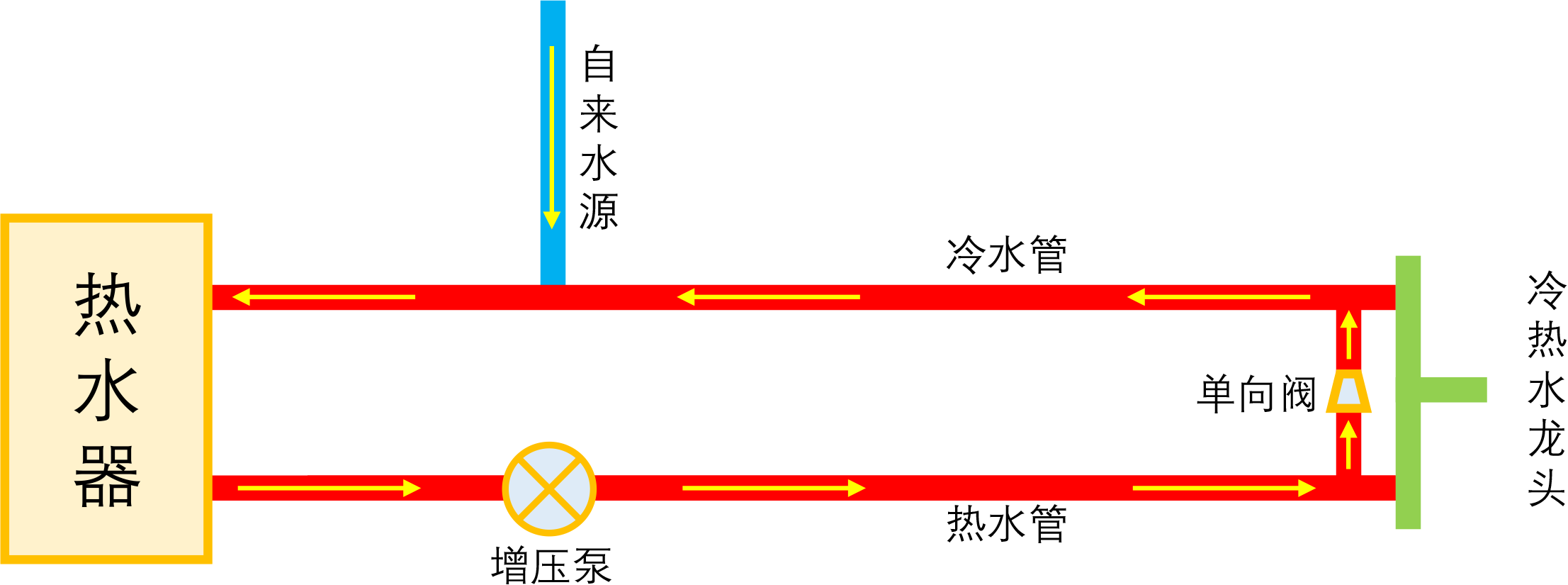
This isn’t just about wasting energy; some water points are sensitive to temperature. For example, the optimal working temperature for RO (Reverse Osmosis) purifiers is around 38^\circ\text{C}; exceeding this can cause irreversible damage, and hot water circulation usually reaches over 40^\circ\text{C}. To solve this, an upgraded solution replaces the check valve with a temperature-controlled check valve:
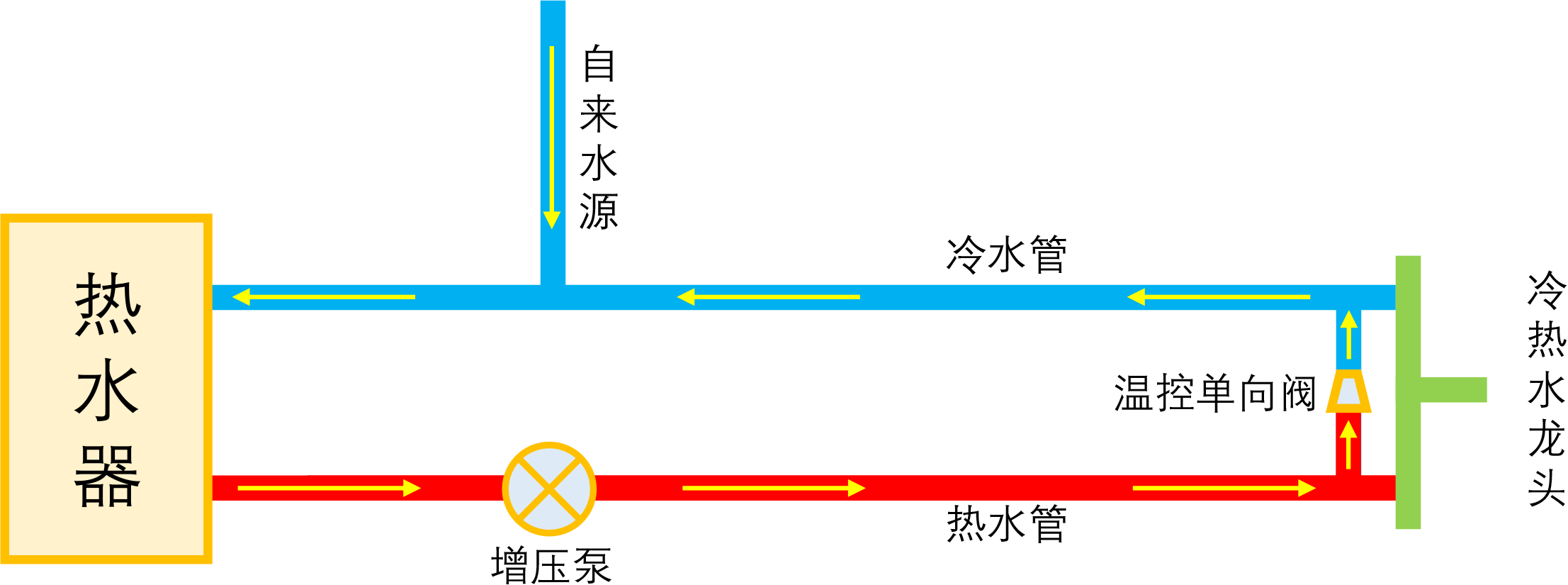
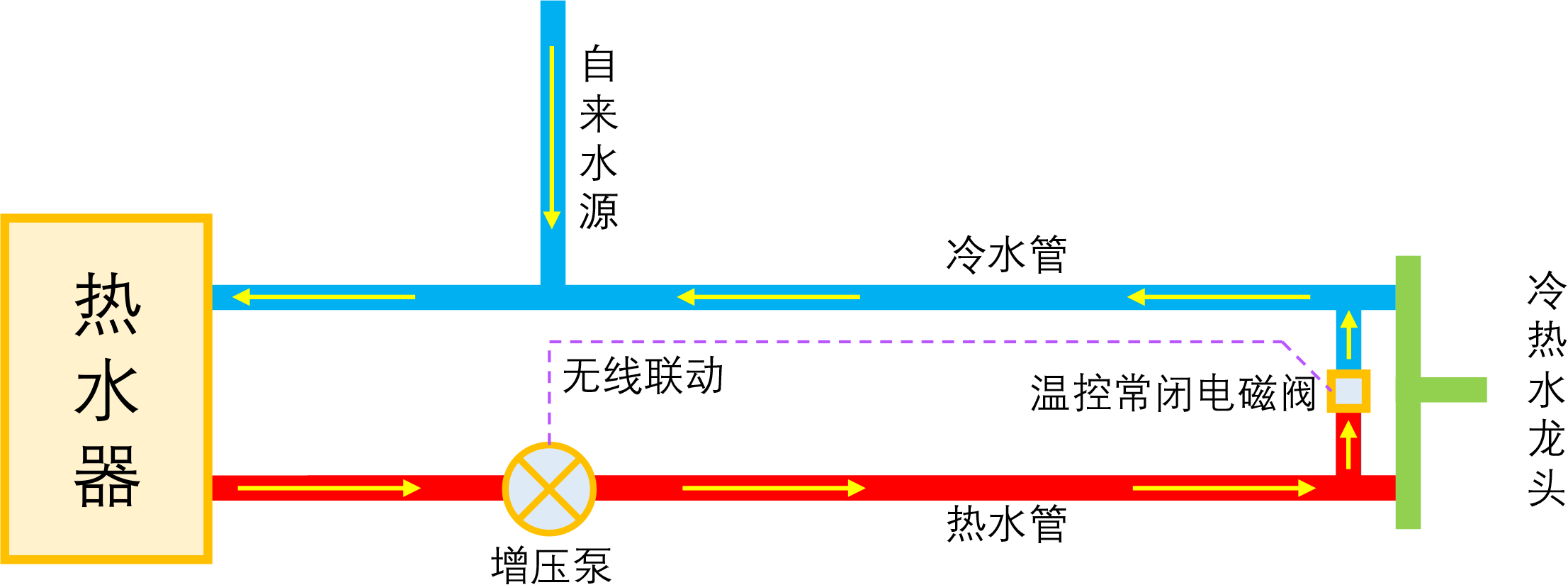
The temperature-controlled check valve ensures the cold water pipe temperature does not exceed a set value. Compared to a pure check valve, the experience is greatly improved. Some newer or more expensive Zero Cold Water heaters have adopted this. However, this only solves the overheating issue; it doesn’t prevent the heater from starting when cold water is used. To fully solve both, the valve should be a “temperature-controlled normally closed solenoid valve” with the following characteristics:
1. By default, the valve is closed, so the cold and hot pipes are disconnected, preventing the heater from starting when cold water is used;
2. When the temperature exceeds the set value, the valve is closed, ensuring the cold water pipe does not overheat;
3. When the temperature is below the set value and the booster pump is on, the valve opens, pushing cold water from the hot pipe into the cold pipe.
Naturally, this requires the solenoid valve to have a (wireless) linkage with the booster pump:
Furthermore, we can add an external remote control to wirelessly link with the solenoid valve to manually trigger Zero Cold Water on demand:
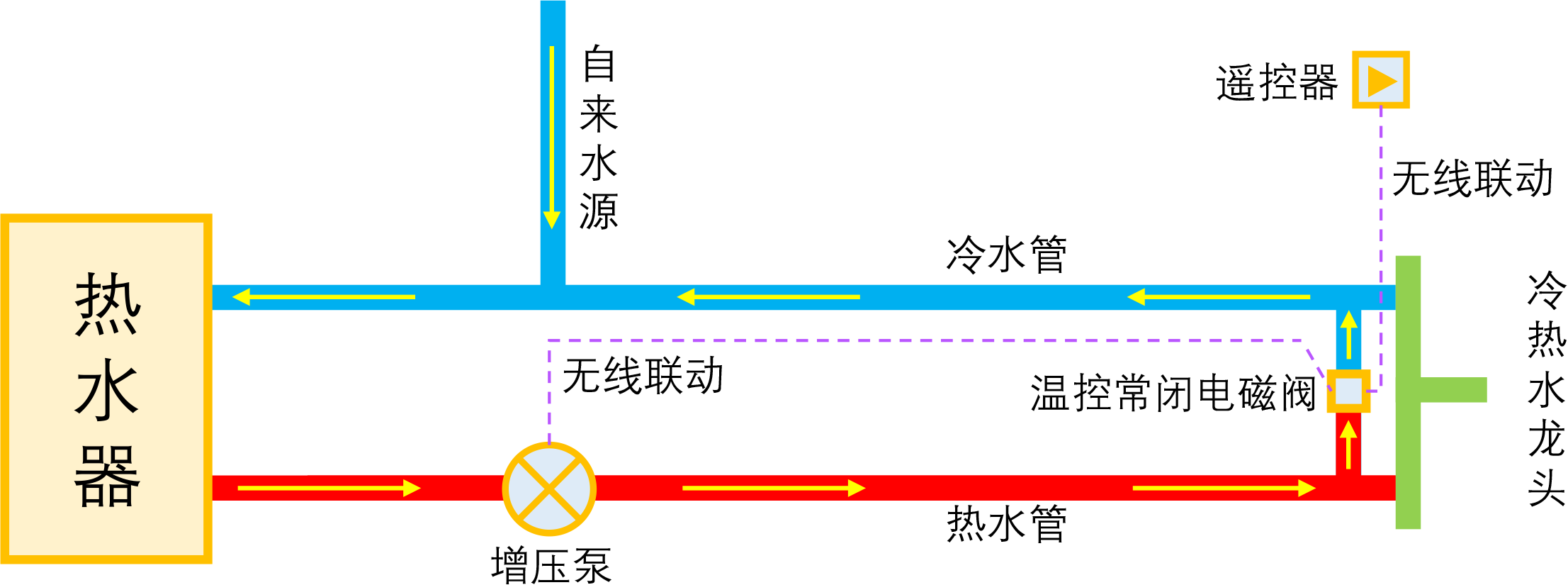
Currently, the author has only found one brand, “Aixiyi”, that offers DIY accessories using this solution.
What is the biggest difficulty in DIYing this? Power! The previously mentioned check valves and temperature-controlled check valves can be implemented without electricity. However, a solenoid valve linked to a pump requires power. These are usually installed under a sink or inside a showerhead, where there are typically no power outlets, so they must be battery-powered. Since the valve must act as a receiver for the pump and remote, it consumes significant power. Batteries usually don’t last long unless power consumption is minimized, which is difficult but possible with existing reference designs.
If there are multiple outlets, the perfect solution is to equip each with such a solenoid valve for “point-to-point” Zero Cold Water. This is the most energy-efficient but also the most expensive in terms of hardware. To save costs, one could install it only at the furthest outlet, but this means the entire pipe must be heated even for the nearest outlet. For showers, adding an accessory directly to the showerhead is often unsightly, so they are usually installed under the bathroom sink or built into specialized showerheads.
Down the Drain
Actually, without a return pipe, the simplest solution is to drain the cold water directly into the sewer, similar to manually running the tap:
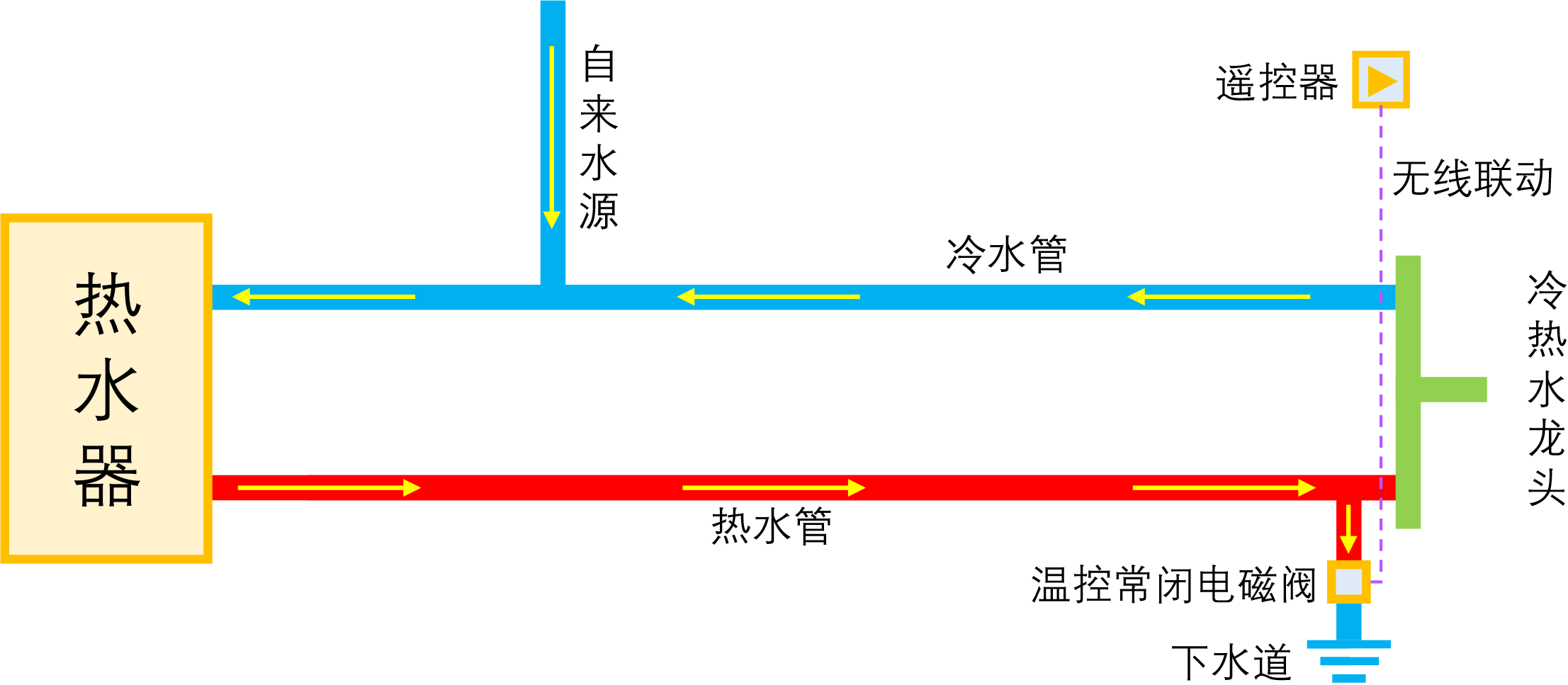
Compared to draining into the cold water pipe, this eliminates the booster pump and completely isolates the hot and cold water. The only downside is that it doesn’t save water. Let’s calculate if it’s worth it. Using the “Aixiyi” accessories as an example, the booster pump alone costs about 350 RMB. Based on our initial estimate, this money is enough to “waste” water for ten years or more. For a DIY enthusiast, wouldn’t you update your solution within ten years anyway?
So, putting aside “environmentalism” and “water conservation,” draining directly to the sewer is the lowest-cost and easiest DIY solution (no pump linkage required). Of course, if you are a staunch supporter of environmental protection, you should stick to the first two solutions.
Summary
This article introduced the principles of achieving Zero Cold Water for water heaters and analyzed several DIY solutions.
In summary, the goal of Zero Cold Water is to improve quality of life, not to save money. It can be achieved with or without a return pipe. In my opinion, the experience of a no-return-pipe setup using the solenoid valve solution is not inferior to a return-pipe setup. Therefore, I believe Zero Cold Water is worth getting (if buying a ready-made unit, at least ensure the check valve is temperature-controlled). Finally, regarding the concern about higher gas/electricity bills: Zero Cold Water does consume more energy than a standard setup, but if the increase is excessive, it is usually due to improper use, such as leaving it on 24/7. It’s like leaving the air conditioner on while you’re not home and then complaining it’s expensive; that’s just how it works.