A Brief Attempt at the ``Cross''
Combinatorial Counting Problem
Translated by DeepSeek V4 Pro. Translations can be inaccurate, please refer to the original post for important stuff.
Su JianlinOctober 9, 2022#9291
Yesterday, I saw a “cross”
combinatorial counting problem in this public
account article that reportedly has a controversial answer:
In a square, if two of the four sides are of color i, and the other two sides are of two other
different colors, then the square is called “i-color dominant.” Consider the following
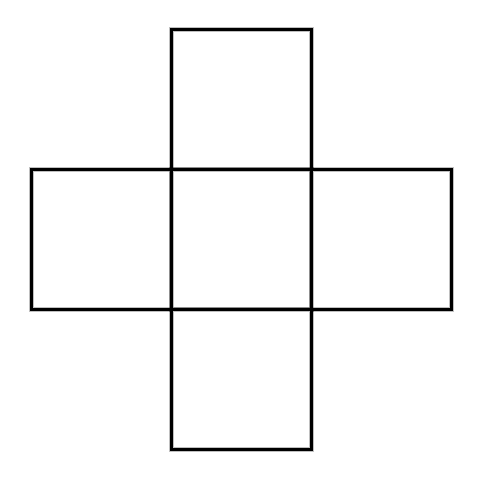
“cross” figure composed of 16 line segments and 5 squares. Each side is
colored with one of three colors: red, yellow, or blue, such that the
dominant colors of the three squares in the horizontal and vertical
directions are all different. How many different coloring methods are
there?
Schematic diagram of the “Cross”
The linked article provides two answers: 54,432 by Teacher Wu Kang,
and 27,216 by Teacher Wang Huixing. This article first confirms through
programming that Teacher Wang Huixing’s 27,216 is the correct answer,
and then provides my own theoretical analysis process.
Programming Verification
For this type of permutation and combination problem where the total
count is not excessively large, the most direct way to verify the
correctness of an answer is naturally through programming enumeration.
The most straightforward programming method is to enumerate all possible
coloring schemes for the 16 line segments and then judge one by one
whether they meet the requirements. However, this scheme would require
enumerating 3^{16} \approx 43 \text{
million} schemes, which is quite a large amount of computation.
Therefore, we can think of ways to reduce the computational load.
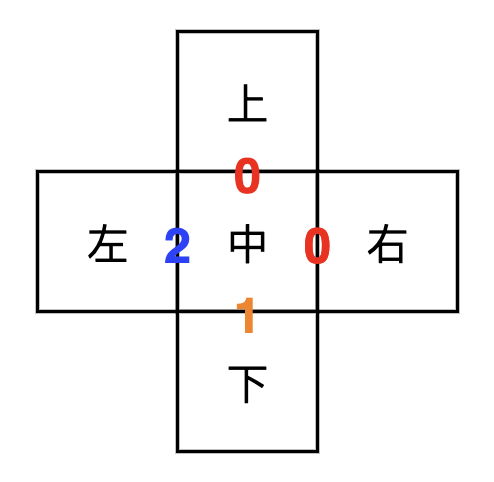
First, we naturally label the five squares as “Top,” “Bottom,”
“Left,” “Right,” and “Center,” as shown below:
Natural partition labels of the “Cross”
Obviously, among these five squares, the “Center” occupies the most
special position. Therefore, whether for theoretical analysis or
programming calculation, we use it as the starting point. For the
convenience of programming, we map the three colors red, yellow, and
blue to the numbers 0, 1, and 2 respectively. Thus, we can
quickly enumerate all possible coloring schemes for the “Center” as
follows:
from itertools import productcenters = [s for s in product(*[range(3)] *4) iflen(set(s)) ==3]
Then, for each coloring scheme of the “Center,” we enumerate its
corresponding coloring schemes for “Top,” “Bottom,” “Left,” and “Right.”
The method is also simple: first identify the dominant color of the
“Center” coloring, then the dominant colors of “Top-Bottom” and
“Left-Right” are selected from the remaining two colors respectively.
Multiply the number of coloring schemes for “Top,” “Bottom,” “Left,” and
“Right” together. Note that after the coloring scheme of the “Center” is
given, when enumerating the schemes for “Top,” “Bottom,” “Left,” and
“Right,” one side of each has already been determined, so the number of
enumerable sides should be 3^3 instead
of 3^4. The total reference code is as
follows:
def master(s):"""Identify the dominant color"""for i inrange(3):if s.count(i) ==2:return iN =0for c in centers: m = master(c) # Current dominant color M = [i for i inrange(3) if i != m] # Remaining two colorsfor i inrange(2): # Top, Bottom dominant colorsfor j inrange(2): # Left, Right dominant colors top = [s for s in product([c[0]], *[range(3)] *3) iflen(set(s)) ==3and master(s) == M[i]] bottom = [s for s in product([c[2]], *[range(3)] *3) iflen(set(s)) ==3and master(s) == M[1- i]] left = [s for s in product([c[1]], *[range(3)] *3) iflen(set(s)) ==3and master(s) == M[j]] right = [s for s in product([c[3]], *[range(3)] *3) iflen(set(s)) ==3and master(s) == M[1- j]] N +=len(top) *len(bottom) *len(left) *len(right)print('Total number of coloring schemes is', N)
Finally, the total number of coloring schemes is calculated to be
27,216.
Theoretical Calculation
To calculate the final number of coloring schemes from a theoretical
perspective, the logic is the same as the experimental verification:
center first, then the sides. However, the brute-force enumeration part
of the code is replaced by calculations using permutation and
combination formulas.
First, consider the number of coloring schemes for the “Center.”
Looking at the combinations, there are three types: “0 0 1 2,” “0 1 1
2,” and “0 1 2 2.” Taking “0 0 1 2” as an example, to insert a 1 into “0
0,” there are 3 possible positions, and then to insert a 2, there are 4
possible positions. So each combination has 3
\times 4 = 12 permutations. Therefore, the number of coloring
schemes for the “Center” is 12 \times 3 =
36.
Next, we divide the coloring schemes of the “Center” into two
categories as shown in the figures below: 1. Two dominant colors are
adjacent; 2. Two dominant colors are opposite.
Center Case 2: Dominant colors opposite
Obviously, the ratio between the two is 2:1. Therefore, among the
coloring schemes of the “Center,” there are 24 where the dominant colors
are adjacent and 12 where the dominant colors are opposite. We discuss
these two cases separately below.
First, dominant colors are adjacent. Without loss of
generality, consider the case on the left in the figure above. At this
time, the dominant color of the “Center” is “Red,” so the dominant
colors for “Top” and “Bottom” can only be “Yellow” or “Blue.” Suppose
the dominant color of “Top” is chosen as “Yellow”; then its coloring
schemes are only 3, and correspondingly, the coloring schemes for
“Bottom” are also only 3. Thus, there are 3
\times 3 = 9 coloring schemes for “Top-Bottom.” If the dominant
color of “Top” is chosen as “Blue,” then its coloring schemes are also
only 3, but correspondingly, the coloring schemes for “Bottom” are 6.
Thus, there are 3 \times 6 = 18
coloring schemes for “Top-Bottom.” Adding the two cases gives 9 + 18 = 27 schemes. The analysis for
“Left-Right” is the same, and “Top-Bottom” and “Left-Right” can be
combined freely. Therefore, there are 27
\times 27 = 729 schemes. Note that this is for only one “Center”
coloring scheme, so the total number of coloring schemes in this case is
729 \times 24 = 17,496.
Second, dominant colors are opposite. Without loss
of generality, consider the case on the right in the figure above. At
this time, the dominant color of the “Center” is “Red,” so the dominant
colors for “Top” and “Bottom” can only be “Yellow” or “Blue.” Suppose
the dominant color of “Top” is chosen as “Yellow”; then its coloring
schemes are only 3, and correspondingly, the coloring schemes for
“Bottom” are also only 3. Thus, there are 3
\times 3 = 9 coloring schemes for “Top-Bottom.” If the dominant
color of “Top” is chosen as “Blue,” its coloring schemes are also only
3, and the coloring schemes for “Bottom” are likewise only 3. Thus,
there are 3 \times 3 = 9 coloring
schemes for “Top-Bottom.” Adding the two cases gives 9 + 9 = 18 schemes.
However, in this case, the result for “Left-Right” is different from
“Top-Bottom” and requires separate analysis. Suppose the dominant color
of “Left” is chosen as “Yellow”; then its coloring schemes are only 3,
and correspondingly, the coloring schemes for “Right” are also only 3.
Thus, there are 3 \times 3 = 9 coloring
schemes for “Left-Right.” If the dominant color of “Left” is chosen as
“Blue,” then its coloring schemes are 6, and the coloring schemes for
“Right” are also 6. Thus, there are 6 \times 6
= 36 coloring schemes for “Left-Right.” Adding the two cases
gives 9 + 36 = 45 schemes. Therefore,
the total number of coloring schemes for “Top,” “Bottom,” “Left,”
“Right,” and “Center” is 18 \times 45 \times
12 = 9,720.
Finally, adding the two together gives 17,496 + 9,720 = 27,216.
Article Summary
It has been a long time since I worked on math problems; this was
purely to brush up on high school mathematics knowledge.