Generative Diffusion Models (13): From
Universal Gravitation to Diffusion Models
Translated by DeepSeek V4 Pro. Translations can be inaccurate, please refer to the original post for important stuff.
Jianlin SuOctober 18, 2022#9305
For many readers, generative diffusion
models might be the first models they have encountered that apply such a
vast array of mathematical tools to deep learning. Throughout this
series, we have demonstrated the profound connections between diffusion
models and mathematical analysis, probability and statistics, ordinary
differential equations (ODEs), stochastic differential equations (SDEs),
and even partial differential equations (PDEs). It is fair to say that
even students specializing in the theoretical study of mathematical
physics equations can likely find a place for their expertise within the
realm of diffusion models.
In this article, we introduce another diffusion model with deep ties
to mathematical physics—an ODE-based diffusion model inspired by the
"Law of Universal Gravitation." This model comes from the paper "Poisson Flow Generative
Models" (PFGM for short), which provides a brand-new perspective on
constructing ODE-based diffusion models.
Universal Gravitation
We all learned the Law of Universal Gravitation in middle school. It
is roughly described as:
The gravitational force between two point masses is proportional to
the product of their masses and inversely proportional to the square of
the distance between them.
Here, we ignore the masses and constants, focusing primarily on the
direction and the relationship with distance. Assuming the source of
gravity is located at \boldsymbol{y},
the gravitational force experienced by an object at \boldsymbol{x} can be written as: \boldsymbol{F}(\boldsymbol{x}) =
-\frac{1}{4\pi}\frac{\boldsymbol{x} - \boldsymbol{y}}{\Vert
\boldsymbol{x} - \boldsymbol{y}\Vert^3} \label{eq:grad-3} We can
set aside the factor \frac{1}{4\pi} for
now, as it does not affect the subsequent analysis. To be precise, the
above equation describes the gravitational field in three-dimensional
space. For a d-dimensional space, the
gravitational field takes the form: \boldsymbol{F}(\boldsymbol{x}) =
-\frac{1}{S_d(1)}\frac{\boldsymbol{x} - \boldsymbol{y}}{\Vert
\boldsymbol{x} - \boldsymbol{y}\Vert^d} \label{eq:grad-d} where
S_d(1) is the surface area of a d-dimensional unit hypersphere. This formula
is actually the gradient of the Green’s function for the d-dimensional Poisson equation, which is the
origin of the word "Poisson" in the paper’s title.
Following Field Lines
If there are multiple gravitational sources, the total force is
simply the sum of the forces from each source, due to the linear
additivity of gravitational fields. Below is a visualization of the
vector field for four gravitational sources, where the sources are
marked with black dots and the colored lines represent field lines:
From the gravitational field diagram above, we can observe an
important characteristic:
With very few exceptions, most field lines originate from infinity
and terminate at a specific gravitational source point.
At this point, an intuitive and "whimsical" idea arises:
If each gravitational source represents a real sample point to be
generated, then any point in the distance can evolve into a real sample
point simply by moving along the field lines, right?
Of course, a genius idea is one thing; turning it into a usable model
requires many details. For instance, we mentioned "any point in the
distance." This represents the initial distribution of the diffusion
model. But questions arise: How far is "in the distance"? How should
"any point" be sampled? If the sampling method is too complex, the model
loses its value.
Fortunately, the gravitational field has a very important equivalence
property:
A multi-source gravitational field at an infinite distance is
equivalent to a gravitational field of a single point mass located at
the center of mass with the total combined mass.
In other words, when the distance is sufficiently large, we only need
to treat it as a single-source point mass field located at the center of
mass. The figure below shows a multi-source gravitational field and its
corresponding center-of-mass field. As the distance increases (at the
position of the orange circle), the two fields become almost
identical.
What are the characteristics of a single point mass field? It is
isotropic! This means that at a sufficiently large radius, the field
lines can be considered to pass uniformly through the surface of a
sphere centered at the point mass. Therefore, we can simply perform
uniform sampling on a sphere with a sufficiently large radius, which
solves the problem of sampling the initial distribution. As for how
large "sufficiently large" is, we will discuss that later.
Mode Collapse
So, is the generative model constructed? Not yet. While the isotropy
of the gravitational field makes the initial distribution easy to
sample, it also causes gravitational sources to cancel each other out,
leading to "Mode Collapse."
Specifically, let’s look at the gravitational field of sources
uniformly distributed on a spherical shell:
Notice the pattern? Outside the shell, it is a normal isotropic
distribution, but the interior of the shell is "empty"! That is, the
gravitational fields inside the shell cancel each other out, creating a
vacuum zone. The author introduced this phenomenon years ago in a
popular science blog post titled "Uniform Force Field Inside a Spherical
Shell."
This cancellation phenomenon means that if we pick any sphere, and
the gravitational sources are uniformly distributed on it, they will
cancel out, effectively making those sources non-existent. Since our
generative model works by moving points from a distance along field
lines to reach a source, if sources cancel out, certain sources will
never be reached. This means some real samples cannot be generated,
resulting in a loss of diversity—the "mode collapse" phenomenon.
Adding a Dimension
It seems mode collapse is unavoidable. Because when constructing the
generative model, we usually assume real samples follow a continuous
distribution. Thus, for any chosen sphere, even if the distribution of
real samples is not uniform, we can always find a uniform "subset" whose
gravity cancels out, effectively making those data points disappear.
Is this the end of the road? No! This is where PFGM’s second "genius
idea" comes in: Add a
dimension!
We analyzed that mode collapse is unavoidable because the assumption
of a continuous distribution makes isotropy inevitable. To avoid mode
collapse, we must find a way to prevent the distribution from being
isotropic. We cannot change the target distribution of the real samples,
but we can add a dimension to it. If we discuss the problem in (d+1)-dimensional space, the original d-dimensional distribution can be viewed as a
plane in (d+1)-dimensional space, and a
plane cannot be isotropic. Take a low-dimensional example: in 2D space,
a "circle" is isotropic, but in 3D space, a "sphere" is isotropic. A
"circle" that is isotropic in 2D is not isotropic when viewed from
3D.
So, suppose the real samples to be generated are originally \boldsymbol{x} \in \mathbb{R}^d. We introduce
a new dimension t, making the data
points (\boldsymbol{x}, t) \in
\mathbb{R}^{d+1}. The original distribution \boldsymbol{x} \sim \tilde{p}(\boldsymbol{x})
is now modified to (\boldsymbol{x}, t) \sim
\delta(t)\tilde{p}(\boldsymbol{x}), where \delta(t) is the Dirac delta distribution.
This essentially places the real samples on the t=0 plane of the (d+1)-dimensional space. After this
treatment, in (d+1)-dimensional space,
the t value of the real sample points
is always 0, so isotropy cannot occur (analogous to the "circle in 3D
space" example).
Sudden Enlightenment
At first glance, adding a dimension seems like a small mathematical
trick, but upon closer inspection, it is quite ingenious. Many details
that were difficult to handle in the original d-dimensional space become clear in (d+1)-dimensional space.
According to Equation [eq:grad-d]
and the linear superposition of gravity, we can write the gravitational
field in (d+1)-dimensional space as:
\begin{aligned}
\boldsymbol{F}(\boldsymbol{x}, t) =&\,
-\frac{1}{S_{d+1}(1)}\iint\frac{(\boldsymbol{x} - \boldsymbol{x}_0, t -
t_0)}{(\Vert\boldsymbol{x} - \boldsymbol{x}_0\Vert^2 + (t -
t_0)^2)^{(d+1)/2}}\delta(t_0)\tilde{p}(\boldsymbol{x}_0)
d\boldsymbol{x}_0dt_0 \\
=&\, -\frac{1}{S_{d+1}(1)}\int\frac{(\boldsymbol{x} -
\boldsymbol{x}_0, t)}{(\Vert\boldsymbol{x} - \boldsymbol{x}_0\Vert^2 +
t^2)^{(d+1)/2}}\tilde{p}(\boldsymbol{x}_0) d\boldsymbol{x}_0 \\
\triangleq&\, (\boldsymbol{F}_{\boldsymbol{x}}, F_t)
\end{aligned} \label{eq:field} where \boldsymbol{F}_{\boldsymbol{x}} represents
the first d components of \boldsymbol{F}(\boldsymbol{x}, t), and F_t is the (d+1)-th component. We will discuss how to
learn \boldsymbol{F}(\boldsymbol{x}, t)
in the next section. For now, assuming \boldsymbol{F}(\boldsymbol{x}, t) is known,
we need to move along the field lines, meaning the trajectory must
always be in the same direction as \boldsymbol{F}(\boldsymbol{x}, t): (d\boldsymbol{x}, dt) =
(\boldsymbol{F}_{\boldsymbol{x}}, F_t) d\tau \quad \Rightarrow \quad
\frac{d\boldsymbol{x}}{dt} = \frac{\boldsymbol{F}_{\boldsymbol{x}}}{F_t}
\label{eq:ode} This is the Ordinary Differential Equation (ODE)
required for the generation process. In the previous d-dimensional scheme, besides mode collapse,
determining when to terminate was also difficult. Intuitively, one would
move along the field line until "hitting" a real sample, but "hitting"
is hard to define. In the (d+1)-dimensional scheme, we know all real
samples are on the t=0 plane, so t=0 naturally serves as the termination
signal.
As for the initial distribution, following our previous discussion,
it should be a "uniform distribution on a (d+1)-dimensional sphere with a sufficiently
large radius." However, since we use t=0 as the termination signal, we might as
well fix a sufficiently large t=T
(roughly in the range of 40 \sim 100)
and sample on the t=T plane. Thus, the
generation process becomes the movement of the ODE [eq:ode] from
t=T to t=0. Both the start and end of the generation
process become very clear.
Of course, sampling on a fixed t=T
plane is not uniform. In fact: p_{prior}(\boldsymbol{x}) \propto
\frac{1}{(\Vert\boldsymbol{x}\Vert^2 + T^2)^{(d+1)/2}} The
derivation is provided in the box below. As we can see, the probability
density depends only on the magnitude \Vert\boldsymbol{x}\Vert. Therefore, the
sampling scheme is to first sample the magnitude according to a specific
distribution and then sample the direction uniformly, combining the two.
For the magnitude r=\Vert\boldsymbol{x}\Vert, transforming to
hyperspherical coordinates gives p_{prior}(r)
\propto r^{d-1}(r^2 + T^2)^{-(d+1)/2}. We can then use the
inverse cumulative distribution function (CDF) method for sampling.
Derivation of the Initial Distribution: Field lines
pass uniformly through the (d+1)-dimensional hypersphere. Thus, the
density at (\boldsymbol{x}, T) is
inversely proportional to the surface area S_{d+1}(\boldsymbol{x}, T), i.e., \propto \frac{1}{(\Vert\boldsymbol{x}\Vert^2 +
T^2)^{d/2}}. However, we are not on the sphere but on the t=T plane. We must project the sphere onto
the plane, as shown below:
As shown in the figure, when points B and D are
sufficiently close, \Delta OAB \sim \Delta
BDC, so: \frac{|BC|}{|BD|} =
\frac{|OB|}{|OA|} = \frac{\sqrt{\Vert\boldsymbol{x}\Vert^2 +
T^2}}{T} This means that a unit length arc on the sphere, when
projected onto the plane, increases by a factor of \frac{\sqrt{\Vert\boldsymbol{x}\Vert^2 +
T^2}}{T}. Since only one dimension changes, the area element on
the sphere also increases by this factor when projected. Therefore,
based on the inverse relationship between probability and area, we get:
p_{prior}(\boldsymbol{x}) \propto
\frac{1}{S_{d+1}(\boldsymbol{x}, T)} \times
\frac{T}{\sqrt{\Vert\boldsymbol{x}\Vert^2 + T^2}} \propto
\frac{1}{(\Vert\boldsymbol{x}\Vert^2 + T^2)^{(d+1)/2}}
Training the Field
Now that we have the initial distribution and the ODE, we only need
to train the vector field function \boldsymbol{F}(\boldsymbol{x}, t). From
Equation [eq:ode], we see that the ODE only depends
on the relative values of the vector field; thus, scaling the vector
field does not affect the final result. According to Equation [eq:field], the vector field can be
written as: \boldsymbol{F}(\boldsymbol{x}, t)
= \mathbb{E}_{\boldsymbol{x}_0\sim
\tilde{p}(\boldsymbol{x}_0)}\left[-\frac{(\boldsymbol{x} -
\boldsymbol{x}_0, t)}{(\Vert\boldsymbol{x} - \boldsymbol{x}_0\Vert^2 +
t^2)^{(d+1)/2}}\right] Using a conclusion we have used multiple
times in previous posts: \mathbb{E}_{\boldsymbol{x}}[\boldsymbol{x}] =
\mathop{\text{argmin}}_{\boldsymbol{\mu}}\mathbb{E}_{\boldsymbol{x}}\left[\Vert
\boldsymbol{x} - \boldsymbol{\mu}\Vert^2\right] We can introduce
a function \boldsymbol{s}_{\boldsymbol{\theta}}(\boldsymbol{x},
t) to learn \boldsymbol{F}(\boldsymbol{x}, t), with the
training objective: \mathbb{E}_{\boldsymbol{x}_0\sim
\tilde{p}(\boldsymbol{x}_0)}\left[\left\Vert\boldsymbol{s}_{\boldsymbol{\theta}}(\boldsymbol{x},
t) + \frac{(\boldsymbol{x} - \boldsymbol{x}_0, t)}{(\Vert\boldsymbol{x}
- \boldsymbol{x}_0\Vert^2 + t^2)^{(d+1)/2}}\right\Vert^2\right]
\label{eq:loss} However, the \boldsymbol{x}, t in the above objective
still need to be sampled, and their sampling method is not explicitly
defined. This is one of the main features of PFGM: it directly defines
the reverse process (generation) without needing to define a forward
process. This sampling step effectively acts as the forward process. To
this end, the original paper considers perturbing each real sample to
construct samples for \boldsymbol{x},
t: \boldsymbol{x} = \boldsymbol{x}_0 +
\Vert \boldsymbol{\varepsilon}_{\boldsymbol{x}}\Vert (1+\tau)^m
\boldsymbol{u},\quad t = |\varepsilon_t| (1+\tau)^m where (\boldsymbol{\varepsilon}_{\boldsymbol{x}},\varepsilon_t)\sim\mathcal{N}(\boldsymbol{0},
\sigma^2\boldsymbol{I}_{(d+1)\times(d+1)}), m\sim U[0,M], \boldsymbol{u} is a unit vector uniformly
distributed on a d-dimensional unit
sphere, and \tau, \sigma, M are
constants. (This design involves some subjectivity; readers can
appreciate and interpret it themselves).
Finally, the training objective in the original paper is slightly
different from Equation [eq:loss], roughly equivalent to: \left\Vert\boldsymbol{s}_{\boldsymbol{\theta}}(\boldsymbol{x},
t) + \text{Normalize}\left(\mathbb{E}_{\boldsymbol{x}_0\sim
\tilde{p}(\boldsymbol{x}_0)}\left[\frac{(\boldsymbol{x} -
\boldsymbol{x}_0, t)}{(\Vert\boldsymbol{x} - \boldsymbol{x}_0\Vert^2 +
t^2)^{(d+1)/2}}\right]\right)\right\Vert^2 In actual training,
since we can only sample a finite number of \boldsymbol{x}_0 to estimate the expectation
inside the parentheses, this objective is actually a biased estimate. Of
course, a biased estimate is not necessarily worse than an unbiased one.
Why the original paper uses a biased estimate is not yet known; it is
speculated that normalization might make the training process more
stable, but because the biased estimate is normalized, it requires a
larger batch size to be accurate, which increases experimental
costs.
Experimental Results
PFGM is a completely new framework. It no longer relies on the
Gaussian assumption as previous models did and results in a model with
truly new connotations. However, we should not seek "newness for the
sake of newness"; if a new framework does not produce more convincing
results, then the novelty is meaningless.
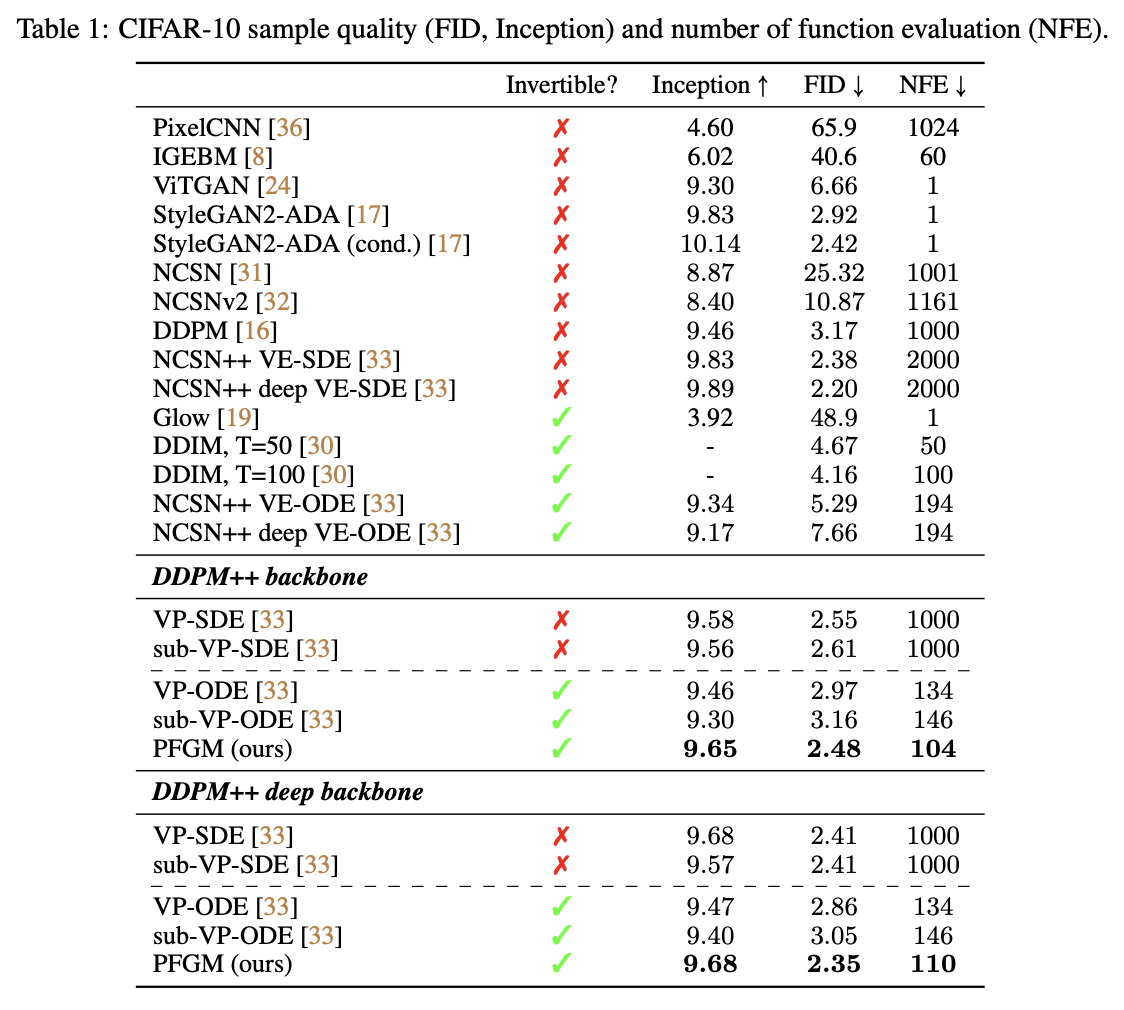
The experimental results in the original paper certainly affirm the
value of PFGM, showing better evaluation metrics, faster generation
speeds, and better robustness to hyperparameters (including model
architecture). I will not display them all here; readers can refer to
the original paper. I noticed the paper was accepted to NeurIPS 2022,
and it is indeed a well-deserved top-tier conference paper!
This article introduced an ODE-based diffusion model inspired by the
"Law of Universal Gravitation." It breaks away from the dependence on
Gaussian assumptions found in many previous diffusion models and
provides a brand-new framework for constructing ODE-based diffusion
models based on field theory. The entire model is highly enlightening
and well worth a careful read.
![[SVG Image: Schematic of Gravitational Field]](https://kexue.fm/usr/uploads/2022/10/3097555639.svg)
![[SVG Image: Multi-source Field]](https://kexue.fm/usr/uploads/2022/10/1214065996.svg)
![[SVG Image: Center-of-mass Field]](https://kexue.fm/usr/uploads/2022/10/488016129.svg)
![[SVG Image: Isotropic Gravitational Field]](https://kexue.fm/usr/uploads/2022/10/1113525710.svg)
![[SVG Image: Projection from Sphere to t=T Plane]](https://kexue.fm/usr/uploads/2022/10/1762495694.svg)