Colorful Jin Yong
In the works of Jin Yong (and indeed in many martial arts novels), martial arts can be categorized into three types. The first type is pure, solid strength, such as Hong Qigong’s “Eighteen Dragon Subduing Palms” or Jinlun Fawang’s “Dragon-Elephant Prajna Skill.” Their main characteristic is overwhelming power. For example:
Qiao Feng’s Twenty-Eight Dragon Subduing Palms were passed down by the previous leader of the Beggar Clan, Wang Jiantong. However, Qiao Feng was born with extraordinary talent for martial arts; his version of the Twenty-Eight Dragon Subduing Palms was like a hot knife through butter, indestructible and even superior to Leader Wang’s. Seeing his opponent push with both palms, Qiao Feng felt that if he resisted with only one palm and ended in a draw, he might appear slightly superior, which would be disrespectful. Thus, he also struck with both palms. The palm force he exerted from both his left and right hands remained three parts external and seven parts internal, keeping most of the strength in reserve.
— From Demi-Gods and Semi-Devils, Century New Edition
The second type relies primarily on feints. That is to say, if you cannot be stronger than your opponent, you can deceive them. An example is the “Falling Petals Divine Sword Palm” of Peach Blossom Island:
This palm technique was created by Huang Yaoshi while observing the falling peach blossoms on Peach Blossom Island. The moves are ever-changing and emphasize the beauty of the posture. As she moved her arms, palm shadows appeared from all directions, sometimes five feints to one real strike, or eight feints to one real strike. It was like a wild wind suddenly rising in a peach grove, with ten thousand flowers falling at once. The beauty lay in the elegance of the hands and feet, as if she were dancing. However, firstly, her internal power was still shallow, and secondly, she was hesitant to hurt him, so she could not strike as sharply as a sword. Guo Jing was dazzled and could no longer defend his position. Before he knew it, pa-pa-pa-pa, he was hit four times on his left shoulder, right shoulder, chest, and back. Huang Rong had used no force, so Guo Jing felt no pain.
— From The Legend of the Condor Heroes, Century New Edition
The third type focuses on skill. It does not seek pure strength, nor does it rely solely on deception; instead, it emphasizes using exactly the right amount of force to achieve the effect of “overcoming hardness with softness” or “moving a thousand catties with four taels.” Clearly, the representative of this style is Tai Chi. Additionally, the “Dog Beating Staff Technique,” the “Great Heaven and Earth Shift,” and the martial arts of the Quanzhen Sect and the Ancient Tomb Sect also contain this principle. For instance:
In a moment of crisis, Yang Guo used a move from the Quanzhen Sect’s sword technique, which unexpectedly produced a miraculous effect. He followed up with the Quanzhen move “White Rainbow Piercing the Sky,” rotating his flat sword to strike the wheel. The wheel was heavy and the sword light; a flat strike would normally have been useless, but the rotation was perfectly timed, aligning with the principle of “moving a thousand catties with four taels” in martial arts. The direction of the iron wheel shifted, and it flew back toward the National Master’s head.
— From The Return of the Condor Heroes, Century New Edition
The expression “moving a thousand catties with four taels” appears in many literary works. Many readers likely believe that this is merely an exaggeration in novels and is physically impossible. Others might feel that the “martial arts” of the ancients are simply lost and truly existed in the past. Here, we will analyze the possibility of “moving a thousand catties with four taels” from a physics perspective, providing an alternative example of reading Jin Yong.
Physics
In fact, the basic principle of “moving a thousand catties with four taels” is to avoid a “head-on collision.” Avoiding a head-on collision means your applied force should be perpendicular to the incoming force. In this way (theoretically), we are not subjected to the impact of the incoming force. Of course, this is not enough. For a basic analysis, we can simplify the problem as follows:
A large-mass object is moving in a straight line at a constant speed (a great force attacking us), then at a certain moment it begins to be acted upon by a force of constant magnitude (the force we can exert), and this force remains perpendicular to the object’s own velocity direction. Find the trajectory of the object (to see if we can avoid this attack).
We can simplify further for the sake of analysis by assuming the motion is in a 2D plane. The key point is to describe the condition that “the direction of force is perpendicular to the direction of velocity.” We know that complex numbers are most suitable for describing angular relationships. Thus, we can assume a complex function z \equiv z(t) to describe the trajectory. If the constant force magnitude is f, we can write the equation of motion as: m\ddot{z} = f \frac{\dot{z}}{|\dot{z}|} e^{i\pi/2}
To solve this equation, first let \dot{z} = re^{i\theta}. Then we have: m\frac{d}{dt}(re^{i\theta}) = fe^{i(\theta+\pi/2)} Expanding this gives: m\dot{r}e^{i\theta} + mir\dot{\theta}e^{i\theta} = fe^{i(\theta+\pi/2)} The magic of complex numbers is that we can now cancel e^{i\theta} from both sides: m\dot{r} + mir\dot{\theta} = fe^{i\pi/2} According to the principle that the real and imaginary parts must be equal, we get: \begin{aligned} &m\dot{r} = 0 \\ &mr\dot{\theta} = f \end{aligned} It is then obvious that: r \equiv v_0, \quad \theta = \theta_0 + \frac{f}{mv_0}t Note that re^{i\theta} describes \dot{z}, which is the velocity. Therefore, the above equation tells us that the speed remains constant while the direction of velocity changes at a constant rate. This is “uniform circular motion”! Of course, this result could be obtained without solving differential equations, but the general analysis process is provided here so that interested readers can use it to analyze more complex processes.
Now, by rotating the coordinate axes, we have: \dot{z} = v_0 \exp \left(i\theta_0 + i\frac{ft}{mv_0}\right) Integrating this gives: z(t) = z_0 + \frac{mv_0^2 e^{i\theta_0}}{if} \left[\exp\left(i\frac{ft}{mv_0}\right) - 1\right] Since the punch direction is “attacking” us, we can take \theta_0 = \pi, yielding: z(t) = z_0 + \frac{imv_0^2}{f} \left[\exp\left(i\frac{ft}{mv_0}\right) - 1\right] Or, looking at the components: \begin{aligned} x &= x_0 - \frac{mv_0^2}{f} \sin\left(\theta_0 + \frac{ft}{mv_0}\right) \\ y &= y_0 + \frac{mv_0^2}{f} \left[\cos\left(\theta_0 + \frac{ft}{mv_0}\right) - 1\right] \end{aligned}
Actual Situation
Since the final solved trajectory is uniform circular motion—a circle!—it is not difficult to understand this passage from The Heaven Sword and Dragon Saber:
Zhang Wuji’s wooden sword drew circles within that mass of cold light. Every move was thrust out in an arc and retracted in an arc. His mind was completely clear, wielding the sword with intent. Every time the wooden sword made a move, it was like releasing a fine silk thread to wrap around the Heaven Sword. The silk threads accumulated more and more, seemingly forming bundles of cotton wool, wrapping the Heaven Sword inside.
...
Zhang Wuji continued to draw circles with his sword. No one except Zhang Sanfeng could tell whether each move was offensive or defensive. This Tai Chi sword technique consisted only of circles of all sizes—upright, inverted, slanted, and straight. If one were to speak of moves, there was only one move, yet this single move appeared and disappeared endlessly.
— From The Heaven Sword and Dragon Saber, Century New Edition
Therefore, from a physics perspective, we know that the secret of Tai Chi is to draw circles in the direction of the incoming force—this is the “sticking” (nian) technique—and to maintain a perpendicular relationship. Clearly, Tai Chi requires great skill. Some readers might wonder: if Zhang Wuji had not learned the Nine Yang Divine Power and his internal strength were not deep, would it still be possible to “move a thousand catties”?
Let’s look at a more rigorous example, with data sourced from “Is ’Four Taels Moving a Thousand Catties’ Possible? — A Physics Analysis”:
Taking the person being hit (the Tai Chi practitioner) as the origin, assume the opponent’s arm mass m = 6\,\text{kg} and the punch velocity v_0 = 7\,\text{m/s}. Let (x_0, y_0) = (0.5\,\text{m}, 0). 0.5 meters is roughly where we begin to exert force on the opponent. Thus: \begin{aligned} x &= 0.5 - \frac{294}{f} \sin\left(\frac{ft}{42}\right) \\ y &= \frac{294}{f} \left[\cos\left(\frac{ft}{42}\right) - 1\right] \end{aligned} When the opponent hits us, x=0, so \sin\left(\frac{ft}{42}\right) = \frac{f}{588} From which we get: y = \frac{294}{f} \left[\sqrt{1 - \left(\frac{f}{588}\right)^2} - 1\right] If the width of the body is d_{min}, then we must have at least |y| > d_{min}. Since this is a transcendental equation, we can solve it numerically.
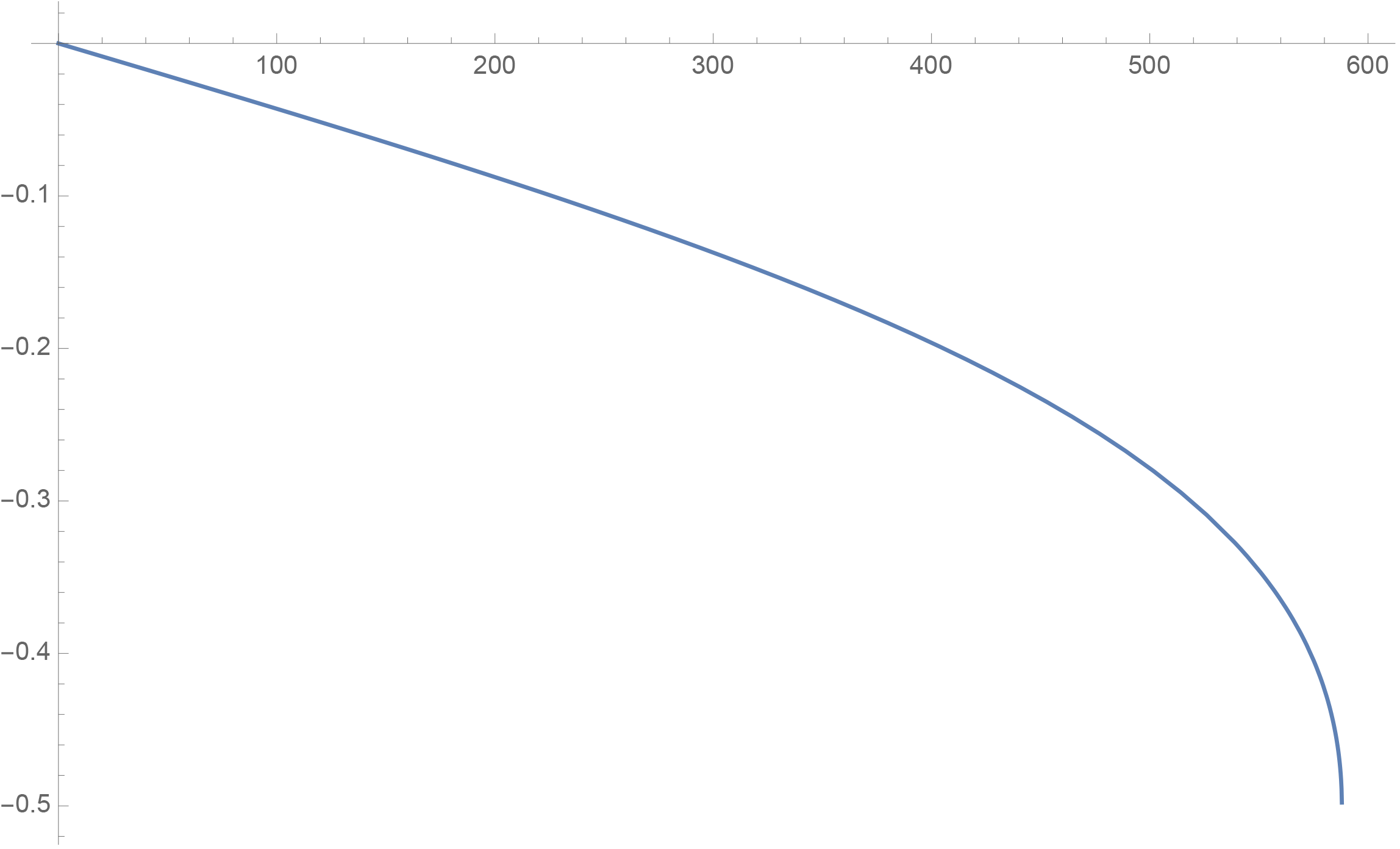
If we want to avoid an attack to the head, we can consider d_{min} = 0.1\,\text{m}. From the graph, we can see that this requires f \approx 250\,\text{N}. What does this force represent? According to the analysis in the cited article, the punching force of an average boxer is around this magnitude! If we want to avoid an attack to the body, we might consider d_{min} = 0.25\,\text{m}, which would require f \approx 500\,\text{N}! This likely exceeds the punching force of an average boxer.
Of course, this is a very mechanical analysis. In reality, we can also flexibly dodge; it is impossible to rely purely on pushing, much like the line from the movie Tai Chi 0: “A grab, a lead, a hook, a pierce—sent me flying up to the sky and down into the earth.” But this analysis is sufficient to show that relying solely on “deflecting,” “moving a thousand catties with four taels” is impossible.
Conclusion
It seems that Tai Chi is indeed a better match for the Nine Yang Divine Power. Without the foundation of the Nine Yang Divine Power, it is likely difficult to use Tai Chi in combat. The insight from the “Great Heaven and Earth Shift” seems a bit more profound:
The first and second levels of the Great Heaven and Earth Shift are similar to the method of “moving a thousand catties with four taels.” However, at higher levels, it reverses into “moving four taels with a thousand catties.” Using the vast internal power of nearly a thousand catties to move the opponent’s tiny force seems like “using a poleaxe to kill a chicken,” but precisely because a “poleaxe” is used, killing the chicken becomes effortless.
— From The Heaven Sword and Dragon Saber, Century New Edition
What if one already has the power of the Nine Yang Divine Power? Readers might be confused: if the Nine Yang Divine Power is already so powerful and sufficient to defeat enemies, why bother practicing Tai Chi? Now it seems that the characteristic of Tai Chi is not saving effort, but reducing damage to oneself. Imagine two fists colliding head-on—what a painful realization that would be! If one avoids the brunt of the force and adopts the Tai Chi method of circular side-pushing, the damage to oneself is minimized.
(Actually, I know nothing about boxing. The above is purely post-meal conversation fodder for the reader’s amusement.)
When reposting, please include the original address of this article: https://kexue.fm/archives/5048
For more detailed reposting matters, please refer to: Scientific Space FAQ