The author has successfully been recommended for admission to the Pure Mathematics program at Sun Yat-sen University. While this major is naturally quite theoretical, I will continue to maintain my interest in data analysis, computer science, and related fields. Recently, I felt inspired to conduct research combining my major with data mining. Therefore, I crawled math papers from arXiv over the past five years (from 2010 to 2014), including data such as titles, categories, years, and months, to perform a simple analysis of the "market conditions" in mathematics over these years. Personally, I believe that since arXiv is currently the world’s largest electronic database for preprints, the conclusions drawn from analyzing its data are representative to a certain extent.
Of course, this article is merely a practice piece for web crawling and basic data analysis; it does not uncover particularly high-value information. The data I crawled is attached at the end of the article for interested readers to conduct further research.
Overall Situation
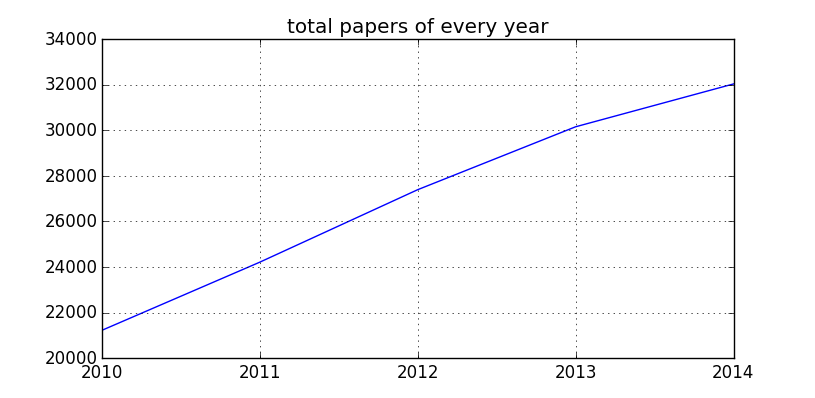
Over these five years, the total number of math papers on arXiv was 135,009, averaging 27,000 papers per year, or approximately 74 papers per day.
In terms of classification, the top fifteen categories by the number of articles are:
| Category | Number of Papers |
|---|---|
| Analysis of PDEs (math.AP) | 9,417 |
| Probability (math.PR) | 9,064 |
| Combinatorics (math.CO) | 8,937 |
| Mathematical Physics (math-ph) | 8,852 |
| Information Theory (cs.IT) | 8,215 |
| Algebraic Geometry (math.AG) | 7,524 |
| Number Theory (math.NT) | 6,789 |
| Differential Geometry (math.DG) | 6,495 |
| Dynamical Systems (math.DS) | 4,834 |
| Functional Analysis (math.FA) | 4,375 |
| Numerical Analysis (math.NA) | 4,058 |
| Optimization and Control (math.OC) | 4,015 |
| Classical Analysis and ODEs (math.CA) | 3,511 |
| Representation Theory (math.RT) | 3,431 |
| Geometric Topology (math.GT) | 3,256 |
In a sense, this table represents the popularity of various directions in mathematics. First, the top-ranked category is Partial Differential Equations (PDEs), which is somewhat related to Mathematical Physics (ranked fourth); both essentially represent the applications of PDEs, especially in fields like physics and biology. Ranked second is Probability Theory. Since almost any phenomenon in our world involves randomness, it is natural that this direction has flourished, making its popularity quite reasonable. Third is Combinatorics, which represents discrete mathematics. Fifth is Information Theory, which is likely a result of the development of data mining in recent years. Following these are Algebraic Geometry, Number Theory, Differential Geometry, Dynamical Systems, Functional Analysis, Numerical Analysis, and Optimization and Control, all of which are considered cutting-edge and popular fields in mathematics.
Next, I split the titles to see which words appear most frequently. As expected, the most common words are stop words with little specific meaning, such as "of", "and", "the", "for", "in", "with", "a", and "on". After removing these stop words, the results are:
equations(5172), groups(4782), spaces(4531), systems(4422), random(3980), functions(3906), quantum(3817), equation(3720), algebras(3686), theory(3459), graphs(3437), problem(3337), finite(3275), model(3216), solutions(3097), theorem(3014), operators(2880), linear(2718), generalized(2622), type(2579), group(2565), space(2402), manifolds(2363), analysis(2315), stochastic(2278), problems(2235), models(2161), surfaces(2156), applications(2060), nonlinear(2017), approach(1961), local(1930), polynomials(1922), method(1919), fields(1886), differential(1882), new(1874), optimal(1869), function(1854), boundary(1789), number(1768), sets(1766), curves(1751)
The first word "equations" and the eighth word "equation" likely correspond to the Analysis of PDEs category. These are followed by "groups" (Group Theory), "spaces", etc., which likely represent the mainstream methods of current mathematical research: placing the object of study into a specific space and investigating it using functional analysis and abstract algebra (especially group theory). Interestingly, the word "quantum" also ranks highly, indicating that mathematical research set against the background of quantum theory is also in full swing. Readers may draw their own conclusions regarding other aspects.
Yearly Changes
After looking at the overall situation, we can examine the changes year by year. First, regarding the total number of articles per year, the count has been increasing every year:
Next, let’s look at the five most frequent categories over these five years to see which fields are gradually becoming more popular.
2010: Math Physics (1619), Probability (1437), Algebraic Geometry (1358), Analysis of PDEs (1319), Combinatorics (1297)
2011: Math Physics (1809), Probability (1671), Combinatorics (1605), Analysis of PDEs (1545), Algebraic Geometry (1414)
2012: Math Physics (2005), Analysis of PDEs (1319), Combinatorics (1826), Probability (1824), Information Theory (1616)
2013: Analysis of PDEs (2211), Probability (2027), Combinatorics (2020), Information Theory (1958), Math Physics (1773)
2014: Analysis of PDEs (2464), Combinatorics (2189), Probability (2105), Information Theory (2008), Math Physics (1646)
It can be seen that for the first three years, Mathematical Physics consistently held the first place. However, in the last two years, while the total number of papers increased, the number of papers in Mathematical Physics saw a significant decline. This seems to suggest that the direction of Mathematical Physics might be encountering a bottleneck. Conversely, the category that has increased year by year and gradually risen to the top is Analysis of PDEs, indicating that the study of partial differential equations remains a mainstream field in contemporary mathematics.
Which categories are growing the fastest? I have selected a few that I consider representative.
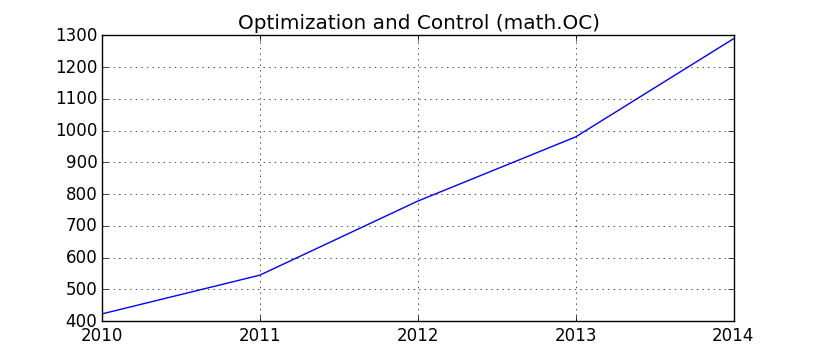
The first is Systems and Control (cs.SY). The number of papers over these five years was 9, 96, 112, 139, and 135, respectively. Somewhat related to this is Optimization and Control (math.OC), with paper counts of 423, 545, 778, 980, and 1289.

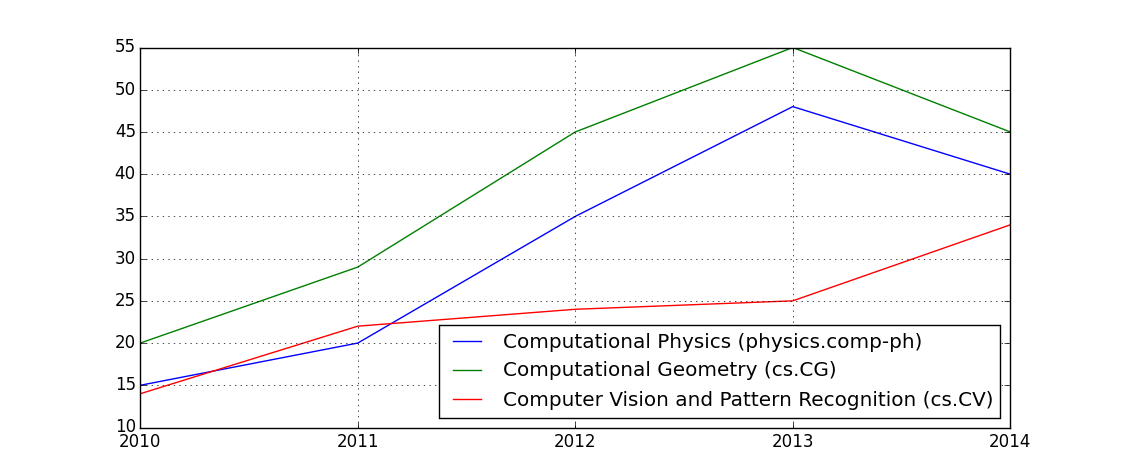
Furthermore, Numerical Analysis is also becoming increasingly popular. Its paper count has increased year by year with a relatively large growth rate: 435, 571, 778, 1012, and 1262. These conditions indicate that the integration of mathematics and computer science is one of the mainstream trends in mathematical development. Other categories reflecting this trend include Computational Physics (physics.comp-ph), Computational Geometry (cs.CG), and Computer Vision and Pattern Recognition (cs.CV).

I have used a simple index to measure the growth rate of a category: \sum_{n=2010}^{2013} \frac{\text{Paper count in year } (n+1)}{\text{Paper count in year } n} I must state that this index is very simple and not necessarily accurate; it is used only for intuitive understanding. The categories with the highest growth rates according to this index are listed in the table below. Interestingly, many of these fields are related to computer science, which I believe is not a coincidence.
| Category | 2010 | 2011 | 2012 | 2013 | 2014 |
|---|---|---|---|---|---|
| Earth and Planetary Astrophysics (astro-ph.EP) | 1 | 11 | 12 | 3 | 7 |
| Systems and Control (cs.SY) | 9 | 96 | 112 | 139 | 135 |
| Other Condensed Matter (cond-mat.other) | 8 | 3 | 8 | 1 | 7 |
| Databases (cs.DB) | 1 | 6 | 5 | 1 | 2 |
| Other Statistics (stat.OT) | 1 | 6 | 4 | 4 | 5 |
| Cellular Automata and Lattice Gases (nlin.CG) | 5 | 1 | 8 | 3 | 1 |
| Computation and Language (cs.CL) | 3 | 3 | 1 | 4 | 14 |
| History and Philosophy of Physics (physics.hist-ph) | 6 | 9 | 1 | 4 | 12 |
| Social and Information Networks (cs.SI) | 4 | 11 | 19 | 21 | 15 |
| Neural and Evolutionary Computing (cs.NE) | 5 | 6 | 4 | 15 | 9 |
| Cell Behavior (q-bio.CB) | 2 | 6 | 3 | 2 | 4 |
| Software Engineering (cs.SE) | 1 | 3 | 4 | 4 | 2 |
| Networking and Internet Architecture (cs.NI) | 29 | 44 | 56 | 76 | 118 |
| Physics and Society (physics.soc-ph) | 5 | 11 | 15 | 15 | 15 |
| Chemical Physics (physics.chem-ph) | 7 | 8 | 4 | 13 | 8 |
| High Energy Physics - Lattice (hep-lat) | 3 | 7 | 11 | 9 | 7 |
| Discrete Mathematics (cs.DM) | 54 | 88 | 125 | 187 | 152 |
| Machine Learning (stat.ML) | 30 | 43 | 60 | 86 | 91 |
| Optimization and Control (math.OC) | 423 | 545 | 778 | 980 | 1289 |
| Computational Physics (physics.comp-ph) | 15 | 20 | 35 | 48 | 40 |
| Data Structures and Algorithms (cs.DS) | 35 | 50 | 81 | 90 | 99 |
| Numerical Analysis (math.NA) | 435 | 571 | 778 | 1012 | 1262 |
| Cryptography and Security (cs.CR) | 21 | 37 | 35 | 66 | 40 |
| Numerical Analysis (cs.NA) | 26 | 26 | 47 | 44 | 61 |
| Quantitative Methods (q-bio.QM) | 7 | 14 | 15 | 8 | 12 |
| Adaptation and Self-Organizing Systems (nlin.AO) | 9 | 13 | 23 | 15 | 18 |
| Computer Vision and Pattern Recognition (cs.CV) | 14 | 22 | 24 | 25 | 34 |
| Computational Geometry (cs.CG) | 20 | 29 | 45 | 55 | 45 |
| Solar and Stellar Astrophysics (astro-ph.SR) | 2 | 6 | 6 | 5 | 1 |
| Artificial Intelligence (cs.AI) | 8 | 13 | 22 | 15 | 15 |
Attachment Download
Finally, I am providing the file I crawled. Interested readers can use it for further analysis.
When reposting, please include the original address of this article: https://kexue.fm/archives/3511
For more detailed reposting matters, please refer to: Scientific Space FAQ