Electricity and magnetism share many similarities. Since nature allows the existence of electrons carrying a single electric charge, does it also allow the existence of objects with only a single magnetic pole? Perhaps so. As early as 1931, the British physicist Paul Dirac predicted the existence of such matter using mathematical formulas and named it the “magnetic monopole.” Today, we have finally discovered their traces!
In the context of string theory in theoretical physics, magnetic monopoles refer to magnetic substances that carry only a single north or south pole. Their magnetic field line distribution is similar to the electric field line distribution of a point charge. The existence of such matter has long been a subject of debate in the scientific community, and as of 2008, no such object had been found. It can be considered one of the most important research topics in 21st-century physics. On September 3, 2009, the journal Science published a paper recording the first human observation of magnetic monopoles.
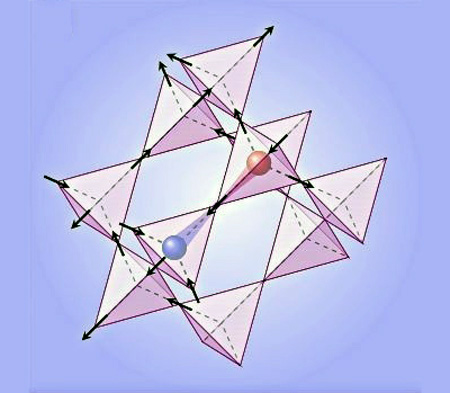
The following is the content of the original report:
Researchers at the Helmholtz-Zentrum Berlin für Materialien und Energie, in collaboration with colleagues from the Dresden University of Technology, the University of St Andrews, the National University of La Plata, and Oxford University, have for the first time observed the existence of magnetic monopoles and the process by which these monopoles emerge in a real material. The research results were published in the September 3 issue of the journal Science.
Magnetic monopoles are hypothetical magnetic particles proposed by scientists in string theory within theoretical physics that carry only a single north or south magnetic pole. In the physical world, this is quite exceptional because magnetic particles usually always appear in pairs as dipoles (north and south poles). The existence of magnetic monopoles has been a matter of dispute in the scientific community; until now, scientists had never discovered such a substance. Therefore, the magnetic monopole can be described as one of the most important research topics in 21st-century physics.
British physicist Paul Dirac predicted as early as 1931, using mathematical formulas, that magnetic monopoles exist at the ends of tubes carrying magnetic fields (so-called Dirac strings). At that time, he believed that since electrons with a fundamental electric charge exist in the universe, particles with a fundamental “magnetic charge” should also exist, which inspired many physicists to begin their search for magnetic monopoles.
Scientists have searched for magnetic monopoles in various ways, including the use of particle accelerators to artificially create them, but to no avail. This time, Jonathan Morris and Alan Tennant of the Helmholtz-Zentrum Berlin conducted a neutron scattering experiment at the Berlin Research Reactor. The material they studied was a dysprosium titanate single crystal. This material crystallizes into a quite remarkable geometric shape, also known as a pyrochlore lattice. With the help of neutron scattering, the researchers confirmed that the magnetic moments inside the material had reorganized into what is called “spin spaghetti,” a name derived from the order of the dipoles themselves. In this way, a network of controllable tubes (strings) can be formed through the transport of magnetic flux. These strings can be observed through their interaction with neutrons, which themselves carry a magnetic moment; thus, the neutrons scatter as an inverse representation of the strings.
During the neutron scattering measurements, the researchers applied a magnetic field to the crystal. This field could be used to influence the symmetry and orientation of the strings, thereby reducing the density of the string network to promote the separation of monopoles. As a result, at temperatures between 0.6K and 2K, these strings became visible, and magnetic monopoles appeared at their ends.
The researchers also discovered characteristics of a gas composed of these monopoles in heat capacity measurements. This further confirms the existence of monopoles and indicates that they interact with each other in the same way as electric charges.
In this work, the researchers have for the first time confirmed that monopoles exist as an emergent state of matter; that is, their appearance is promoted by a special arrangement of dipoles, which is entirely different from the constituent parts of the material. In addition to the basic knowledge mentioned above, Morris further explained the results, stating that this work is defining new fundamental properties of matter. Generally speaking, these properties are applicable to all materials with the same topological structure (magnetic moments on a pyrochlore lattice).
The researchers believe that this technology will have a significant impact. Most importantly, however, it marks the first time that the separation of magnetic monopoles has been observed from a three-dimensional perspective.
Abstract of the paper published in Science
When reposting, please include the original address of this article: https://kexue.fm/archives/141
For more details on reposting, please refer to: Scientific Space FAQ