I found these online; there seem to be three different versions, all of which are recorded here.
Regarding the method for the compass-and-straightedge construction of
a regular 17-gon, please see:
https://kexue.fm/article.asp?id=104
This article only proves its existence (that is, calculating \cos(2\pi/17)).
\cos \frac{2\pi}{17}=\frac{-1+\sqrt{17}+\sqrt{34-2\sqrt{17}}+2\sqrt{17+3\sqrt{17}-\sqrt{34-2\sqrt{17}}-2\sqrt{34+2\sqrt{17}}}}{16}
Version 1 (from the Mathematical R&D Forum):
Let the central angle of the regular 17-gon be \theta, then 17\theta=2\pi, which means 16\theta=2\pi-\theta.
Thus \sin 16\theta=-\sin \theta.
Furthermore: \begin{aligned}
\sin 16\theta &= 2\sin 8\theta \cos 8\theta = 2^2\sin 4\theta \cos
4\theta \cos 8\theta \\
&= 2^4 \sin \theta \cos \theta \cos 2\theta \cos 4\theta \cos
8\theta
\end{aligned} Since \sin \theta \neq
0, dividing both sides by it gives: 16\cos \theta \cos 2\theta \cos 4\theta \cos
8\theta = -1 Also, from 2\cos \theta
\cos 2\theta = \cos \theta + \cos 3\theta etc., we have: 2(\cos \theta + \cos 2\theta + \dots + \cos
8\theta) = -1 Noting that \cos 15\theta
= \cos 2\theta and \cos 12\theta = \cos
5\theta, let: \begin{aligned}
x &= \cos \theta + \cos 2\theta + \cos 4\theta + \cos 8\theta \\
y &= \cos 3\theta + \cos 5\theta + \cos 6\theta + \cos 7\theta
\end{aligned} We have: x+y =
-1/2 And xy = (\cos \theta + \cos
2\theta + \cos 4\theta + \cos 8\theta)(\cos 3\theta + \cos 5\theta +
\cos 6\theta + \cos 7\theta) =
1/2(\cos 2\theta + \cos 4\theta + \cos 4\theta + \cos 6\theta + \dots +
\cos \theta + \cos 15\theta) Through calculation, we find xy = -1.
Thus: x = (-1+\sqrt{17})/4, \quad y =
(-1-\sqrt{17})/4 Next, let: x_1 = \cos
\theta + \cos 4\theta, \quad x_2 = \cos 2\theta + \cos 8\theta
y_1 = \cos 3\theta + \cos 5\theta, \quad y_2
= \cos 6\theta + \cos 7\theta Therefore: x_1 + x_2 = (-1+\sqrt{17})/4 y_1 + y_2 = (-1-\sqrt{17})/4 By solving
these (you can try solving them yourselves…):
Finally, from \cos \theta + \cos 4\theta =
x_1 and \cos \theta \cos 4\theta =
(y_1)/2, we can solve for \cos
\frac{2\pi}{17}. Since it is a combination of addition,
subtraction, multiplication, division, and square roots of numbers, the
regular 17-gon can be constructed using a compass and straightedge.
Version 2 (source forum unknown):


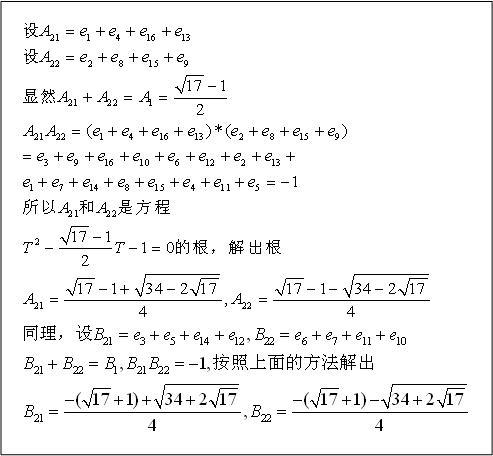
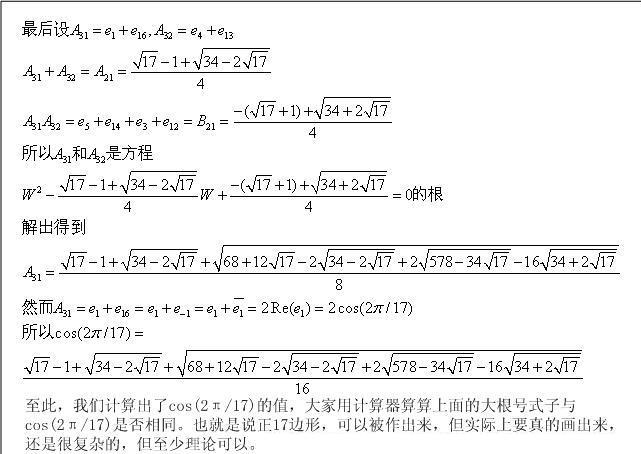
Version 3 (PDF file, also from the internet):
Introduction to the Logic and Method of Constructing a Regular Heptadecagon.zip
When reprinting, please include the original address of this article: https://kexue.fm/archives/133
For more detailed reprinting matters, please refer to: “Scientific Space FAQ”