Description:
The Saturnian equinox, long-awaited by Cassini and curious observers alike, has finally arrived!
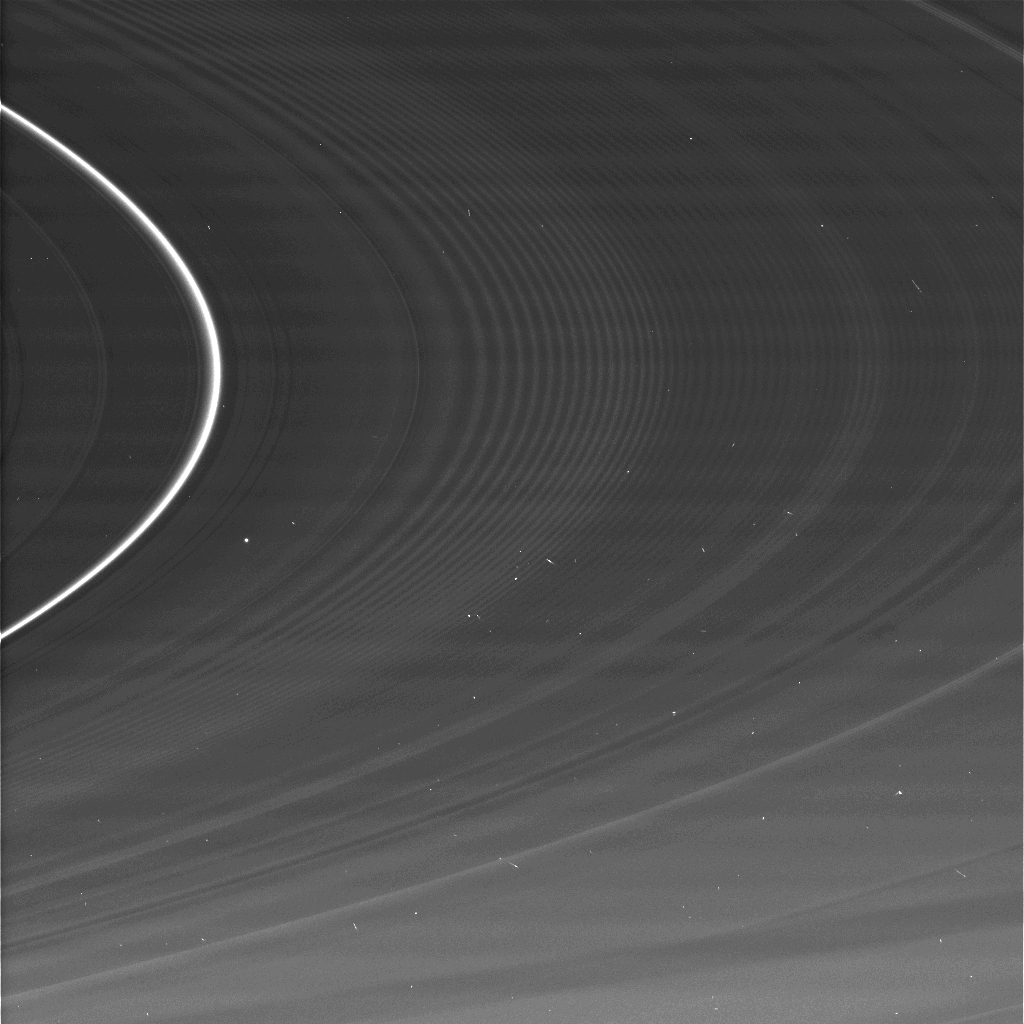
When do Saturn’s rings appear to point directly at the Sun? This occurred early this month during Saturn’s equinox. Because Earth, the Sun, and Saturn were nearly aligned in a straight line, the rings appeared to disappear from the perspective of observers on Earth. The Cassini spacecraft continues to orbit Saturn, but with a different view: the spacecraft looks down from above the ring plane. This image shows that during the hours of the equinox on August 10, 2009, Saturn’s rings were darker than ever seen before. Planetary scientists will study images taken near the equinox to better understand the size distribution of the solar system’s most extensive ring system from the perspectives of dynamics and particle science.
Saturn’s equinox is the period when the Sun crosses Saturn’s equator and ring plane vertically. Similar to Earth, Saturn’s equinox represents a transitional period for the planetary system.
Like Earth and other planets, Saturn’s rotation axis is not perpendicular to its orbital plane around the Sun. Therefore, from Saturn’s perspective, the Sun moves from a position over the southern hemisphere back to the northern hemisphere. A full cycle of seasonal changes on Saturn and its moons (one Saturnian year) is equivalent to 29.5 Earth years. Consequently, approximately every 15 years—half a Saturnian year—the planet passes through an equinox (vernal or autumnal), at which time the Sun passes exactly through the plane of Saturn’s rings.
At this time, the shadow of Saturn’s rings falls exactly on its equator. If Saturn’s moons—especially those whose orbits lie in the same plane as Saturn’s equator—cast shadows, these shadows will traverse the ring system. The occurrence of this phenomenon essentially marks the arrival of the equinox. At this time, any feature protruding from the plane of the rings will cast a shadow upon them, including small moonlets or tiny vertical structures within the rings. At the exact moment of the equinox, the shadow of the rings on Saturn becomes a very thin line near the equator, and the rings themselves become extremely dim, with only the edges appearing faintly.
NASA URLs:
http://antwrp.gsfc.nasa.gov/apod/astropix.html
http://antwrp.gsfc.nasa.gov/apod/ap090825.html
When reposting, please include the address of this article: https://kexue.fm/archives/99
For more detailed information on reposting, please refer to: Scientific Space FAQ