While we are still intoxicated by the vast starry river, autumn has quietly arrived. The weather is becoming cooler, clear and transparent days are increasing, and the nights are growing longer. As an astronomy enthusiast, you must love this season. But do not forget to bring more warm clothes, as the temperature difference between day and night can be very large. Take care of your health; do not let your observations make you fall ill.
At the same time, if you are a student, it is time to go back to school. In the new school year, meeting more like-minded friends and conducting astronomical observations together will be an incredibly pleasant experience.
Observation Highlights:
\bullet September \bullet The Sun moves from Leo to Virgo
01: Alpha Aurigid meteor shower peak (09:00, ZHR=7)
02: Venus near the Beehive Cluster (M44)
03: Jupiter in conjunction with the Moon
04: Saturn’s rings disappear (inclination is 0 as seen from Earth)
10: Lunar occultation of the Pleiades (M45)
14: Lunar occultation of Mars
17: Venus in conjunction with the Moon
18: Uranus at opposition
19: Mercury in conjunction with the Moon, Saturn in conjunction with the Moon
20: Venus in conjunction with Regulus
24: Lunar occultation of Antares
29: Delta Aurigid meteor shower peak (ZHR=3)
30: Jupiter in conjunction with the Moon
Comet Dynamics:
09/08: Comet P/2001 MD7 (LINEAR) at perihelion (1.224 AU)
09/25: Comet C/2008 N1 (Holmes) at perihelion (2.783 AU)
Lunar Phases:
Full Moon: 05th, 00:02
Last Quarter: 12th, 10:16
New Moon: 19th, 02:44
First Quarter: 26th, 12:49
Detailed Information:
The following observation location is: Xinxing County, Yunfu City, Guangdong Province (112.2E, 22.68N)
September 1: Alpha Aurigid Meteor Shower Peak
Entering the second half of the year, meteor showers become more frequent. Just as the Perseids in August have concluded, the Alpha Aurigids follow in September. Other active showers during this period include the Arietids, Pisceids, and Cassiopeids. Although these are low-rate showers, on a clear moonless night in a location with low light pollution, seeing more than 50 meteors throughout the night should not be a problem.
In fact, besides the Alpha Aurigids, the Delta Aurigid meteor shower also has its radiant in Auriga during September.

So far, there are no expectations for a major outburst of the Alpha Aurigids this year, but observation conditions are relatively favorable. The conventional peak is expected around 9:00 AM Beijing Time on September 1. Since this occurs during daylight, the best time for observation is from the night of August 31 to the pre-dawn hours of September 1. Especially after 0:00 AM on the 1st, the radiant will have reached a suitable altitude. The moon sets around 2:00 AM that day, so it will have little impact on observations.
The Delta Aurigid meteor shower was only recently confirmed as a distinct shower; it was previously considered part of the September Perseids. Its active period is roughly from September 18 to October 10, with a potential peak on September 29. For the Qingdao region, the moon sets after 1:00 AM, after which conditions become suitable for observation. However, the peak rate for this shower is only in the single digits, making it difficult to observe. While there are many showers in September, they are challenging to observe due to the small size and low number of meteors.
September 2: Venus near the Beehive Cluster (M44)
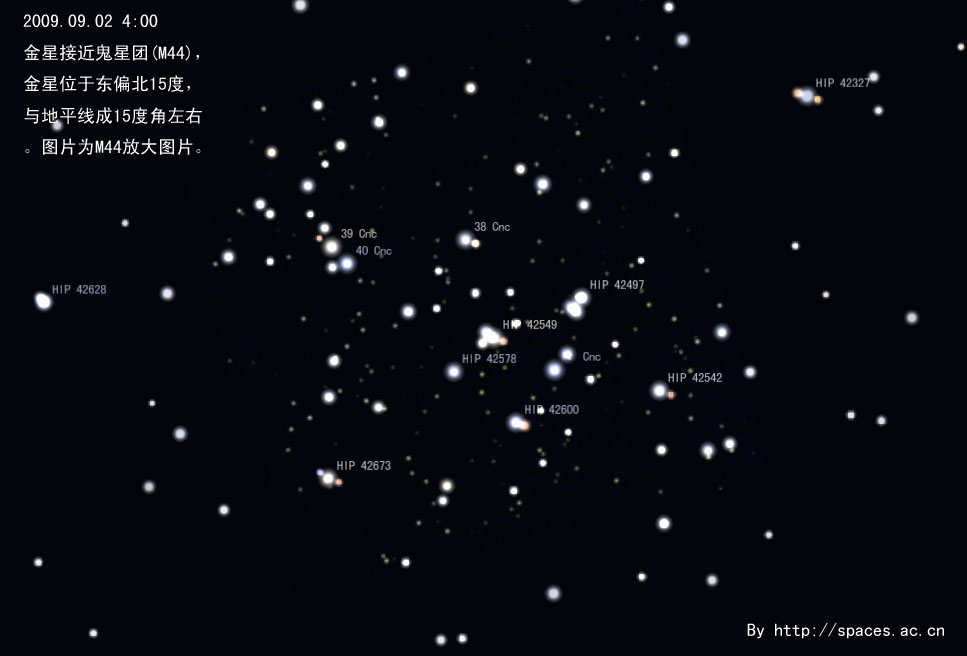
The Beehive Cluster (Praesepe) is an open cluster located in Cancer. It is also known as M44 in the Messier catalog. In ancient China, it was known as "Jishiqi" (Accumulated Corpse Exhalation). The Beehive Cluster spans less than 10 parsecs. It is now known to be an open cluster composed of more than 500 stars, located at a distance of 520 light-years.
September 10: Lunar Occultation of the Pleiades (M45)
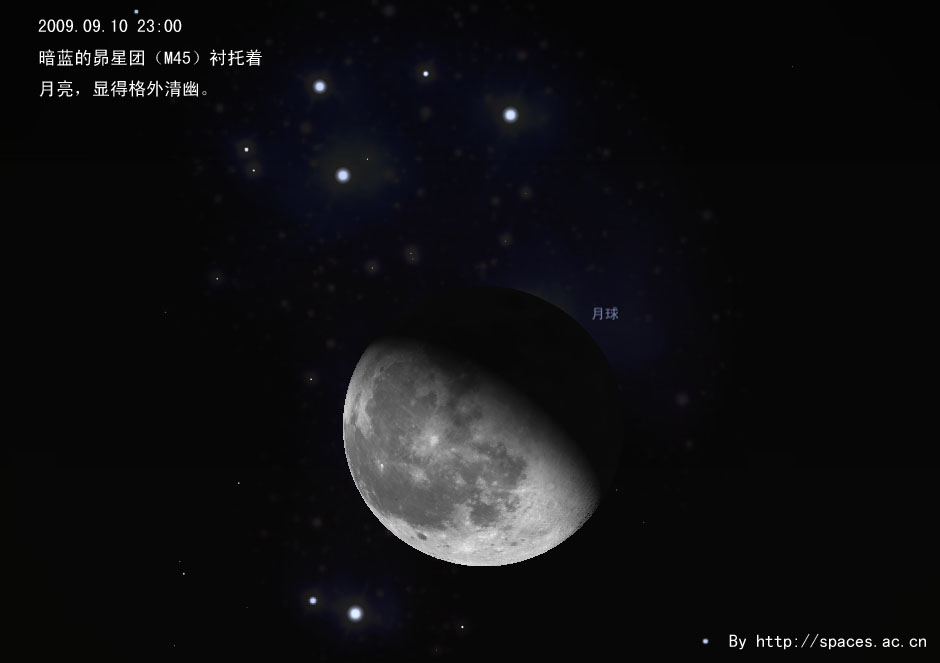
On the night of September 10, a crescent moon will hang high in the sky. Not far to the upper left of the moon, the public can faintly see a small cluster of crystal-blue "diamonds"—the famous "Seven Sisters" star cluster. Around 23:00, the moon will gradually occult the Pleiades. As the moon passes through the cluster, we will see the member stars disappear or reappear one after another, a spectacular sight. The moon’s watery silver glow reflecting against the beautiful cluster will create a romantic "Autumn Whisper" in the silent sky.
The Pleiades is the famous open cluster M45 in Taurus. It is located 440 light-years from Earth with a magnitude of 1.8, making it one of the most beautiful clusters visible to the naked eye. In ancient China, it was called the Mao cluster. Generally, six stars are visible to the naked eye; if your eyesight is good, you can see more, making it a test for visual acuity or sky clarity. Since the Pleiades is close to the ecliptic (only 4 degrees away), lunar occultations of the cluster occur frequently and are a very attractive sight.
September 17: Uranus at Opposition
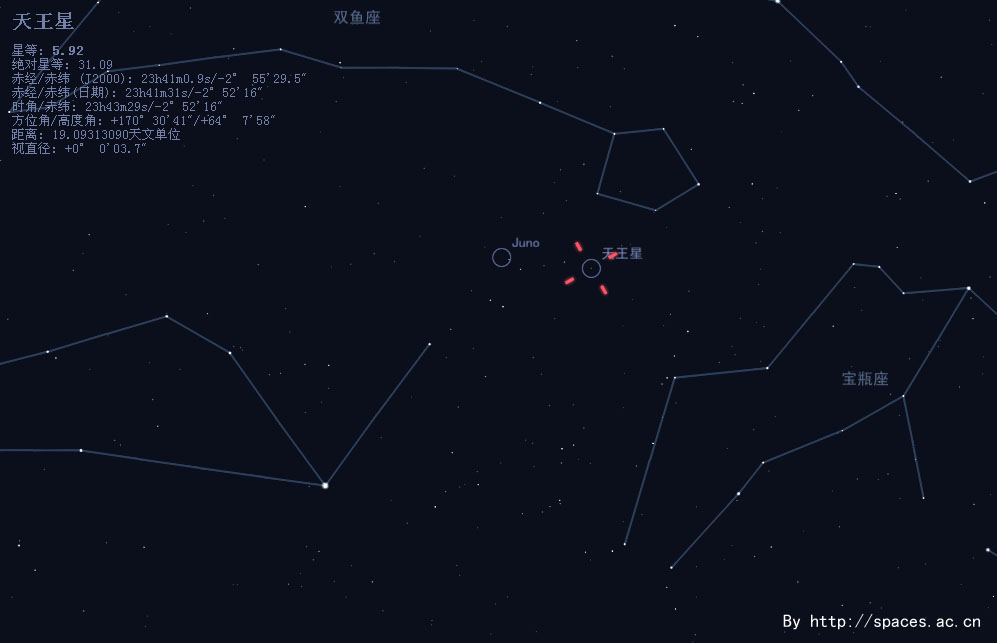
During this opposition on September 17, Uranus will be approximately 19 astronomical units (2.856 billion kilometers) from Earth. Its brightness will reach magnitude 5.7, located within the constellation Aquarius. To find it in the vast sea of stars, the help of an astronomical telescope is required.
Planetary Dynamics
Sun
At the beginning of the month, the Sun’s apparent Right Ascension and Declination are 8h 45.3m, +18^\circ 02.0’.
At the end of the month, the Sun’s apparent Right Ascension and Declination are 10h 37.7m, +8^\circ 40.1’.
This month, the Sun moves from Leo to Virgo.
September 7, 19:58: White Dew (Solar Term), solar longitude 165^\circ.
September 23, 05:19: Autumnal Equinox, solar longitude 180^\circ.Moon
Perigee on September 16, 16:00; Apogee on September 28, 12:00. Full Moon on the 5th at 00:03, Last Quarter on the 12th at 10:16, New Moon on the 19th at 02:44, First Quarter on the 26th at 12:50. On the 13th at 24:00, the Moon occults Mars, with Mars 1.1^\circ south of the Moon. On the night of the 10th, the Moon occults the Pleiades (M45). On the 24th at 14:00, the Moon occults Antares, with Antares 0.8^\circ south of the Moon.Mercury
In the early to mid-month, Mercury is an evening star, located low in the northwest sky at sunset, approaching the Sun daily and unfavorable for observation. On September 20, Mercury reaches inferior conjunction and is lost in the Sun’s glare. After inferior conjunction, Mercury becomes a morning star, its distance from the Sun increases rapidly, and its visibility improves daily. It becomes faintly visible in the southeast before dawn. Mercury is stationary on the 7th at 04:00 and again on the 29th at 03:00.Venus
This month, Venus moves from Cancer into Leo. As a morning star, it is visible in the northeast sky before dawn, shifting to the southeast in the latter part of the month. Although the distance between Venus and the Sun continues to close, and its altitude at sunrise drops from 30^\circ to about 24^\circ, it remains a good time to observe Venus before sunrise with a magnitude of -3.9. On the morning of the 2nd, Venus is near the Beehive Cluster (M44). On the 17th at 02:00, Venus is in conjunction with the Moon, 3^\circ north of the Moon. On the 20th at 18:00, Venus is in conjunction with Regulus, 0.5^\circ north of the star.Mars
Moving through Gemini, Mars rises in the east around 0:00 AM with a magnitude of 0.9. The latter half of the night is a good time for observing Mars.Jupiter
Retrograding in Capricornus, Jupiter hangs low in the southeast sky at sunset with a magnitude of -2.8. It sets around 3:00 AM the next day. Observation conditions remain good. On the 3rd at 05:00, Jupiter is in conjunction with the Moon, 3^\circ south of the Moon. On the 30th at 08:00, Jupiter is again in conjunction with the Moon, 3^\circ south.Saturn
Moving from Leo to Virgo. This month, Saturn is difficult to see due to its proximity to the Sun. On September 18, Saturn is in conjunction with the Sun, rising and setting almost simultaneously with it, making observation impossible. After this, Saturn moves to the west of the Sun and begins to move further away daily.Uranus
Moving through Aquarius. On the 6th at 05:00, Uranus is in conjunction with the Moon, 6^\circ south of the Moon. On the 17th at 18:00, Uranus is at opposition.Neptune
Moving through Capricornus. On the 3rd at 15:00, Neptune is in conjunction with the Moon, 3^\circ south of the Moon. On the 30th at 21:00, Neptune is again in conjunction with the Moon, 3^\circ south.
(Some content extracted from "Astronomy Enthusiast", images from Stellarium, organized by Scientific Space)
When reprinting, please include the original address: https://kexue.fm/archives/97
For more detailed reprinting matters, please refer to: Scientific Space FAQ