Explanation:
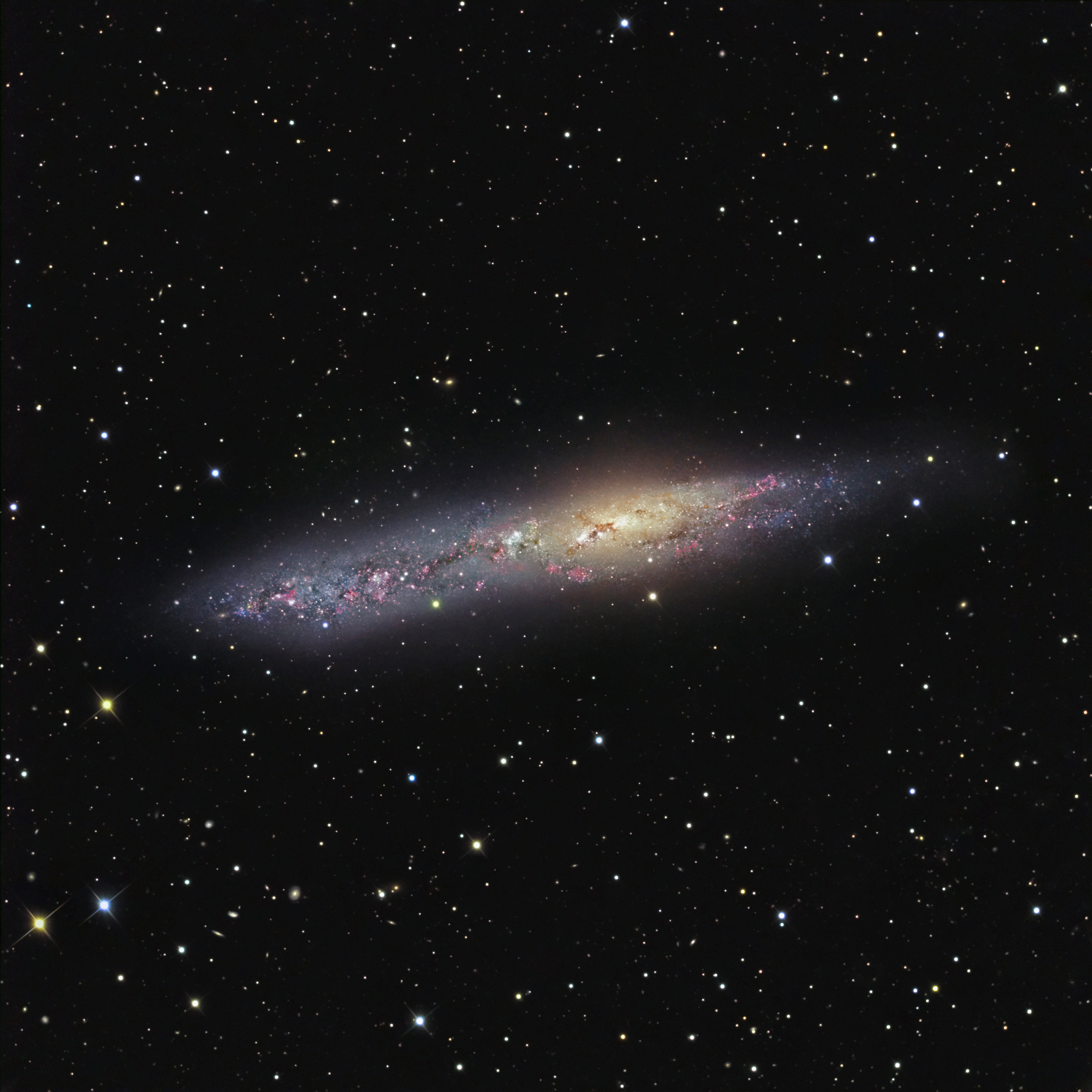
The image shows the irregular galaxy NGC 55.
NGC 55 is a barred spiral galaxy located in the constellation Sculptor, approximately 7 million light-years from Earth. It has a magnitude of 7.8, a Right Ascension of 15 minutes 8 seconds, and a Declination of -39^\circ13’10”. It was first discovered on July 7, 1826.
It is generally believed that the spiral galaxy NGC 300 and NGC 55 are neighboring galaxies and members of the Sculptor Group.
The irregular galaxy NGC 55 is considered to be very similar to the Large Magellanic Cloud (LMC). However, while the Large Magellanic Cloud is about 180,000 light-years away and is considered a satellite galaxy of our Milky Way, NGC 55 is about 6 million light-years away and is a member of the Sculptor Galaxy Group. NGC 55 is classified as an irregular galaxy; in deep-exposure photographs of the Large Magellanic Cloud, a bar-like galactic disk can be found. However, galaxy NGC 55 is about 50,000 light-years wide, and the photograph shows NGC 55 from the side, displaying a flattened form that stands in sharp contrast to the face-on Large Magellanic Cloud. Much like the emission nebulae produced in star-forming regions within the Large Magellanic Cloud, NGC 55 also appears to have star-forming regions. In this high-definition image of NGC 55, one can find a very bright galactic nucleus interspersed among dust clouds, with pink representing star-forming regions and blue representing young star clusters.
NASA Website: http://antwrp.gsfc.nasa.gov/apod/astropix.html
Appendix: How to view past "Astronomy Picture of the Day" on NASA?
We can access them via the URL http://antwrp.gsfc.nasa.gov/apod/ap090811.html, where the red part can be modified. 09, 08, and 11 represent the year, month, and day respectively, using two digits each.
When reprinting, please include the address of this article: https://kexue.fm/archives/71
For more detailed reprinting matters, please refer to: Scientific Space FAQ