Translated by DeepSeek V4 Pro. Translations can be inaccurate, please refer to the original post for important stuff.
Su JianlinAugust 8, 2009#65
Author’s Note: 3.8 billion years
ago, at the beginning of the solar system’s formation, an
"earth-shattering" impact event occurred. This created the craters on
the moon and the pitted surfaces of many celestial bodies. However, it
may also have been the source of life. Research indicates it might have
brought water to Earth.
This translation was not very difficult,
though some technical terms were troublesome. For instance, "Giant
plumes"—I was initially unclear on its meaning. After consulting others,
I learned it refers to "mantle plumes" (or impact plumes). I hope fellow
enthusiasts will not jump to conclusions when encountering unfamiliar
terms in the future; try searching on Google more often.
Comets (Not Asteroids) Heavily Battered the
Moon by Hazel Muir
A new study of ancient rocks in Greenland suggests that the
"perpetrators" of the violent impacts on the Earth and Moon 3.85 billion
years ago were icy comets—rather than rocky asteroids. This work
indicates that most of the water currently on Earth may have been
brought by comets.
"We can observe the craters on the lunar surface with the naked eye,
but no one knew how they were formed—whether by rock, iron, or ice,"
says Uffe Grae Jorgensen, an astronomer at the Niels Bohr Institute in
Copenhagen, Denmark. "It is exciting that the discovered signs indicate
this was caused by ice."
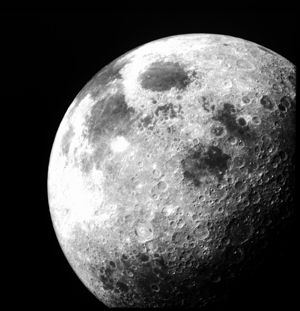
The moon after ages of change.
Research has found that both the Earth and the Moon formed 4.5
billion years ago. However, almost all the craters on the Moon formed
later, originating from a "Late Heavy Bombardment" (LHB, see: Wikipedia:
Late Heavy Bombardment) approximately 3.9 to 3.8 billion years ago.
It is estimated that 100 million billion tonnes (10^{17} tonnes) of meteoritic ice or rock
struck the lunar surface. At the same time, Earth was also being struck
by debris—though our restless planet has erased these scars through
"plate tectonics."
To determine whether asteroids or comets were the true "culprits" of
the impact, Jorgensen decided to measure the concentration of iridium in
ancient geological rocks. Since almost all iridium transitioned into
iron and sank into the Earth’s core shortly after the Earth’s formation,
iridium is extremely rare on the Earth’s surface. However, iridium is a
relatively common element in comets and meteorites.
Ice? Rock?
His team calculated and compared the iridium content that asteroid
and comet impacts would leave on the Earth and Moon. Because comets have
more volatile components and higher impact velocities due to their
elongated orbits, their impacts would create giant plumes. Compared to
asteroid impacts, this would allow more iridium to escape into
space.
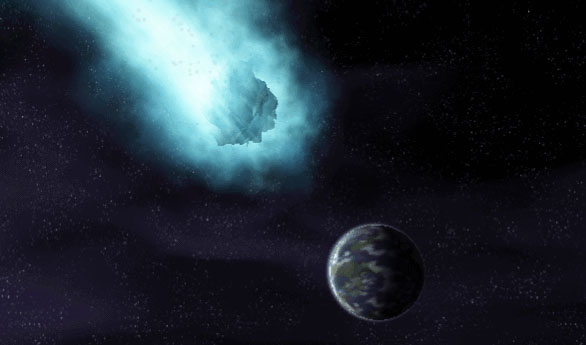
Simulation of an asteroid hitting Earth.
The team estimated that if it were an asteroid impact, the iridium
content in Earth and Moon rocks would be 18,000 ppt and 10,000 ppt
(parts per trillion), respectively. If it were a comet impact, these two
figures would be only 130 and 10.
Ancient lunar rocks brought back by NASA’s Apollo missions have
confirmed that the iridium content in lunar rocks is only 10 ppt or even
less. To find relevant information on Earth, Jorgensen’s team collected
a batch of the world’s oldest rocks (3.8 billion years old) from
Greenland and sent them to a Japanese laboratory to measure the iridium
content with unprecedented precision. The results showed an iridium
content of 150 ppt.
This provides strong evidence that comets—not asteroids—caused the
major bombardment.
Simulation of a comet hitting Earth.
Giant Plumes
If this is the case, according to the Jorgensen team’s calculations,
comets brought 3,400 tonnes of ice to every square meter of the Earth.
It is estimated that half of the cometary material returned to space
through giant plumes, leaving approximately 1 billion cubic kilometers
of water on Earth.
This figure is roughly equal to the total volume of Earth’s current
oceans, though it remains unclear whether water was produced during the
chemical changes of the early Earth. (i.e., it is unknown whether
Earth’s water is "home-grown" or "imported"; see this
English reference or this Chinese
reference).
Michael Mumma, a comet expert at NASA’s Goddard Space Flight Center
in Maryland who was not involved in the study, stated that the new
results are very interesting: "The paper is certain to stimulate lively
debate."
Comets, not asteroids, to blame for moon’s scarred
face by Hazel Muir
Icy comets – not rocky asteroids – launched a dramatic assault on the
Earth and moon around 3.85 billion years ago, a new study of ancient
rocks in Greenland suggests. The work suggests much of Earth’s water
could have been brought to the planet by comets.
"We can see craters on the moon’s surface with the naked eye, but
nobody actually knew what caused them – was it rocks, was it iron, was
it ice?" says Uffe Græ Jørgensen, an astronomer at the Niels Bohr
Institute in Copenhagen, Denmark. "It’s exciting to find signs that it
was actually ice."
Evidence suggests that the Earth and moon had both formed around 4.5
billion years ago. But almost all the craters on the moon date to a
later period, the "Late Heavy Bombardment" 3.8 to 3.9 billion years ago,
when around 100 million billion tonnes of rock or ice crashed onto the
lunar surface. The Earth would have been pummelled by debris at the same
time, although plate tectonics on our restless planet have since erased
the scars.
To find out whether asteroids or comets were the main culprits for
the bombardment, Jørgensen decided to measure levels of the element
iridium in ancient terrestrial rocks. Iridium is rare on the Earth’s
surface because almost all of it bound to iron and sank into the Earth’s
core soon after the planet had formed. But iridium is relatively common
in comets and meteorites.
Rock or ice
His team calculated the amount of iridium that asteroids would leave on
the Earth and moon compared to comets. Because comets have more volatile
elements and higher impact speeds due to their more elongated orbits
around the sun, they would create giant plumes on impact, allowing more
iridium to escape into space than during asteroid impacts.
The team predicted that asteroid bombardment would leave iridium
levels of 18,000 and 10,000 parts per trillion in rocks on the Earth and
moon respectively, while the same figures for comet bombardment would be
about 130 and 10.
Ancient moon rocks returned by NASA’s Apollo missions have already
confirmed that the lunar iridium levels are 10 parts per trillion or
less. To find out the terrestrial value, Jørgensen’s team sampled some
of the world’s oldest rocks from Greenland, aged 3.8 billion years, and
asked a Japanese laboratory to assess their iridium levels more
accurately than ever before. They contained iridium levels of 150 parts
per trillion.
That strongly suggests comets, rather than asteroids, caused the
violent bombardment.
Giant plumes
If so, Jørgensen’s team calculates that around 3400 tonnes of icy comet
material fell on each square metre of the Earth. About half the comet
material would ricochet back into space in giant plumes, leaving behind
roughly a billion cubic kilometres of cometary water in total.
That is a similar amount to that in the Earth’s oceans today,
although it is not clear whether there was already water on the planet
due to chemical reactions on the early Earth (see Earth’s water brewed
at home, not in space).
Michael Mumma, a comet expert at NASA’s Goddard Space Flight Center
in Maryland who was not involved in the research, says the new report is
interesting: "The paper is certain to stimulate lively debate."