Description:
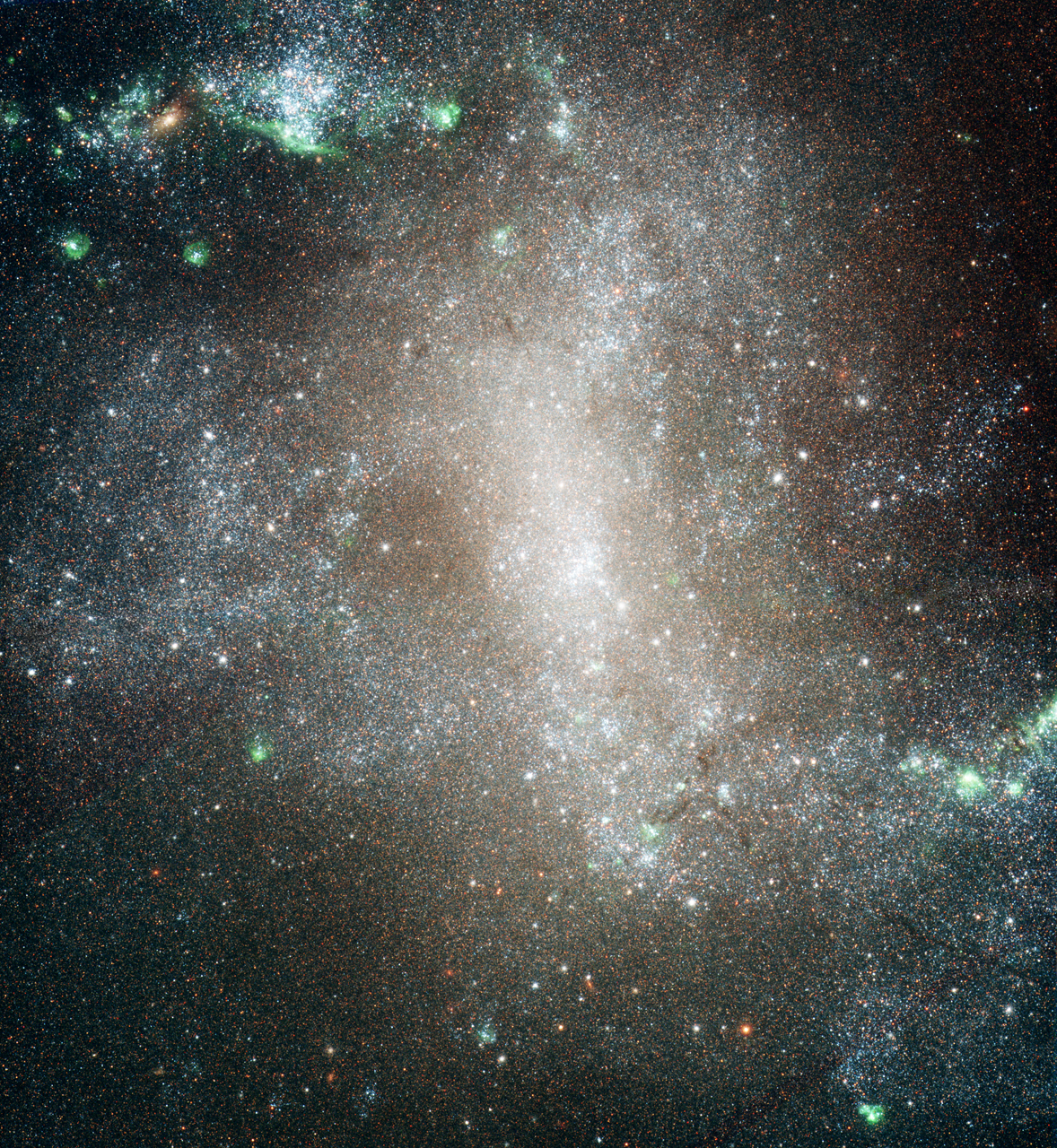
The sand-like NGC 1313 star cluster.
This is NGC 1313 captured by the Advanced Camera for Surveys (ACS) on the Hubble Space Telescope. NGC 1313 is a barred spiral galaxy, whose unique stars appear like sand on a cosmic beach. The span in the image above is approximately 10,000 light-years.
Note: There is not much Chinese information about NGC 1313 online, so I am reposting this. This is a Google cache; the original page is no longer active.
The image presents a chaotic and magnificent scene of massive star birth in this galaxy, with the spiral arms filled everywhere with dense clusters of bright stars and gas. However, as astronomers delve deeper into the core of this galaxy, they do not understand it better, but instead find more difficult mysteries. However, as astronomers delve deeper into the core of this galaxy, they do not understand it better, but instead find more difficult mysteries.
NGC 1313 is very similar in some respects to the two largest satellite galaxies of our Milky Way—the Magellanic Clouds. The distance is about 15 million light-years; on an astronomical scale, it is considered a fairly close neighbor to the Milky Way. The distance is about 15 million light-years; on an astronomical scale, it is considered a fairly close neighbor to the Milky Way. NGC 1313 is basically a barred spiral galaxy, with a short bar structure in the center of the galaxy and loose spiral arms extending outward from both ends of the short bar. NGC 1313 is basically a barred spiral galaxy, with a short bar structure in the center of the galaxy and loose spiral arms extending outward from both ends of the short bar. There are a large number of young, hot star clusters on the spiral arms, born at a staggering rate from the dense gas and dust clouds on the spiral arms; the light from these young star clusters illuminates the surrounding gas, causing bright and dark clouds to appear alternately in the spiral arms, showing a very magnificent scene. There are a large number of young, hot star clusters on the spiral arms, born at a staggering rate from the dense gas and dust clouds on the spiral arms; the light from these young star clusters illuminates the surrounding gas, causing bright and dark clouds to appear alternately in the spiral arms, showing a very magnificent scene.
However, NGC 1313 is not just a beautiful photo; it also hides puzzles that have troubled astronomers in fields such as stars and galaxies. However, NGC 1313 is not just a beautiful photo; it also hides puzzles that have troubled astronomers in fields such as stars and galaxies. About 1/4 of the massive stars in starburst galaxies are born during this brief but vigorous stage, with a birth rate more than 1000 times higher than that of the Milky Way today. About 1/4 of the massive stars in starburst galaxies are born during this brief but vigorous stage, with a birth rate more than 1000 times higher than that of the Milky Way today. Usually, this kind of massive star birth occurs during the process of two galaxies merging or a close-range encounter, triggered by the intense disturbance of gas and dust clouds caused by their mutual interaction. Usually, this kind of massive star birth occurs during the process of two galaxies merging or a close-range encounter, triggered by the intense disturbance of gas and dust clouds caused by their mutual interaction.
Judging from the appearance of NGC 1313, this galaxy should have already experienced a troublesome period of galaxy merger or a close-range galaxy flyby: its spiral arms are not very asymmetric, and gas globules are widely scattered within the spiral arms. Judging from the appearance of NGC 1313, this galaxy should have already experienced a troublesome period of galaxy merger or a close-range galaxy flyby: its spiral arms are not very asymmetric, and gas globules are widely scattered within the spiral arms. In addition, astronomers also conducted observations with the ESO 3.6-meter telescope located at La Silla in Chile, and the results found that the “true” center of NGC 1313—the point around which surrounding matter rotates—does not coincide with the position of the short bar structure at the galaxy’s core, causing the entire galaxy to rotate unevenly. In addition, astronomers also conducted observations with the ESO 3.6-meter telescope located at La Silla in Chile, and the results found that the “true” center of NGC 1313—the point around which surrounding matter rotates—does not coincide with the position of the short bar structure at the galaxy’s core, causing the entire galaxy to rotate unevenly.
What makes astronomers even more troubled is: NGC 1313 seems to be an isolated galaxy, not belonging to any galaxy cluster, having no neighboring galaxies, and showing no signs of having swallowed small galaxies in the past. What makes astronomers even more troubled is: NGC 1313 seems to be an isolated galaxy, not belonging to any galaxy cluster, having no neighboring galaxies, and showing no signs of having swallowed small galaxies in the past. So, what exactly caused the asymmetry of NGC 1313’s spiral arms and the massive star birth? So, what exactly caused the asymmetry of NGC 1313’s spiral arms and the massive star birth? In addition, some astronomers believe: In NGC 1313, most stars are formed in the dense gas scattered on the spiral arms, rather than being born on the bar structure, which suggests that the bar structure might not be the main body of NGC 1313; however, astronomers are temporarily unable to be certain about what mechanism caused the high compression of gas on the spiral arms to form a large number of stars. In addition, some astronomers believe: In NGC 1313, most stars are formed in the dense gas scattered on the spiral arms, rather than being born on the bar structure, which suggests that the bar structure might not be the main body of NGC 1313; however, astronomers are temporarily unable to be certain about what mechanism caused the high compression of gas on the spiral arms to form a large number of stars.
In addition, astronomers have discovered two objects radiating a large amount of high-energy X-rays between the regions of intense star birth, which astronomers call “ultra-luminous X-ray sources (ULX),” and speculate that these two objects might be black holes with masses up to hundreds of times the mass of the Sun, formed through the merger of binary star systems. In addition, astronomers have discovered two objects radiating a large amount of high-energy X-rays between the regions of intense star birth, which astronomers call “ultra-luminous X-ray sources (ULX),” and speculate that these two objects might be black holes with masses up to hundreds of times the mass of the Sun, formed through the merger of binary star systems. Current known theories cannot explain why ordinary stars would create such monsters. Current known theories cannot explain why ordinary stars would create such monsters. Another problem that troubles astronomers. Another problem that troubles astronomers.
The more research, the more puzzles; however, it is precisely because of this that NGC 1313 has become a major site for astronomers to dig for treasures. The more research, the more puzzles; however, it is precisely because of this that NGC 1313 has become a major site for astronomers to dig for treasures.
Source: http://www.eso.org/outreach/press-rel/pr-2006/pr-43-06.html, 2006.11.23, KLC
NASA Website: http://antwrp.gsfc.nasa.gov/apod/astropix.html
Please include the original address when reposting: https://kexue.fm/archives/64
For more detailed reposting matters, please refer to: Scientific Space FAQ