First of all, I would like to thank Shea and Ye Quanzhi for their efforts; their content is cited in this article. Thanks also to websites such as "Songshuhui (Science Squirrel Garden)", "China Meteor and Comet Network (CMCN)", and "Mufoo Astronomy Forum".
Attention!! Earth is currently entering the dust trail left by Comet Swift-Tuttle, which is the source of the annual Perseid meteor shower. Although the Perseids will not reach their peak until August 11–12, the show has already begun.
We previously introduced this grand meteor shower in the August astronomical forecast. Now, let’s take a more focused look! The Perseid meteor shower is known as one of the "big three" annual showers. This year, the traditional peak of the Perseids is expected to fall on August 13, from 01:30 to 04:00 (Beijing Time). The best observation locations globally are regions such as Chicago and Washington in the United States.
E. Lyytinen and M. Maslov have pointed out that the gravitational perturbation from Saturn will bring the traditional dust trail closer to Earth, making this year’s Perseids more active. Additionally, Earth may pass through three specific filaments (returns) at a relatively close distance. The specific predictions are as follows (all in Beijing Time):
Traditional Peak: 13th, 01:30–04:00;
ZHR \sim100 (IMO) \sim200 (Maslov)
rev-1872: 12th, 12:33 / ZHR \sim1 (Maslov); 12th, around 13:00 / ZHR
<10 (Lyytinen)
rev-1737: 12th, 15:35 / ZHR \sim1
(Maslov)
rev-1610: 12th, 16:07 / ZHR \sim5
(Maslov); 12th, 17:00 / ZHR \sim10–100
(Lyytinen)
Clearly, the encounters with the three filaments are not very favorable for China, but the traditional peak is quite suitable for observation. Considering that the last quarter moon will be not far south of the radiant point, observations for purely aesthetic purposes might not be ideal, but conducting formal counting observations would be very helpful for studying the relationship between Saturn and the dust trails.
On July 26, Brian Emfinger in Arkansas, USA, captured the "vanguard" of this meteor group shortly after midnight:
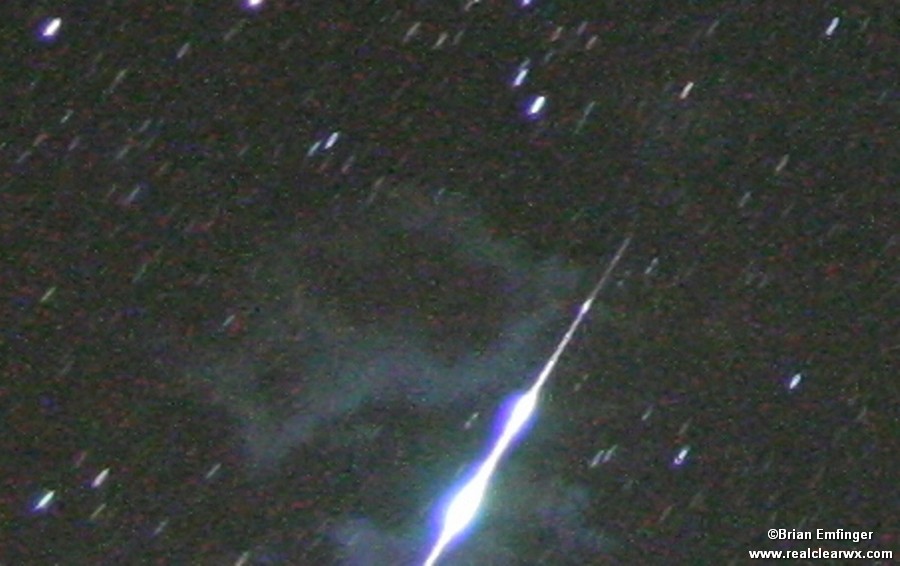
"I captured this fireball and its smoky trail with an ordinary digital camera," Emfinger said. "It was so bright!"
However, Bill Cooke of NASA’s Meteoroid Environment Office reminds us not to get too excited just yet. "We have just entered the outskirts of this dust trail. If you gaze at the night sky now, you might only see a few Perseids per hour," he said.
However, everything will change in August.
Earth will pass through the densest part of this dust trail sometime on August 12, at which point you can see dozens of meteors per hour.
The best plan for enjoying the meteor shower is: Spread a blanket on flat ground (Note: spreading a blanket on a road is definitely not a good idea), lie down, and simply look up at the sky. Perseid meteors can appear anywhere in the sky, but if you trace their paths backward, they will all converge at a single point in the constellation Perseus (the radiant). If possible, it is best to stay away from city lights.
However, on August 12, there will be some light you cannot avoid. A 55% gibbous moon (last quarter) will appear in the constellation Aries, adjacent to Perseus. The moon is beautiful, but don’t stare at it. Bright moonlight will ruin your night vision, making it impossible to see the faint meteors in the sky.
Nevertheless, the moon’s impact is not actually that large. Around August 11, between 9:00 PM and 11:00 PM, both the moon and Perseus will be low in the northeastern sky. This position reduces the moon’s interference while providing an ideal opportunity to view "earthgrazers."
"An earthgrazer is a meteor that comes from the horizon and skims through the atmosphere above the observer’s head," Cooke explained. "Their trails are long, their speed is slow, their colors are brilliant, and they are also the brightest." He cautioned that you might only encounter one earthgrazer per hour, but even just one is absolutely worth it.
For China, this year’s Perseid meteor shower can be observed over two consecutive early mornings. Observations can be made with the naked eye without the need for any instruments. The best observation times for various locations are from 2:00 AM on August 12 until dawn, and from midnight on August 13 until dawn.
On the morning of August 12, the sunrise time in Guangzhou is 06:02. The best observation direction for all regions is the morning sky to the east-northeast, and the best environment is a night sky where stars of magnitude 5 or brighter are visible. This year, August 12 corresponds to the 27th day of the sixth lunar month, and the moon phase will be a thin waning crescent, so moonlight will not have a significant impact on the observation. At that time, the morning sky will feature the waning crescent moon, the Morning Star (Venus), and Saturn (to the east of Venus) as our companions, making our meteor shower observation even more interesting and poetic.
Enjoy the upcoming Perseid meteor shower.
Beginner’s Guide: As mentioned above, although the Perseids may show some activity this year, I do not recommend staying up all night to watch them due to the relatively strong moonlight. If you wish to watch, the early morning of the 13th is more suitable; it is best not to look directly toward the moonlight. If you concentrate and the observation conditions are not too bad (e.g., don’t stay in the city), an average count of about a dozen meteors per hour is acceptable.
References:
Maslov, 2006.
IMO, 2008.
Lyytinen, 2000. WGN.
Scientific Principles of the Perseid Meteor Shower
The parent comet of the Perseid meteor shower is Comet Swift-Tuttle. The meteor shower occurs annually between July 17 and August 24, often with several peaks. The number of meteors during the peak period ranges from 100 to 160 per hour.
Comet Swift-Tuttle was discovered as early as 1862 and takes 130 years to orbit the Sun once. When Earth passes through the dense debris zone left by the disintegration of Comet Swift-Tuttle, hundreds of comet fragments strike Earth per hour, about a hundred of which streak through the atmosphere as meteors, forming the meteor shower. Because these meteors appear to fly from the direction of the constellation Perseus, they are called the "Perseid meteor shower."
The Perseids belong to a high-speed meteor group, with an average velocity of 59 kilometers per second, and 45% of them leave persistent trails. The brightness of the meteors is generally above second magnitude, similar to the stars of the Big Dipper. Occasionally, colorful fireballs appear, with brightness approaching that of Venus. Because there are many bright meteors, many can be seen even in urban areas with severe light pollution. In ideal observation areas, one might even see nearly a thousand meteors throughout the entire night.
This Year’s Meteor Shower as an Abnormal Outburst
The Perseid meteor shower had a major outburst in 1992, with the peak reaching 400 meteors per hour. In the following decade or so, no major peaks occurred. The orbital period of Comet Swift-Tuttle is about 130 years; as the comet gradually moves away from Earth, the probability of its orbital debris causing a meteor shower outburst also decreases significantly.
However, experts believe that this year’s meteor shower may experience an abnormal outburst, with the peak significantly higher than in previous years.
Finnish astronomer Esko Lyytinen and American astronomer Tom Van Flandern, through calculations, believe that Earth will pass through the trail left by Comet Swift-Tuttle’s 1862 return this year, making a brief, intense outburst possible.
The best observation points for this Perseid meteor shower are Eastern Europe, East North Africa, Central Russia, India, and Western China. Lyytinen stated: "According to our expectations, hundreds of meteors will appear per hour at the peak, but they will not be very bright."
When reposting, please include the original address: https://kexue.fm/archives/62
For more detailed reposting matters, please refer to: "Scientific Space FAQ"