Written by Stephen Battersby Compiled by Shea
How many planets are there in the solar system? The official answer is eight—unless you happen to live in the U.S. state of Illinois. In early 2009, the "defiant" Illinois state government declared that the International Astronomical Union (IAU), which sets the standards for "planets," had actually unfairly stripped Pluto of its "planet" title.
Three years ago, the IAU decided to draft the first scientific definition for the word "planet."
After several days of heated debate at the IAU General Assembly held in Prague, the capital of the Czech Republic, delegates voted to pass a definition of a planet. According to this definition, Pluto was excluded from the ranks of planets and demoted to a "dwarf planet."
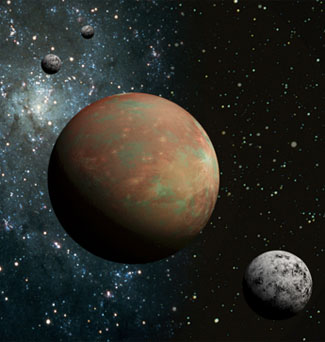
This resolution was met with opposition from many people who grew up with the "nine planets," and some astronomers also expressed dissent, as only 4% of the IAU’s 10,000 members participated in the vote. The Illinois government believed the resolution slighted Pluto’s discoverer, Clyde Tombaugh, who was born in that state.
In early August 2009, the IAU will hold its first general assembly in Rio de Janeiro, Brazil, since Pluto’s demotion. Surprisingly, IAU President Karel van der Hucht does not wish for anyone to challenge the resolution made in Prague. However, Pluto "fans" need not lose heart, as the voice of opposition remains strong.
If Pluto is to be "restored," it may be due to new discoveries rather than arguments. Mark Sykes of the Planetary Science Institute in the U.S. believes that as our understanding of the solar system and other planetary systems deepens, the IAU’s controversial definition of a planet will one day become a thing of the past.
"We are in the midst of a conceptual revolution," he says. "Eventually, we will move away from the idea of planets as special objects in the sky—and because of that, they don’t necessarily have to be few in number."
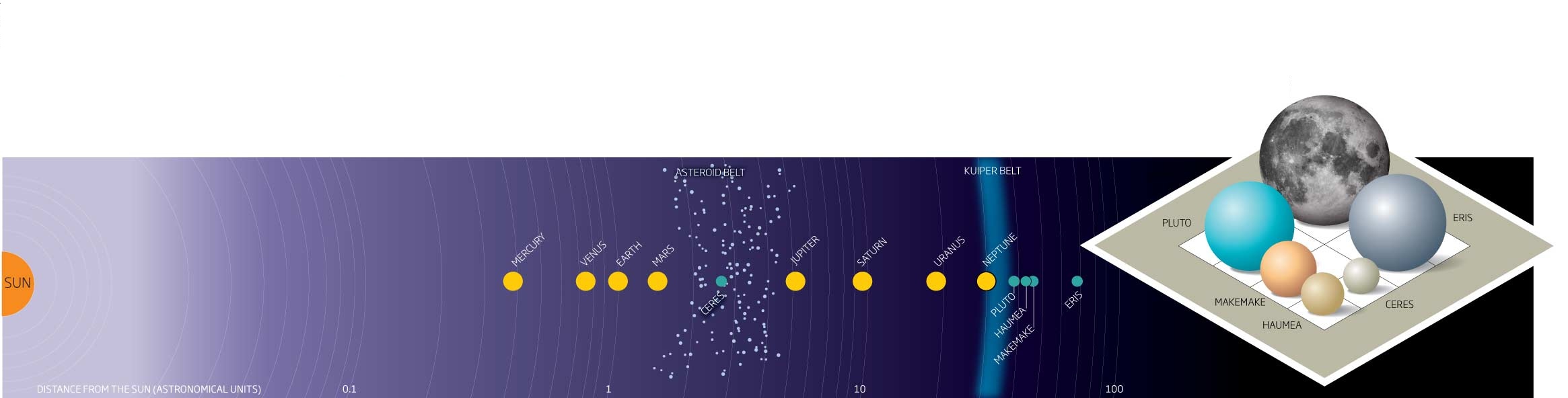
Sykes believes that exploration missions to Pluto and Ceres (located between Mars and Jupiter) will reveal these dwarf planets to be vibrant and complex worlds. At the same time, astronomers may discover Earth-sized objects elsewhere in the universe that, according to the IAU definition, could not be called "planets."

Sykes and some other astronomers prefer a simple, generalized definition of a planet: if an object is large enough to be spherical under its own gravity, then it should be called a "planet." This would make Pluto a planet again, while Ceres and many other objects would also join the planetary ranks.
The IAU’s initial proposed definition was similar to this, but it faced opposition in Prague. Critics pointed out that Pluto is just one member of the Kuiper Belt—a collection of many small icy bodies beyond Neptune’s orbit. Under this simple definition, many Kuiper Belt objects would become planets. The assembly was eventually persuaded to add a condition: a planet must be able to eject or absorb neighboring small bodies. In other words, a planet must "clear the neighborhood around its orbit." Consequently, only the eight planets from Mercury to Neptune satisfy this criterion.
This is also the crux of the controversy. "This is a terrible mistake," says Alan Stern of the Southwest Research Institute, who leads NASA’s "New Horizons" mission to Pluto. "Any definition of a planet that depends on the object’s location is unworkable. If you put Earth in Pluto’s orbit, it would instantly cease to be a planet."
Although Earth’s gravity could easily clear small bodies within a relatively small range around us, two factors determine that Earth would be unable to do so if placed in Pluto’s orbit: first, the outer solar system is vast; second, objects there move very slowly. According to Sykes, for an object as small as Earth, even 4.5 billion years might not be enough to clear that region.
Strange Celestial Bodies
Some astronomers believe that the puzzling mystery of the Kuiper Belt’s formation may indicate the existence of a yet-to-be-discovered object larger than Mars. Sykes says such an object would definitely qualify as a "planet." If this hypothesis is correct, this icy body would embarrass the IAU definition, as it clearly has not cleared the area around its orbit.
Gonzalo Tancredi of the University of the Republic in Uruguay, one of the winners in Prague, disagrees. He says a Mars-sized object could clear a tube-shaped region in the Kuiper Belt. But is this enough to qualitatively define "clearing its surrounding area"? Both sides hold their ground. So why not leave this question to the IAU assembly in early August? Stern believes doing so would only make things worse. "The IAU is not the right place to discuss this. They are very good at making simple things complicated," he says. He also believes the word "planet" will evolve naturally: "There are no police in science. People will decide what is right, and practice will solve the problem."
To this end, Pluto fans may not have to wait long. In 2015, we will get a close-up look at this controversial icy world. When NASA’s "New Horizons" probe reaches Pluto, Stern expects it to discover complex terrain and an active atmosphere. Through observations of Pluto’s atmosphere refracting background starlight, we already know that Pluto’s atmosphere expands and contracts with the seasons and is disturbed by large-scale electromagnetic waves.
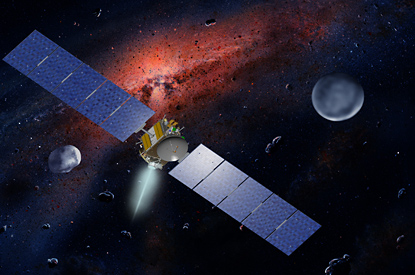
Later that same year, NASA’s "Dawn" probe will arrive at Ceres. Infrared spectra of Ceres show that part of its surface is covered by clay, a sign of ongoing geological activity. Clay on Earth is formed by hot water flowing through rock. Sykes expects to find geological activity on Ceres driven by a moving ice mantle. "We are going to discover worlds that are vastly different from asteroids," Sykes says.
Will this change people’s attitudes? Jack Lissauer of NASA’s Ames Research Center says it will ultimately come down to psychology: "Neither side of the conflict can produce a fundamental argument, and because there are so many disputes, there will ultimately be no real winner."
Although Lissauer is not a staunch supporter of the IAU resolution, he is also not fond of other definitions. He says: "Being spherical is not a good criterion. It creates many intermediate cases, as many objects will appear roughly spherical."
With new discoveries accelerating, perhaps now is not the best time to seek a new definition. Beyond the solar system, other debates are also brewing. For example, what kind of extrasolar planet can be called a "Super-Earth"? Furthermore, is there a clear dividing line between gas giants and brown dwarfs?
Meanwhile, for our "backyard," Sykes has an even more radical suggestion. If the simple "spherical" definition is extended, should we reclassify the Moon and other large satellites of planets? "We have stars orbiting other stars, so why can’t planets orbit other planets?" he asks.
This seems unlikely, but who knows? Perhaps the debate surrounding Pluto will eventually bring us unexpected results. Just as in ancient Greek times, will the Moon once again become a planet?
International Astronomical Union (IAU) Resolution: Definition of a Planet in the Solar System
Modern observations are changing our understanding of planetary systems. The naming of celestial bodies should reflect this latest knowledge, particularly regarding the term "planet." The word "planet" originally described "wanderers," known then only as moving points of light in the sky. Recent discoveries enable us to create a new definition using the scientific information now available.
Resolution 5A
The IAU therefore resolves that planets and other bodies in our Solar System be defined into three distinct categories in the following way:
(1) A planet (Note 1) is a celestial body that:
is in orbit around the Sun,
has sufficient mass for its self-gravity to overcome rigid body forces so that it assumes a hydrostatic equilibrium (nearly round) shape, and
has cleared the neighbourhood around its orbit.
(2) A "dwarf planet" is a celestial body that:
is in orbit around the Sun,
has sufficient mass for its self-gravity to overcome rigid body forces so that it assumes a hydrostatic equilibrium (nearly round) shape (Note 2),
has not cleared the neighbourhood around its orbit, and
is not a satellite.
(3) All other objects (Note 3) orbiting the Sun shall be referred to collectively as "Small Solar System Bodies."
Note 1: The eight planets are: Mercury, Venus, Earth, Mars, Jupiter, Saturn, Uranus, and Neptune.
Note 2: An IAU process will be established to assign borderline objects into either dwarf planet or other categories.
Note 3: These currently include most of the Solar System asteroids, most Trans-Neptunian Objects (TNOs), comets, and other small bodies.The IAU further resolves:
Pluto is a "dwarf planet" by the above definition and is recognized as the prototype of a new category of Trans-Neptunian Objects.
When reposting, please include the original address: https://kexue.fm/archives/43
For more detailed reposting matters, please refer to: Scientific Space FAQ