Continuing Observations of the
International Space Station
Translated by DeepSeek V4 Pro. Translations can be inaccurate, please refer to the original post for important stuff.
Su JianlinJuly 29, 2009#41
If you see a
bright star moving in the night sky, you might guess it is an airplane.
However, please add another hypothesis: it might just be the
“International Space Station (ISS)”!
I previously published a post about observing the International Space
Station at https://kexue.fm/archives/14.
However, that post focused more on the translation of an article; this
time, I am introducing the actual observation of the space station.
To observe it, you first need to know when
the ISS will pass over your head and how long it will stay; otherwise,
it is all just talk!
Below is the position map of the International Space Station
(refresh to see the latest, click for a larger image):
To accurately find the time it passes over your area, you first need
to know the latitude and longitude of your location. Many websites
currently provide this query, for example: http://astro.lady.qq.com/a/20050616/000062.htm
By checking, I found that my location (Xinxing, Yunfu, Guangdong) is
at 22.68N, 112.2E.
Generally speaking, you only need to modify the latitude and
longitude, while &tz=ChST
represents China Standard Time!
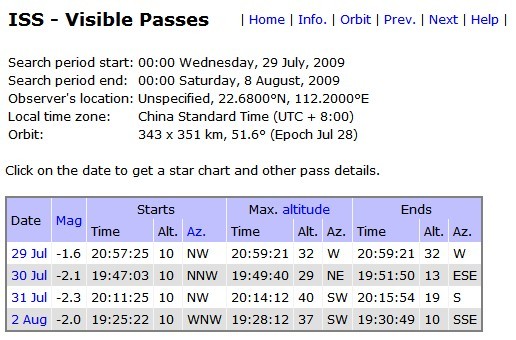
After modification, click to open, and we can
see:
This includes the appearance time,
disappearance time, direction, brightness (around -2, which is quite
bright), and so on.
Alright, you can bring your
telescope and camera now and prepare for action! However, the appearance
time is short, so you must be quick when observing!
Appendix: Solar Transit of the International Space Station
and Space Shuttle:
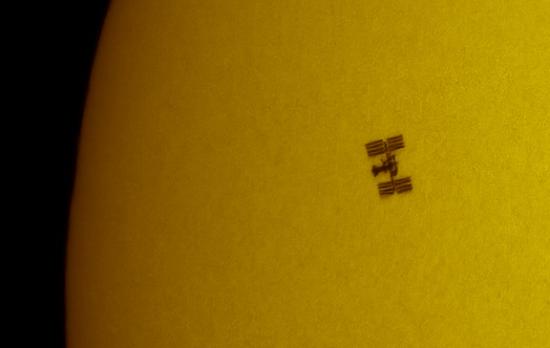
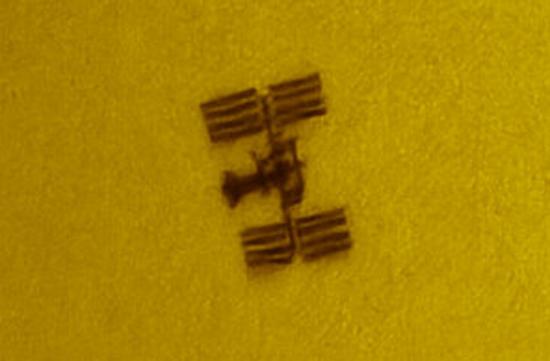
According to the US “Wired” magazine website, a French photographer
recently captured a spectacular image of the US Space Shuttle
“Endeavour” transiting the Sun after docking with the International
Space Station.
You might not be able to take such a photo with your digital camera,
because Thierry Legault, a French photographer and amateur astronomer
known for his astronomical photos, captured this spectacular scene
through a special solar filter, and he is a leader among
photographers.