Long, long ago, there was a vast country named the Universe. It had countless citizens, among whom was a large family called “Light.” These citizens, “Light,” were not bound by any human laws, but they were restricted by three “laws”: the Law of Rectilinear Propagation, the Law of Reflection, and the Law of Refraction.
The Law of Rectilinear Propagation of Light
We already know that in a uniform medium, the propagation path of light is a straight line. This is a conclusion summarized from human practice, and the definition of a straight line itself arose from optical observations. Under the illumination of a point light source, the shadow of an object is equivalent to a geometric projection made with straight lines.
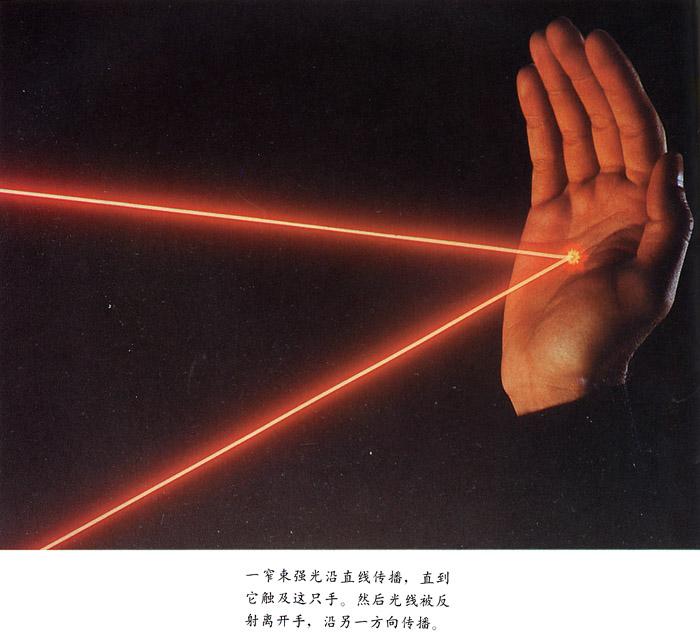
However, “Light” is a bit cunning; it does not always obey the Law of Rectilinear Propagation. Because this fellow “Light” is somewhat special, it possesses both particle and wave properties. When we force “Light” to pass through a hole with a very small diameter, this citizen reveals its “wave” nature and is no longer constrained by this law. If we use a hole with a diameter of 1/100 mm for pinhole imaging, we can only see a blurred image. If the diameter is below 1/2000 mm, an image can no longer be formed. Light has successfully gone on strike!
[Click to view GIF: Pinhole Imaging]
![[Click to view GIF: Pinhole Imaging]](https://kexue.fm/usr/uploads/2009/07/20090723124655.gif)
The Law of Reflection of Light
In the kingdom of the Universe, interactions between citizens are inevitable. When “Light” encounters a “mirror,” it must follow the “Law of Reflection.” In fact, any object that can reflect light can be called a “mirror.” Clearly, the social circle of “Light” is quite broad.
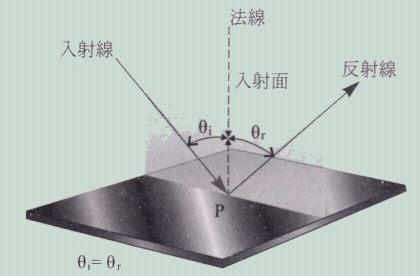
The content of the Law of Reflection is as follows: 1. The incident ray, the reflected ray, and the normal lie in the same plane, and the incident ray and the reflected ray are on opposite sides of the normal; 2. The angle of reflection equals the angle of incidence. Under the same conditions, if a light ray is incident along the path of the original reflected ray, it will be reflected along the path of the original incident ray; this is known as the “reversibility of light.” Diffuse reflection, like specular reflection, strictly follows this law; it is just that the interface of diffuse reflection is composed of many “mirrors” with different normal directions, resulting in irregular reflected rays.
However, the relationship between different “mirrors” and “Light” varies. Some get along better, while others may clash. For example, when light meets glass, they become very friendly: 96% of the light is willing to coexist with the glass, and only 4% is rejected at the door and reflected away. On the other hand, the citizen named Aluminum appears quite unfriendly; when light meets it, less than 10% of the light is willing to associate with it, while the remaining 90% is rejected. This involves a concept called “reflectivity,” which is the ratio of the reflected light intensity to the incident light intensity. Perhaps in this kingdom, different substances have different identities; noble figures like Aluminum are beyond the reach of many.
The Law of Refraction of Light
This is another “law” that light must obey, a weapon for light to “venture into the world.” When light enters another uniform medium of different density from one uniform medium, the path of light will deflect. As for how much it deflects and how it deflects, it depends on the degree of friendliness between the light and the medium.

The Law of Refraction states: 1. The refracted ray lies in the plane determined by the incident ray and the normal, and the refracted ray and the incident ray are on opposite sides of the normal; 2. The ratio of the sine of the angle of incidence to the sine of the angle of refraction is a constant for two given media; this constant is equal to the ratio of the speed of light in the first medium to that in the second medium.
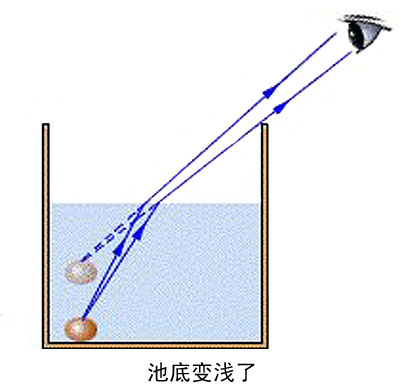
We can take an example: the speed of light in air is approximately 3 \times 10^8 m/s, while the speed in water is approximately 2.24 \times 10^8 m/s. If light enters from air at an angle of approximately 45^\circ with the normal, and the angle of refraction is a, then we have:
\frac{\sin 45^\circ}{\sin a} = \frac{3 \times 10^8}{2.24 \times 10^8} = 1.34
From this, it can be calculated that a = 31.9^\circ.
Summary
It can be seen that no matter where or what it is, matter will be subject to certain constraints, and such constraints are the very foundation of creating the universe.
Please include the address of this article when reprinting: https://kexue.fm/archives/29
For more detailed reprint matters, please refer to: Scientific Space FAQ