Sina Technology News, early morning of July 18. According to the Daily Mail, we might think the Sun is spectacular, but compared to the red supergiant Antares burning over 600 light-years away, it appears pale and weak.
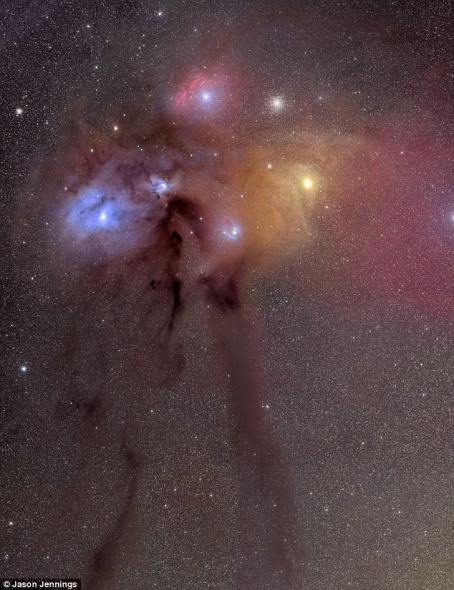
In this beautiful image, Antares emits an orange glow, surrounded by gas and dust reflecting bright yellow. Antares is a giant in the Milky Way, with a diameter 800 times that of our Sun and a luminosity 10,000 times greater than the Sun.
Antares is the king of the Rho Ophiuchi cloud complex, which is considered by many astrophotographers to be the most beautiful region in the night sky.
The Rho Ophiuchi cloud complex features dazzling nebulae. The yellow reflection nebula around Antares and the red regions in the image are formed by hydrogen gas in the glowing red nebula. The blue reflection nebula on the left side of the image surrounds the Rho Ophiuchi triple star system; the blue color is the result of nearby stars illuminating interstellar dust. The image also contains oddly shaped dark nebulae, such as the “Pipe Nebula,” which appears inverted to the left of Antares.
Additionally, there is a “Dark River” flowing along the bottom of the image. This is composed of hydrogen gas and thick dust clouds that absorb background starlight. Although this “Dark River” is 500 light-years from Earth, the globular cluster M4, shimmering with white light above Antares, is 7,000 light-years away. It is one of the largest clusters in the Milky Way, consisting of more than 10,000 stars.
This beautiful image is a mosaic of 8 photos spanning 10 degrees across the sky. It is located in the constellation Scorpius; if you live in the Northern Hemisphere, you can see it in the southern sky near the horizon. It was captured by Australian astrophotographer Jason Jennings over four different days within three months. Using an astronomical camera worth £5,400 designed for wide-field spatial imaging, the total exposure time was 8 hours. (Yang Xiaowen)
When reprinting, please include the address of this article: https://kexue.fm/archives/24
For more detailed reprinting matters, please refer to: Scientific Space FAQ