Predicting celestial phenomena is generally only a matter for professional astronomical researchers; we amateurs usually just look up relevant information. However, since the advent of the computer (PC), it is entirely possible for individuals to predict celestial phenomena. Now, I am publishing an article about the “Total Solar Eclipse” that I wrote over a month ago, teaching everyone how to use Stellarium to accurately predict the celestial conditions in their own location. Now, let us be astronomers for once.
Content:
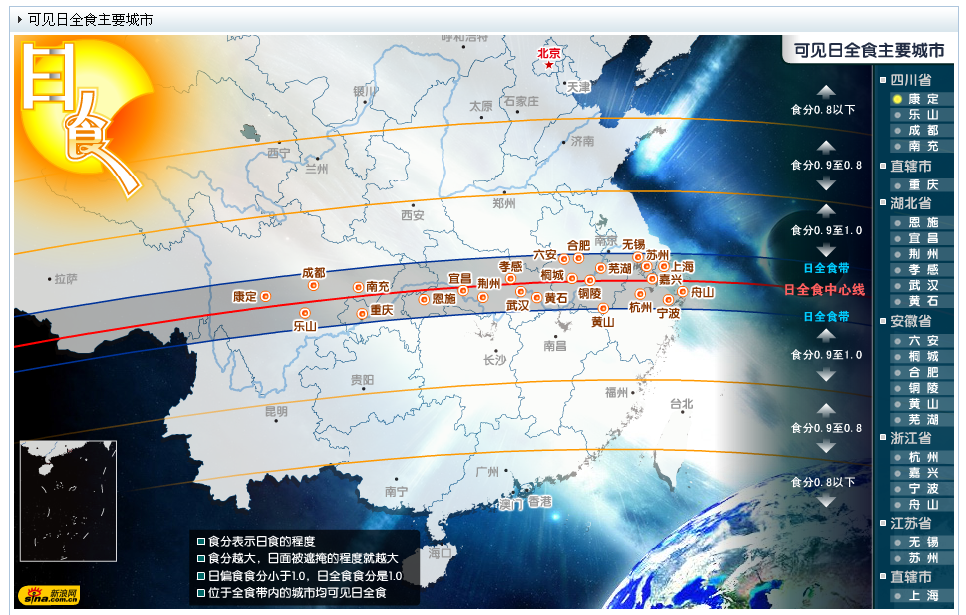
As the International Year of Astronomy, 2009 is a very meaningful year. For China, the significance is even more profound. Because on July 22, 2009, China will witness an unprecedented spectacle of a total solar eclipse!
The Scene:
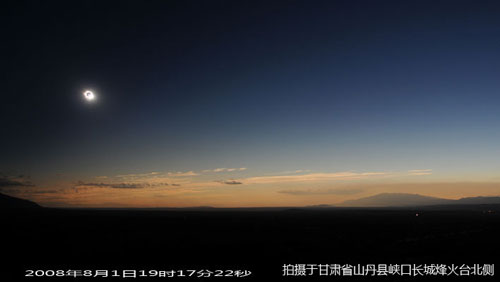
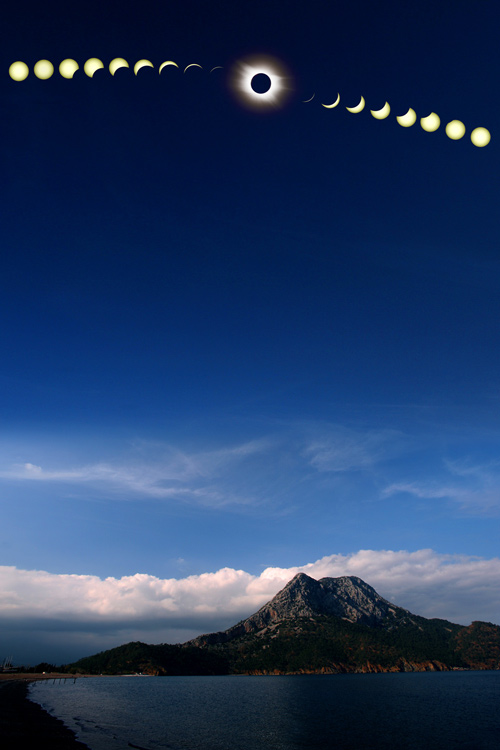
When the Moon moves between the Sun and the Earth, if the Moon happens to block the light of the Sun, then a gap appears in the Sun as seen from Earth, or it may even disappear entirely. This is a solar eclipse.
The universe is extremely friendly to the Earth. She not only created the rich and colorful life on Earth but also ingeniously gave us the spectacle of a total solar eclipse. The diameter of the Sun is about 400 times that of the Moon, and the distance from the Earth to the Sun is also exactly 400 times the distance from the Earth to the Moon. Thanks to nature’s craftsmanship, we are able to see this wonder. On Mars or other planets, this is something one wouldn’t even dare to dream of. However, for Earth, this exact ratio has also become an unsolved mystery.
For specific details, please download the Doc document: Click to download this file
Reports regarding the solar eclipse:
When reposting, please include the original address of this article: https://kexue.fm/archives/16
For more detailed reposting matters, please refer to: Scientific Space FAQ