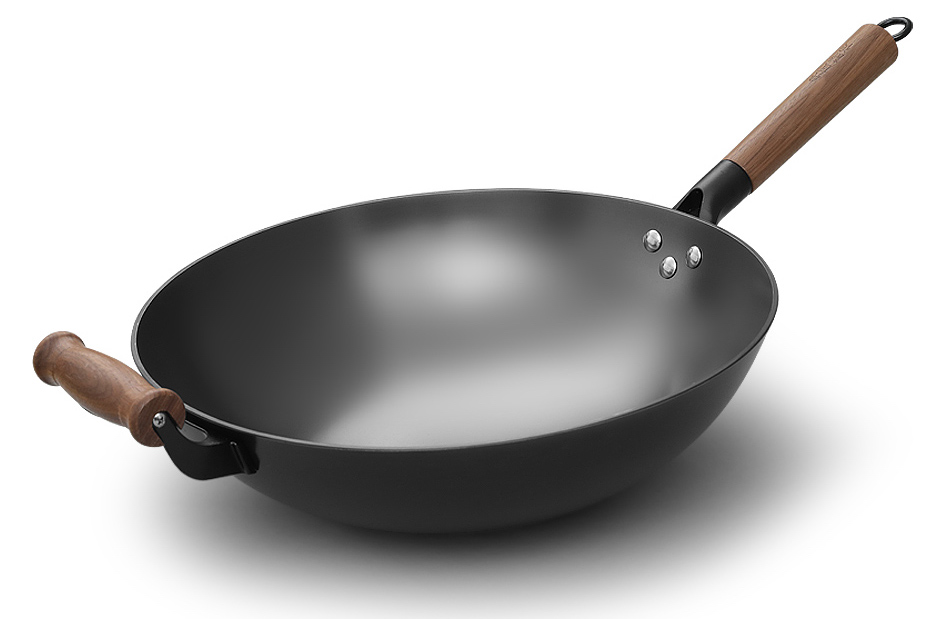
Many friends who enjoy cooking have likely struggled with one thing: the choice of a wok.
The dilemma regarding woks ultimately boils down to a trade-off between non-stick properties and convenience. The simplest non-stick pan is, of course, the one with a non-stick coating. If your only heat source at home is an induction cooker and your cooking habits are relatively gentle, then a coated non-stick pan is often the best choice. However, once you have a gas stove with an open flame, or if you prefer high-heat stir-frying, a coated pan might not be so suitable. After all, at excessively high temperatures, there is always a risk of the coating peeling off. In such cases, one generally considers uncoated non-stick pans.
There are various choices for uncoated non-stick pans, such as simple iron pans, stainless steel pans with honeycomb patterns, titanium-clad pans, pure titanium pans, and so on, with prices generally increasing accordingly. However, in the end, I believe most people will return to the humble iron pan.
The iron pan was the original choice to begin with. But since new options like stainless steel and titanium pans appeared later, it means traditional iron pans have drawbacks that some find difficult to accept. Simply put, the disadvantage of the iron pan lies in the traditional usage tutorials that overemphasize “maintenance.” For example, you have to season the pan, dry and oil it after every use, avoid using it for soup, avoid washing it with detergent, and never put it in the dishwasher. If you use an iron pan under these cautious constraints, you have clearly strayed from the original intention of using one: it being “simple and durable.”
Note that what I am referring to here are the traditional “usage tutorials”—it is a problem with the traditional tutorials, not the iron pan itself. It is not necessarily true that just because something has been passed down from our ancestors, it must be correct. Habits like drying and oiling after use, not cooking soup, and not using detergent indeed help the iron pan form an oil film to achieve non-stick properties, but they also cause us to carry a bit of “aged oil” into every dish we cook, which does not seem like a healthy choice.
In fact, even without initial seasoning and even if you clean it thoroughly after every use, an iron pan can still achieve a non-stick effect; it does not necessarily require the cultivation of a years-old oil film. The trick to making it non-stick is very simple. Before cooking each time, perform these three steps:
Turn on the heat and do not add oil yet. Heat the iron pan thoroughly. The purpose of this step is to let the iron molecules expand with heat and dry out any moisture. Even if the surface of the pan looks dry, moisture may remain between the molecular gaps. Therefore, whether the pan is dry or wet, it must be heated thoroughly.
Add oil and coat the pan well. The purpose of this step is to use the cooking oil to fill the gaps created by the thermal expansion of the iron molecules, making it impossible for the ingredients to enter these gaps and cause sticking.
If you add the ingredients directly at this point, they might not stick, but because the temperature is very high, they are likely to burn (note that “sticking” and “burning” are not the same thing). At this stage, there are two options: 1) In a restaurant, they usually pour out the hot oil and add fresh cool oil before adding the ingredients; 2) At home, you can simply turn off the heat and wait for a minute before adding the ingredients.
These three steps are essentially the same as the “seasoning” process for a new pan. In other words, the fundamental method for making an iron pan non-stick is to perform a simple seasoning every time you use it, rather than so-called maintenance. In fact, most people who have cooked for a long time should vaguely know these three steps. Perhaps they cannot summarize them as steps one, two, and three or explain the principles, but they intuitively know how to operate to make the pan less sticky.

Once you understand the principle of why iron pans are non-stick, the drawbacks are resolved. It doesn’t matter how you use it or how you wash it. So, as the relatively cheapest option, what reason is there not to use an iron pan? Therefore, as the title of this article suggests, “the ultimate destination of woks is the iron pan.” Simply choose an iron pan and focus more energy on other aspects of your culinary skills. By the way, I recommend choosing one with a handle. Even if you don’t toss the food, you occasionally need to shake the pan, and a handle is clearly more convenient. Just choose a regular round wooden handle; I do not recommend choosing handles with strange shapes or materials claimed to be “ergonomic.”
Compared to the non-stick nature of woks, what I actually want to complain about more is: everyone is flocking to research non-stick woks, but why is no one researching non-stick spatulas? Sometimes when frying an egg or a fish, if you don’t toss the pan but use a spatula to flip it, the pan often doesn’t stick, but the food sticks all over the spatula, resulting in a broken mess. From this, it is evident that among those who research cookware, very few might actually know how to cook.
When reposting, please include the original address of this article: https://kexue.fm/archives/9855
For more detailed reposting guidelines, please refer to: Scientific Space FAQ