The typical use of BERT involves loading its pre-trained weights, attaching a few new layers, and then fine-tuning it on downstream tasks. In other words, the standard usage is supervised training. Based on this workflow, we can perform Chinese word segmentation, NER, and even syntax analysis—tasks that most people have likely heard of, if not implemented. However, it might come as a surprise and pique your interest to learn that one can perform word segmentation and even extract syntactic structures directly from a pre-trained BERT model without any fine-tuning.
This article introduces the ACL 2020 paper “Perturbed Masking: Parameter-free Probing for Analyzing and Interpreting BERT”. It provides a method for analyzing and interpreting BERT using the Masked Language Model (MLM). By leveraging this approach, we can achieve unsupervised word segmentation and syntax analysis.
Correlation Matrix
It is recommended to read this article in conjunction with the following posts: “Chinese Word Segmentation Series: 2. New Word Discovery Based on Segmentation”, “Principle of Minimum Entropy (II): Lexicon Construction by ’Decisive Action’ ”, and “Principle of Minimum Entropy (III): Sentence Templates and Language Structure by ’Flying Elephant Across the River’ ”. These articles primarily introduce the key idea for unsupervised word segmentation and syntax analysis: Correlation Matrix.
token - token
Following the notation of the original paper, let the sentence to be analyzed be represented as a sequence of tokens \boldsymbol{x}=[x_1, x_2, \dots, x_T]. We need a T \times T correlation matrix \mathcal{F} that represents the correlation between any two tokens in the sentence. In the previously recommended articles, we used mutual information to measure this correlation. With the help of a pre-trained BERT model, we can propose a new measure of correlation.
Let H(\boldsymbol{x}) denote the output sequence of the BERT encoder for the sequence \boldsymbol{x}, where H(\boldsymbol{x})_i is the encoding vector corresponding to the i-th token. Additionally, \boldsymbol{x}\backslash \{x_i\} represents the sequence where the i-th token is replaced by \text{[MASK]}, and \boldsymbol{x}\backslash \{x_i, x_j\} represents the sequence where both the i-th and j-th tokens are replaced by \text{[MASK]}. Let f(x_i, x_j) denote the degree of dependence of the i-th token on the j-th token, or the “influence” of the j-th token on the i-th token. We define it as: f(x_i, x_j) = d\big(H(\boldsymbol{x}\backslash \{x_i\})_i, H(\boldsymbol{x}\backslash \{x_i, x_j\})_i\big) where d(\cdot, \cdot) is a vector distance. The original paper uses Euclidean distance, i.e., d(\boldsymbol{u}, \boldsymbol{v}) = \Vert \boldsymbol{u} - \boldsymbol{v} \Vert_2.
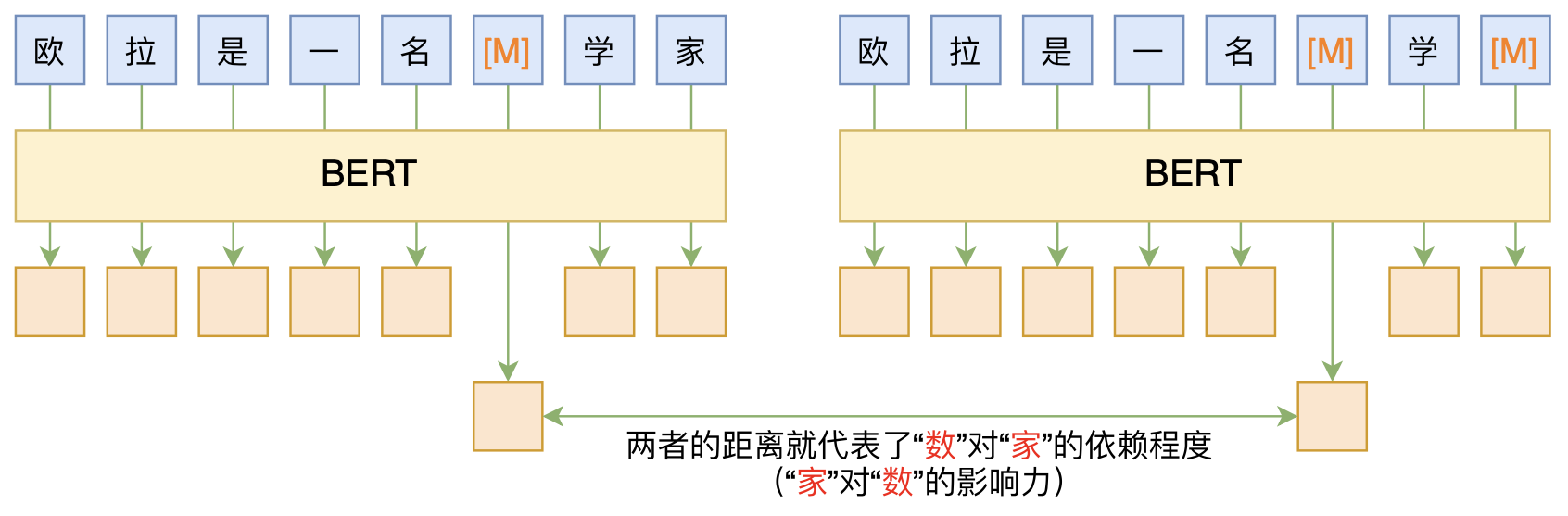
The intuition behind this definition is: in the MLM model, both H(\boldsymbol{x}\backslash \{x_i\})_i and H(\boldsymbol{x}\backslash \{x_i, x_j\})_i are features used to predict x_i. Following the intuition that “more masks lead to less accurate predictions,” we have reason to believe that H(\boldsymbol{x}\backslash \{x_i\})_i predicts x_i more accurately than H(\boldsymbol{x}\backslash \{x_i, x_j\})_i. Since H(\boldsymbol{x}\backslash \{x_i, x_j\})_i removes the information of x_j compared to H(\boldsymbol{x}\backslash \{x_i\})_i, the distance between the two can represent the “influence” of x_j on x_i.
Note 1: The original paper provides another way to define f(x_i, x_j), but the explanation is vague, and I find that method less reasonable, so I will not introduce it here.
Note 2: Readers might think of directly using the Self-Attention matrix from BERT as the correlation. However, this is not ideal: first, BERT has many layers, each with its own attention matrix, and it is unclear which one is best; second, the article “Google’s New Work Synthesizer: We Don’t Know Self-Attention Well Enough” tells us that the attention matrix might not work as we imagine, and the values within it are not necessarily correlations.
span - span
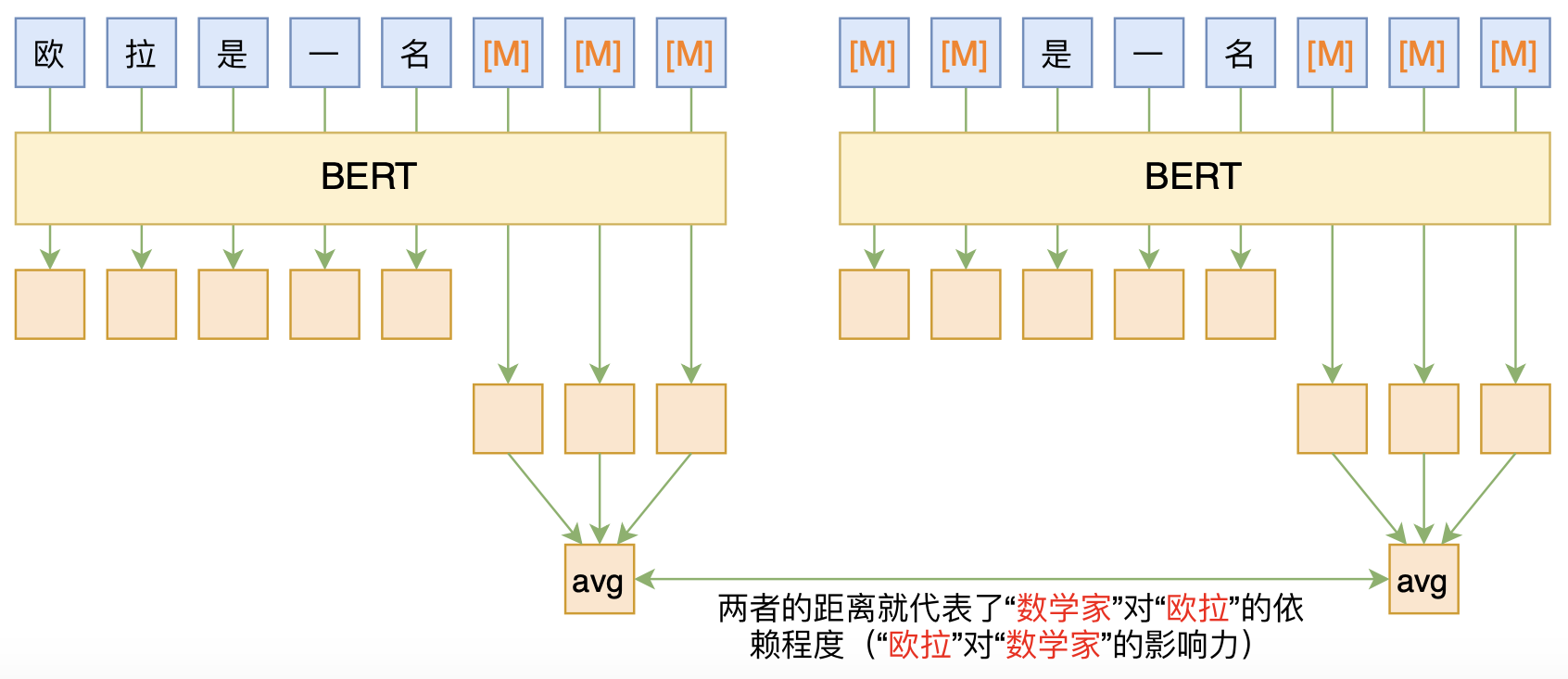
Of course, we do not necessarily have to use tokens as units. For instance, in syntax analysis, we usually work with words. Since BERT’s input is still tokens, we need to group tokens into several spans, i.e., D=[e_1, e_2, \dots, e_N], where e_i=[x_1^i, x_2^i, \dots, x_{M_i}^i]. In this case, we need an N \times N correlation matrix, defined similarly to before: f(e_i, e_j) = d\big(H(D\backslash \{e_i\})_i, H(D\backslash \{e_i, e_j\})_i\big) Here, H(D\backslash \{e_i\})_i refers to the average of the M_i vectors output by BERT corresponding to e_i.
Language Structure
Once we have this correlation matrix, we can perform many tasks, such as word segmentation and syntax analysis. On one hand, BERT’s MLM model provides a way to perform unsupervised word segmentation and parsing; on the other hand, these reasonable unsupervised results conversely demonstrate the rationality of BERT itself. This is why the authors titled their paper “Analyzing and Interpreting BERT.”
Chinese Word Segmentation
As a basic verification, we can try using it for unsupervised Chinese word segmentation. This part is my own experiment and does not appear in the original paper, likely because the paper’s experiments were on English data, while word segmentation is a task with more “Chinese characteristics.”
In fact, once the correlation matrix is available, word segmentation becomes a natural application. Similar to the methods in the “Chinese Word Segmentation Series,” we only need to consider the correlation between adjacent tokens. By setting a threshold, we can split two tokens if their correlation is less than the threshold and join them if it is greater than or equal to the threshold. This forms a simple word segmentation tool. In my experiments, I used \frac{f(x_i, x_{i+1}) + f(x_{i+1}, x_i)}{2} as the measure of correlation between adjacent tokens.
For specific details, please refer to the code: perturbed_masking/word_segment.py. Below is a demonstration of the results (translated from Chinese):
[’Xi Jinping’, ’General Secretary’, ’June’, ’8th’, ’went to’, ’Ningxia’, ’inspect’, ’research’, ’.’, ’That day’, ’afternoon’, ’, he successively’, ’arrived at’, ’Wuzhong’, ’City’, ’Hongsibao Town’, ’Hongde’, ’Village’, ’, Yellow River’, ’Wuzhong’, ’City urban section,’, ’Jinxing’, ’Town Jinhuayuan’, ’Community’, ’,’, ’understand’, ’local’, ’promote’, ’poverty’, ’alleviation’, ’,’, ’strengthen’, ’Yellow River Basin’, ’ecological’, ’protection’, ’,’, ’promote’, ’ethnic unity’, ’etc.’, ’situation’, ’.’]
[’E. coli’, ’is’, ’human and’, ’many’, ’animals’, ’intestinal’, ’tract in most’, ’main’, ’and quantity’, ’most’, ’of’, ’a type of’, ’bacteria’]
[’Su Jianlin’, ’is’, ’Scientific’, ’Spaces’, ’blogger’]
[’Jiuzhaigou’, ’National’, ’Nature’, ’Protection’, ’Zone’, ’located in’, ’Sichuan’, ’Province’, ’Aba Tibetan and Qiang’, ’Autonomous’, ’Prefecture’, ’Nanping County territory’, ’,’, ’distance’, ’Chengdu City 400+ km’, ’,’, ’is’, ’a’, ’depth’, ’40+ km’, ’mountain valley’, ’land’]
As we can see, the results are quite impressive. Although there are some minor errors, it is remarkable for a purely unsupervised segmentation algorithm. We can further control the granularity of segmentation by adjusting the threshold, or use it as a word discovery tool to improve segmentation quality (e.g., by counting segmentation results, filtering low-frequency words, and using the remaining words as a lexicon). It is worth noting that the above experiments used the original BERT base version released by Google, which does not incorporate word segmentation information (later WWM versions used word segmentation to construct masks). Thus, these results are truly unsupervised.
Syntax Analysis
Similar to the paper “ON-LSTM: Using Ordered Neurons to Express Hierarchical Structure”, the basic idea of unsupervised syntax analysis is to recursively divide \boldsymbol{x}=[x_1, x_2, \dots, x_T] into three parts: ((\boldsymbol{x}_{<k}), (x_k, (\boldsymbol{x}_{>k}))). This is somewhat like clustering, where \boldsymbol{x}_{<k} is one class and \boldsymbol{x}_{\geq k} is another. The clustering logic is to maximize intra-class correlation and minimize inter-class correlation. We can propose the following objective: \mathop{\text{argmax}}_k \underbrace{\frac{\sum_{i=1}^{k-1}\sum_{j=1}^{k-1} f(x_i, x_j)}{(k-1)^2}}_{\text{Intra-class}} + \underbrace{\frac{\sum_{i=k}^{T}\sum_{j=k}^{T} f(x_i, x_j)}{(T-k+1)^2}}_{\text{Intra-class}} - \underbrace{\frac{\sum_{i=1}^{k-1}\sum_{j=k}^{T} f(x_i, x_j)}{(k-1)(T-k+1)}}_{\text{Inter-class}} - \underbrace{\frac{\sum_{i=k}^{T}\sum_{j=1}^{k-1} f(x_i, x_j)}{(k-1)(T-k+1)}}_{\text{Inter-class}} where f(x_i, x_i) is defined as 0. This formula can be visualized as follows:
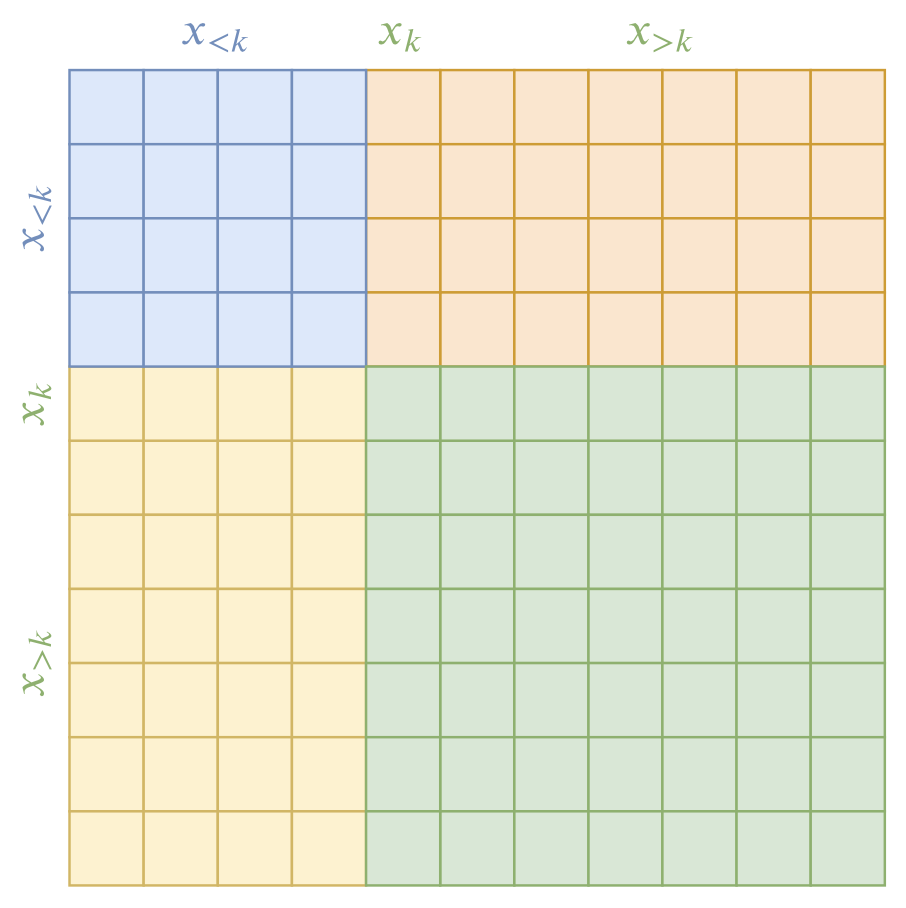
The goal of clustering is to make the mean of the red and green parts as large as possible, while the mean of the yellow and orange parts is as small as possible.

The results show that the hierarchical structure of the sentence is basically extracted. For implementation, please refer to: perturbed_masking/syntax_parsing.py. The original authors also open-sourced their code: Perturbed-Masking.
Summary
This article briefly introduced an ACL 2020 paper that proposes using BERT’s MLM model to calculate correlations between sentence components. Using these correlations, we can perform unsupervised word segmentation and syntax analysis. I have replicated this in Chinese using bert4keras, confirming the effectiveness of this approach.
Reprinted from: https://kexue.fm/archives/7476
For more details on reprinting, please refer
to: Scientific
Space FAQ