In NLP, we often need to compare the similarity of two sentences. The standard method is to find a way to encode the sentences into fixed-size vectors and then use a geometric distance (such as Euclidean distance, \cos distance, etc.) as the similarity measure. This approach is relatively simple and fast for retrieval, satisfying engineering requirements to a certain extent.
In addition, one can directly compare the differences between two variable-length sequences. For example, Edit Distance uses dynamic programming to find the optimal mapping between two strings and calculates the degree of mismatch. Nowadays, we have tools like Word2Vec and BERT that can convert text sequences into corresponding vector sequences. Therefore, we can directly compare the differences between these two vector sequences, rather than first condensing the vector sequences into a single vector.
The latter approach is relatively slower but allows for more fine-grained comparisons and is theoretically more elegant, thus having its own application scenarios. This article briefly introduces two similarity metrics belonging to the latter category, referred to as WMD and WRD.
Earth Mover’s Distance
The two metrics introduced in this article are both based on the Wasserstein distance. A brief introduction will be provided here; for related content, readers may also refer to the author’s previous work "From Wasserstein Distance and Duality Theory to WGAN". The Wasserstein distance is also vividly called the "Earth Mover’s Distance" (EMD), as its meaning can be intuitively expressed through a "dirt-moving" example.
Optimal Transport
Suppose at positions i=1,2,\dots,n, we have distributions of earth with quantities p_1,p_2,\dots,p_n. For simplicity, let the total amount of earth be 1, i.e., \sum p_i = 1. Now, we want to move the earth to positions j=1,2,\dots,n', where the required quantities are q_1, q_2, \dots, q_{n'}. The cost of moving earth from i to j is d_{i,j}. We seek the plan with the minimum cost and the corresponding minimum cost value.
This is a classic optimal transport problem. We denote the optimal plan as \gamma_{i,j}, representing the amount of earth moved from i to j in this plan. Obviously, we have the constraints: \sum_j \gamma_{i,j}=p_i,\quad \sum_i \gamma_{i,j}=q_j,\quad \gamma_{i,j} \geq 0 \label{eq:cond} Thus, our optimization problem is: \min_{\gamma_{i,j} \geq 0} \sum_{i,j} \gamma_{i,j} d_{i,j}\quad \text{s.t.} \quad \sum_j \gamma_{i,j}=p_i, \sum_i \gamma_{i,j}=q_j
Reference Implementation
Although it looks complex, a careful observation reveals that the
above formula is actually a linear
programming problem—finding the extremum of a linear function
under linear constraints. Since scipy comes with a linear
programming solver linprog, we can use it to implement a
function for calculating the Wasserstein distance:
import numpy as np
from scipy.optimize import linprog

def wasserstein_distance(p, q, D):
    """Solve Wasserstein distance via linear programming
    p.shape=[m], q.shape=[n], D.shape=[m, n]
    p.sum()=1, q.sum()=1, p in [0,1], q in [0,1]
    """
    A_eq = []
    for i in range(len(p)):
        A = np.zeros_like(D)
        A[i, :] = 1
        A_eq.append(A.reshape(-1))
    for i in range(len(q)):
        A = np.zeros_like(D)
        A[:, i] = 1
        A_eq.append(A.reshape(-1))
    A_eq = np.array(A_eq)
    b_eq = np.concatenate([p, q])
    D = D.reshape(-1)
    # Remove the last redundant constraint to avoid contradictions from float errors
    result = linprog(D, A_eq=A_eq[:-1], b_eq=b_eq[:-1])
    return result.fun
Readers may notice that when passing the constraints,
A_eq=A_eq[:-1], b_eq=b_eq[:-1] is used, which removes the
last constraint. This is because 1=\sum_{i=1}^n p_i = \sum_{j=1}^{n'} q_j,
so the equality constraints in [eq:cond] are
inherently redundant. In actual calculations, floating-point errors
might cause redundant constraints to contradict each other, leading to
failure in solving the linear program. Thus, removing the last redundant
constraint reduces the possibility of errors.
Word Mover’s Distance
Clearly, the Wasserstein distance is suitable for calculating the difference between two sequences of different lengths. When we perform semantic similarity tasks, two sentences are usually of different lengths, which perfectly matches this characteristic. Therefore, it is natural to think that the Wasserstein distance might be used to compare sentence similarity. The first attempt at this was the paper "From Word Embeddings To Document Distances".
Basic Form
Suppose there are two sentences s = (t_1,t_2,\dots,t_n) and s' = (t'_1, t'_2, \dots, t'_{n'}). After some mapping (such as Word2Vec or BERT), they become corresponding vector sequences (\boldsymbol{w}_1,\boldsymbol{w}_2,\dots,\boldsymbol{w}_n) and (\boldsymbol{w}'_1, \boldsymbol{w}'_2, \dots, \boldsymbol{w}'_{n'}). Now we find a way to use the Wasserstein distance to compare the similarity of these two sequences.
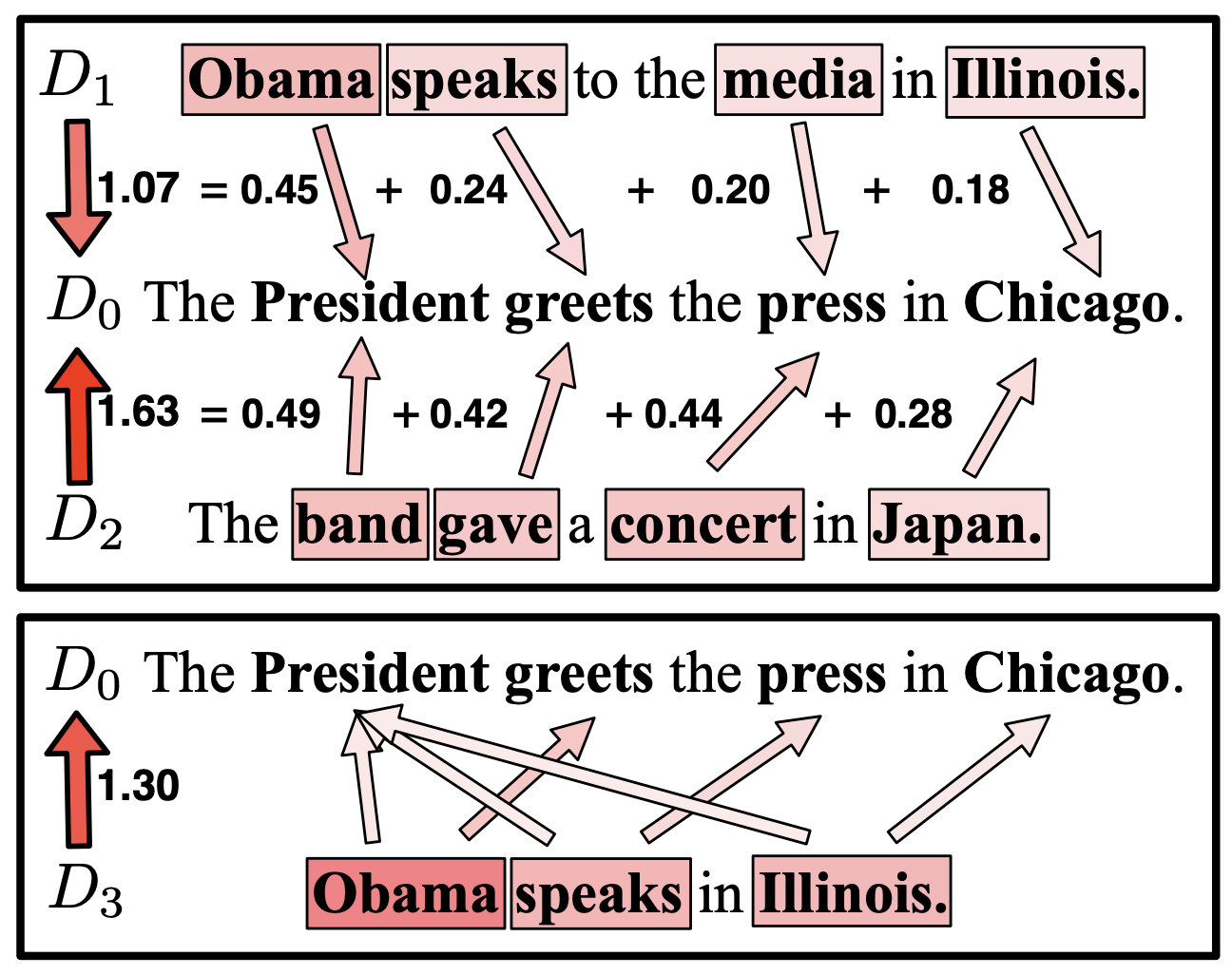
According to the previous section, the Wasserstein distance requires three quantities: p_i, q_j, d_{i,j}. We define them one by one. Since there is no prior knowledge, we can simply set p_i \equiv \frac{1}{n} and q_j \equiv \frac{1}{n'}. Now only d_{i,j} remains. Obviously, d_{i,j} represents some difference between the vector \boldsymbol{w}_i from the first sequence and the vector \boldsymbol{w}'_j from the second sequence. For simplicity, we can use the Euclidean distance \left\Vert \boldsymbol{w}_i - \boldsymbol{w}'_j\right\Vert. Thus, the degree of difference between the two sentences can be expressed as: \min_{\gamma_{i,j} \geq 0} \sum_{i,j} \gamma_{i,j} \left\Vert \boldsymbol{w}_i - \boldsymbol{w}'_j\right\Vert\quad \text{s.t.} \quad \sum_j \gamma_{i,j}=\frac{1}{n},\sum_i \gamma_{i,j}=\frac{1}{n'} This is the Word Mover’s Distance (WMD). It can be understood as the shortest path to transform one sentence into another, and in a sense, it can also be seen as a smooth version of Edit Distance. In practice, WMD is usually calculated after removing stop words.
Reference Implementation
The reference implementation is as follows:
def word_mover_distance(x, y):
    """Reference implementation of WMD (Word Mover's Distance)
    x.shape=[m,d], y.shape=[n,d]
    """
    p = np.ones(x.shape[0]) / x.shape[0]
    q = np.ones(y.shape[0]) / y.shape[0]
    D = np.sqrt(np.square(x[:, None] - y[None, :]).sum(axis=2))
    return wasserstein_distance(p, q, D)
Lower Bound Formula
In a retrieval scenario, calculating WMD for an input sentence against every sentence in a database and then sorting them is computationally expensive. Therefore, we should try to reduce the number of WMD calculations, for example, by filtering out samples using simpler and more efficient metrics before calculating WMD for the remaining ones.
Fortunately, we can derive a lower bound formula for WMD, which the original paper calls Word Centroid Distance (WCD): \begin{aligned} \sum_{i,j} \gamma_{i,j} \left\Vert \boldsymbol{w}_i - \boldsymbol{w}'_j\right\Vert &= \sum_{i,j} \left\Vert \gamma_{i,j}(\boldsymbol{w}_i - \boldsymbol{w}'_j)\right\Vert\\ &\geq \left\Vert \sum_{i,j}\gamma_{i,j}(\boldsymbol{w}_i - \boldsymbol{w}'_j)\right\Vert\\ &= \left\Vert \sum_i\left(\sum_j\gamma_{i,j}\right)\boldsymbol{w}_i - \sum_j\left(\sum_i\gamma_{i,j}\right)\boldsymbol{w}'_j\right\Vert\\ &= \left\Vert \frac{1}{n}\sum_i\boldsymbol{w}_i - \frac{1}{n'}\sum_j\boldsymbol{w}'_j\right\Vert\\ \end{aligned} In other words, WMD is greater than the Euclidean distance between the average vectors of the two sentences. So, when retrieving sentences with small WMD, we can first use WCD to filter out sentences with large distances and then use WMD for the remaining ones.
Word Rotator’s Distance
WMD is actually quite good, but if one were to nitpick, some shortcomings can still be found:
1. It uses Euclidean distance as a measure of semantic gap, but experience from Word2Vec tells us that when calculating the similarity of word vectors, \cos is often better than Euclidean distance;
2. Theoretically, WMD is an unbounded quantity, which means it is not easy to intuitively perceive the degree of similarity, making it difficult to adjust the threshold for similarity.
To solve these two problems, a simple idea is to normalize all vectors by dividing them by their respective norms before calculating WMD, but this completely loses the norm information. A recent paper "Word Rotator’s Distance: Decomposing Vectors Gives Better Representations" cleverly proposed that while normalizing, the norm can be integrated into the constraints p, q, which forms WRD.
Basic Form
First, WRD proposes the view that "the norm of a word vector is positively correlated with the importance of the word" and validates this view through experimental results. In fact, this view is consistent with the author’s previously proposed simpler GloVe model; see "A More Unique Word Vector Model (V): Interesting Results". In WMD, p_i, q_j also represent the importance of a word in a sentence in some sense, so we can set: \begin{aligned} &p_i = \frac{\left\Vert \boldsymbol{w}_i\right\Vert}{Z}, &Z=\sum_{i=1}^n \left\Vert\boldsymbol{w}_i\right\Vert\\ &q_j = \frac{\left\Vert \boldsymbol{w}'_j\right\Vert}{Z'}, &Z'=\sum_{j=1}^{n'}\left\Vert\boldsymbol{w}'_j\right\Vert \end{aligned} Then d_{i,j} uses the cosine distance: d_{i,j}=1 - \frac{\boldsymbol{w}_i\cdot \boldsymbol{w}'_j}{\left\Vert\boldsymbol{w}_i\right\Vert\times \left\Vert\boldsymbol{w}'_j\right\Vert} Resulting in: \min_{\gamma_{i,j} \geq 0} \sum_{i,j} \gamma_{i,j} \left(1 - \frac{\boldsymbol{w}_i\cdot \boldsymbol{w}'_j}{\left\Vert\boldsymbol{w}_i\right\Vert\times \left\Vert\boldsymbol{w}'_j\right\Vert}\right)\quad \text{s.t.} \quad \sum_j \gamma_{i,j}=\frac{\left\Vert \boldsymbol{w}_i\right\Vert}{Z},\sum_i \gamma_{i,j}=\frac{\left\Vert \boldsymbol{w}'_j\right\Vert}{Z'} This is the Word Rotator’s Distance (WRD). Since the metric used is cosine distance, the transformation between two vectors is more like a rotation rather than a move, hence the name. Also, because it uses cosine distance, its result is within [0, 2], making it relatively easier to perceive the degree of similarity.
Reference Implementation
The reference implementation is as follows:
def word_rotator_distance(x, y):
    """Reference implementation of WRD (Word Rotator's Distance)
    x.shape=[m,d], y.shape=[n,d]
    """
    x_norm = (x**2).sum(axis=1, keepdims=True)**0.5
    y_norm = (y**2).sum(axis=1, keepdims=True)**0.5
    p = x_norm[:, 0] / x_norm.sum()
    q = y_norm[:, 0] / y_norm.sum()
    D = 1 - np.dot(x / x_norm, (y / y_norm).T)
    return wasserstein_distance(p, q, D)

def word_rotator_similarity(x, y):
    """1 - WRD
    x.shape=[m,d], y.shape=[n,d]
    """
    return 1 - word_rotator_distance(x, y)
Lower Bound Formula
Similar to WMD, we can also derive a lower bound formula for WRD: \begin{aligned} 2\sum_{i,j} \gamma_{i,j} \left(1 - \frac{\boldsymbol{w}_i\cdot \boldsymbol{w}'_j}{\left\Vert\boldsymbol{w}_i\right\Vert\times \left\Vert\boldsymbol{w}'_j\right\Vert}\right)&=\sum_{i,j} \gamma_{i,j} \left\Vert \frac{\boldsymbol{w}_i}{\left\Vert \boldsymbol{w}_i\right\Vert} - \frac{\boldsymbol{w}'_j}{\left\Vert \boldsymbol{w}'_j\right\Vert}\right\Vert^2 \\ &\geq \left\Vert \sum_{i,j}\gamma_{i,j}\left(\frac{\boldsymbol{w}_i}{\left\Vert \boldsymbol{w}_i\right\Vert} - \frac{\boldsymbol{w}'_j}{\left\Vert \boldsymbol{w}'_j\right\Vert}\right)\right\Vert^2\\ &= \left\Vert \sum_i\left(\sum_j\gamma_{i,j}\right)\frac{\boldsymbol{w}_i}{\left\Vert \boldsymbol{w}_i\right\Vert} - \sum_j\left(\sum_i\gamma_{i,j}\right)\frac{\boldsymbol{w}'_j}{\left\Vert \boldsymbol{w}'_j\right\Vert}\right\Vert^2\\ &= \left\Vert \frac{1}{Z}\sum_i\boldsymbol{w}_i - \frac{1}{Z'}\sum_j\boldsymbol{w}'_j\right\Vert^2\\ \end{aligned} The inequality is based on Jensen’s inequality (or a generalized version of the basic inequality). However, this part of the content did not appear in the WRD paper; it was supplemented by the author.
Summary
This article introduced two text similarity algorithms, WMD and WRD, both of which utilize the Wasserstein distance (Earth Mover’s Distance) to directly compare the differences between two variable-length vector sequences. While these similarity algorithms may lack efficiency, they are theoretically elegant and perform quite well, making them worth learning.
Original address: https://kexue.fm/archives/7388
For more details on reprinting, please refer to: "Scientific Space FAQ"