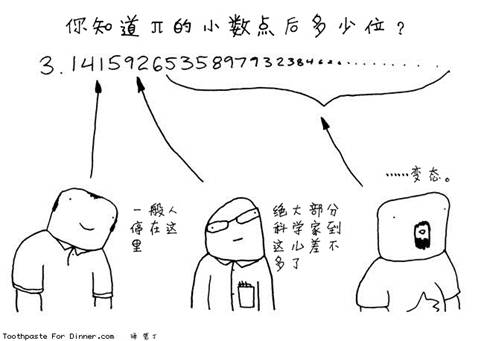
Today is March 14th, which happens to be 3.14—the "Pi Day" (\pi day) that many science students love to joke about.

Pi Day
There are many stories to tell about \pi. Using the "most beautiful formula" e^{i\pi}+1=0 to tell the story of \pi seems a bit too cliché and lacks technical depth. However, I believe the collection of formulas produced by the "prodigy" mathematician Srinivasa Ramanujan will never go out of style. For example:
\sqrt{\phi +2}-\phi =\frac{e^{{-{\frac{2\pi }{5}}}}}{1+{\frac{e^{{-2\pi }}}{1+{\frac{e^{{-4\pi }}}{1+{\frac{e^{{-6\pi }}}{1+\,\cdots }}}}}}}=0.2840...,\quad \phi=\frac{1+\sqrt{5}}{2}
Look, Euler’s formula connecting e, i, \pi, 1, 0 is nothing special; my formula connects e, \pi, and the golden ratio in the form of an infinite continued fraction!
Or another example: \frac{1}{\pi}=\frac{2\sqrt{2}}{99^2}\sum_{k=0}^{\infty}\frac{(4k)!}{(k!)^4}\frac{1103+26390k}{396^{4k}} Is it just a series for \pi? What’s the big deal? The amazing part is that if you take only the first term of this series, you get \pi=3.1415927..., which already provides 8 significant digits. With a bit more analysis, you’ll find that this series converges at a terrifying speed... In fact, it (and its variants) serves as the fundamental formula for modern computers to calculate billions of digits of Pi. (For related content, see Wikipedia).
An upgraded version derived by later mathematicians: \frac { 1 } { \pi } = \frac { 12 } { ( 640320 ) ^ { 3 / 2 } } \sum _ { k = 0 } ^ { \infty } \frac { ( 6 k ) ! ( 545140134 k + 13591409 ) } { ( 3 k ) ! ( k ! ) ^ { 3 } ( - 262537412640768000 ) ^ { k } } Its theoretical basis is: e^{\pi \sqrt{163}} \approx 640320^{3} + 744 By the way, e^{\pi \sqrt{163}} is also known as the "Ramanujan constant."
Ramanujan has many other spectacular formulas (see "How were those spectacular formulas of Ramanujan discovered?"), which feel like they could only be produced by someone with a "cheat code." Although many of these formulas might not have immediate practical value, many of them far exceed our imagination—and by "our," I don’t just mean ordinary people, but also many great mathematicians. For instance, G.H. Hardy commented on these formulas:
A single look at them is enough to show that they could only be written down by a mathematician of the highest class. They must be true because, if they were not true, no one would have had the imagination to invent them.
One must realize that coming up with a new formula for \pi or e is often a remarkable feat in itself. However, Ramanujan’s formulas usually blend \pi, e, and others in very bizarre ways within complex operations like series, radicals, and continued fractions—and yet, they happen to be correct! It’s no wonder Hardy evaluated them this way; ordinary people wouldn’t even dare to imagine such formulas.
Want another one? \begin{aligned}R_n^{+}:=& \frac{2}{\pi}\int_{0}^{\pi/2}\sqrt[2^{n+1}]{x^2 + \ln^2\!\cos x} \\ & \sqrt{\frac{1}{2}+\frac{1}{2}\sqrt{\frac{1}{2}+\cdots+\frac{1}{2}\sqrt{ \frac{1}{2}+ \frac{1}{2}\sqrt{ \frac{\ln^{2}\!\cos x}{ x^2 + \ln^2\! \cos x}}}}}\,\mathrm{d}x \\ R_n^{-}:=& \frac{2}{\pi}\int_{0}^{\pi/2}\frac{1}{\sqrt[2^{n+1}]{x^2 + \ln^2\!\cos x}} \\ & \sqrt{\frac{1}{2}+\frac{1}{2}\sqrt{\frac{1}{2}+\cdots+\frac{1}{2}\sqrt{ \frac{1}{2}+ \frac{1}{2}\sqrt{ \frac{\ln^{2}\!\cos x}{ x^2 + \ln^2\! \cos x}}}}}\,\mathrm{d}x. \end{aligned} Then we have R_n^{+}= \sqrt[2^n]{\ln 2} and R_n^{-}= \frac{1}{\sqrt[2^n]{\ln 2}}. Can you imagine such complex integrals having such simple results? (See "Ramanujan Log-Trigonometric Integrals").
Ten Years of Blogging
By the way, there is one more thing. After entering March, Scientific Space (Kexue.fm) officially entered its tenth year, which means I have been blogging for ten years.

Actually, I don’t remember exactly which day I started blogging, but it should have been in March 2009. Since today is Pi Day, let’s treat today as the anniversary!
I first came into contact with the internet in 2006. For the first three years, I was passionate about running IT forums (if interested, please see this article). Later, as the trend passed and IT forums gradually declined, along with some other reasons, I focused back on writing a blog. After all, a personal space is easier to control.
At the beginning, the focus was mainly on popular science. A popular blog at that time was "Songshuhui" (Science Squirrel Garden), and I was primarily inspired by them. Gradually, I focused on writing my own learning and research notes. The theme of Scientific Space has changed along with my interests: starting with astronomy, then mathematics and physics, and now mostly related to machine learning. This is how the current "mishmash" of 10 categories was formed.
In the past two years, probably because I’ve written more on machine learning topics and kept up with the trends, the blog’s popularity has increased. Currently, I average about one article per week, almost all of which are original, aiming to explain the principles of something in plain language. Although the themes of the articles have changed, I have not forgotten the original philosophy of the blog—"Cracking the nuts of science, making science popular." I hope to continue encouraging and moving forward with everyone.
Ten years is not a short cycle. During these ten years, while many things have come and gone, many websites have persisted. For example, the aforementioned Science Squirrel Garden is still updating and has developed platforms like "Guokr"; there is also the "Mathematics Research and Development Forum", which has existed for over ten years and remains active—it’s no exaggeration to say it is currently the most valuable mathematics forum. There are other websites as well that I can’t recall at the moment. Scientific Space has just reached its first decade; I hope to walk many more decades with you all.
Ten years later,
We are friends and can still say hello~
When reposting, please include the original link: https://kexue.fm/archives/6469
For more detailed reposting matters, please refer to: "Scientific Space FAQ"