Some time ago, Tianchi released an Astronomical Data Mining Competition — LAMOST Spectral Classification (identifying corresponding spectra into one of four categories). Although there was no prize money, I found it quite interesting, so I signed up. After working on it for a while, I felt my results were decent. However, in the end, I forgot (or rather, didn’t notice at all) that there was a step to submit new test set results in the last two days of the preliminary round. And then, there was no "then." I was left with an unfinished model; it could be said that I "died before the victory was won," and I was the one who caused it!

Later, I discussed it with other contestants and found that my model was actually quite good. I remember the top score in the preliminary round was 0.83+, while my score at the time was 0.82+, ranking around 4th or 5th. Moreover, it is said that many teams with scores above 0.8 had already used ensemble models, while my 0.82+ score was the result of just a single model. In daily group chats, I noticed many friends are working on 1D sequence classification models, and spectral classification is essentially a 1D sequence classification. Therefore, I am sharing the model, hoping it will be of some reference value to interested friends.
Model
In fact, it is not a particularly special model; it is just a standard 1D convolution plus residual connections. For friends familiar with image processing, this is a very common structure.


The form of each Conv1D Block is shown in the right figure. For specific parameters, please refer to the code below.
Principle
I would also like to mention why CNNs can be used here.
Features suitable for CNNs should satisfy local correlation, meaning that the associations between features are mainly reflected locally and extend from the local to the global level. Obviously, images and audio satisfy this characteristic, which is why current mainstream image and audio recognition models use CNNs.
As for spectral sequences, they are equivalent to a function graph (2600 points), as shown below. They also exhibit local correlation, so we use CNNs to solve it. Of course, using RNN models like LSTM is not impossible, but RNNs cannot be parallelized, which is unbearable for such long sequences. To use 1D convolution, we need to convert the sequence into a 2600 \times 1 format. Furthermore, we understand that the human eye identifies spectra by recognizing emission and absorption lines. Simply put, these are features with large differences. To identify such features, all our pooling operations use Max Pooling, and the activation function is only ReLU [since \text{relu}(x) = \max(x, 0)].
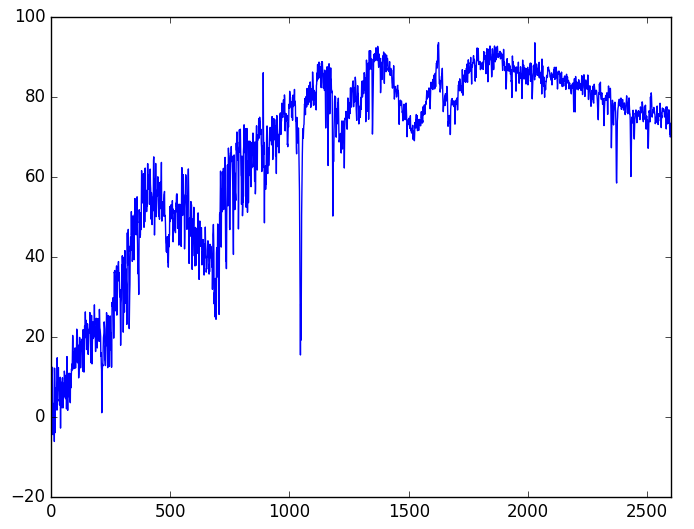
Additionally, because these sequences are relatively long (up to 2600 dimensions), some tricks were used: dilated convolutions were employed, the number of Blocks was increased as much as possible, and a pooling layer was added after each Block to reduce dimensionality.
Training
Before providing the training code, let me explain the training process.
The evaluation metric for the competition is the Macro F1 score, which calculates an F1 score for each category and then averages the F1 values of the four categories. Generally speaking, the F1 score is non-differentiable, so the Macro F1 score is also non-differentiable and cannot be used directly as a loss function. However, we can write an approximate formula for the (negative) Macro F1 score:
def score_loss(y_true, y_pred):
    loss = 0
    for i in np.eye(4):
        y_true_ = K.constant([list(i)]) * y_true
        y_pred_ = K.constant([list(i)]) * y_pred
        loss += 0.5 * K.sum(y_true_ * y_pred_) / K.sum(y_true_ + y_pred_ + K.epsilon())
    return - K.log(loss + K.epsilon())
Here, y_true is the target one-hot distribution, and
y_pred is the predicted probability for each category. At
first glance, it might be hard to understand. Readers need to understand
the F1 calculation formula and then express it in a calculation format
for one-hot inputs to gradually grasp it.
To optimize this evaluation metric, I first used the Adam optimizer
(learning rate 0.001) and standard categorical cross-entropy to train
the model to its optimum. Then, I switched to score_loss
and reduced the learning rate to 0.0001 to continue training the model
to its optimum. These processes are reflected in the code. It is
somewhat strange that training directly with the Macro F1 score as the
loss does not converge.
Code
Below is the reference code; there is indeed nothing particularly special. If you have any questions, feel free to leave a comment for discussion.
#! -*- coding: utf-8 -*-

import numpy as np
import os,glob
import pandas as pd
import json
import keras.backend as K
from keras.callbacks import Callback
from keras.utils import to_categorical
from tqdm import tqdm
np.random.seed(2018)


# Data Reading.
# Spectra are stored as one txt per sample, containing a sequence in string format.
# For readers doing other sequence classification, just know this generates sequence samples.
class Data_Reader:
    def __init__(self):
        self.labels = pd.read_csv('../first_train_index_20180131.csv')
        self.label2id = {'star':0, 'unknown':1, 'galaxy':2, 'qso':3}
        self.id2label = ['star', 'unknown', 'galaxy', 'qso']
        self.labels['type'] = self.labels['type'].apply(lambda s: self.label2id[s])
        self.labels = dict(zip(self.labels['id'], self.labels['type']))
        if os.path.exists('../train_data.json'): # Read saved data
            print 'Found. Reading ...'
            self.train_data = json.load(open('../train_data.json'))
            self.valid_data = json.load(open('../valid_data.json'))
            self.nb_train = len(self.train_data)
            self.nb_valid = len(self.valid_data)
        else: # If not saved, build from raw data
            print 'Not Found. Preparing ...'
            self.data = glob.glob('../train/*.txt')
            np.random.shuffle(self.data)
            self.train_frac = 0.8
            self.nb_train = int(self.train_frac*len(self.data))
            self.nb_valid = len(self.data) - self.nb_train
            self.train_data = self.data[:self.nb_train]
            self.valid_data = self.data[self.nb_train:]
            json.dump(self.train_data, open('../train_data.json', 'w'))
            json.dump(self.valid_data, open('../valid_data.json', 'w'))
        self.input_dim = len(self.read_one(self.train_data[0]))
        self.fracs = [0.8, 0.1, 0.05, 0.05] # Sampling ratio for each class in a batch
        self.batch_size = 160 # batch_size
        for i in range(4):
            self.fracs[i] = int(self.fracs[i]*self.batch_size)
        self.fracs[0] = self.batch_size - np.sum(self.fracs[1:])
    def read_one(self, fn):
        return np.array(json.loads('[' + open(fn).read() + ']'))
    def for_train(self): # Generate training set
        train_data = [[], [], [], []]
        for n in self.train_data:
            train_data[self.labels[int(n.split('/')[2].split('.')[0])]].append(n)
        print 'Samples:',self.fracs
        Y = np.array([0]*self.fracs[0] + [1]*self.fracs[1] + [2]*self.fracs[2] + [3]*self.fracs[3])
        Y = to_categorical(np.array(Y), 4)
        while True:
            X = []
            for i in range(4):
                for n in np.random.choice(train_data[i], self.fracs[i]):
                    X.append(self.read_one(n))
            X = np.expand_dims(np.array(X), 2)/100.
            yield X,Y
            X = []
    def for_valid(self): # Generate validation set
        X,Y = [],[]
        for n in self.valid_data:
            X.append(self.read_one(n))
            Y.append(self.labels[int(n.split('/')[2].split('.')[0])])
            if len(X) == self.batch_size or n == self.valid_data[-1]:
                X = np.expand_dims(np.array(X), 2)/100.
                Y = to_categorical(np.array(Y), 4)
                yield X,Y
                X,Y = [],[]


D = Data_Reader()

from keras.layers import *
from keras.models import Model
import keras.backend as K

def BLOCK(seq, filters): # Define network Block
    cnn = Conv1D(filters*2, 3, padding='SAME', dilation_rate=1, activation='relu')(seq)
    cnn = Lambda(lambda x: x[:,:,:filters] + x[:,:,filters:])(cnn)
    cnn = Conv1D(filters*2, 3, padding='SAME', dilation_rate=2, activation='relu')(cnn)
    cnn = Lambda(lambda x: x[:,:,:filters] + x[:,:,filters:])(cnn)
    cnn = Conv1D(filters*2, 3, padding='SAME', dilation_rate=4, activation='relu')(cnn)
    cnn = Lambda(lambda x: x[:,:,:filters] + x[:,:,filters:])(cnn)
    if int(seq.shape[-1]) != filters:
        seq = Conv1D(filters, 1, padding='SAME')(seq)
    seq = add([seq, cnn])
    return seq

# Build model: standard CNN + Residual + Pooling
input_tensor = Input(shape=(D.input_dim, 1))
seq = input_tensor

seq = BLOCK(seq, 16)
seq = MaxPooling1D(2)(seq)
seq = BLOCK(seq, 16)
seq = MaxPooling1D(2)(seq)
seq = BLOCK(seq, 32)
seq = MaxPooling1D(2)(seq)
seq = BLOCK(seq, 32)
seq = MaxPooling1D(2)(seq)
seq = BLOCK(seq, 64)
seq = MaxPooling1D(2)(seq)
seq = BLOCK(seq, 64)
seq = MaxPooling1D(2)(seq)
seq = BLOCK(seq, 128)
seq = MaxPooling1D(2)(seq)
seq = BLOCK(seq, 128)
seq = Dropout(0.5, (D.batch_size, int(seq.shape[1]), 1))(seq)
seq = GlobalMaxPooling1D()(seq)
seq = Dense(128, activation='relu')(seq)

output_tensor = Dense(4, activation='softmax')(seq)

model = Model(inputs=[input_tensor], outputs=[output_tensor])
model.summary()

# Define negative macro f1 score as loss
def score_loss(y_true, y_pred):
    loss = 0
    for i in np.eye(4):
        y_true_ = K.constant([list(i)]) * y_true
        y_pred_ = K.constant([list(i)]) * y_pred
        loss += 0.5 * K.sum(y_true_ * y_pred_) / K.sum(y_true_ + y_pred_ + K.epsilon())
    return - K.log(loss + K.epsilon())

# Define macro f1 score calculation formula
def score_metric(y_true, y_pred):
    y_true = K.argmax(y_true)
    y_pred = K.argmax(y_pred)
    score = 0.
    for i in range(4):
        y_true_ = K.cast(K.equal(y_true, i), 'float32')
        y_pred_ = K.cast(K.equal(y_pred, i), 'float32')
        score += 0.5 * K.sum(y_true_ * y_pred_) / K.sum(y_true_ + y_pred_ + K.epsilon())
    return score

from keras.optimizers import Adam
model.compile(loss='categorical_crossentropy', # Cross-entropy as loss
              optimizer=Adam(1e-3),
              metrics=[score_metric])

try:
    model.load_weights('guangpu_highest.model')
except:
    pass


def predict():
    import time
    data = pd.read_csv('../first_test_index_20180131.csv')['id']
    data = '../test/' + data.apply(str) + '.txt'
    data = list(data)
    I,X,Y = [],[],[]
    for n in tqdm(iter(data)):
        X.append(D.read_one(n))
        I.append(int(n.split('/')[2].split('.')[0]))
        if len(X) == D.batch_size:
            X = np.expand_dims(np.array(X), 2)/100.
            y = model.predict(X)
            y = y.argmax(axis=1)
            Y.extend(list(y))
            X = []
    d = pd.DataFrame(list(zip(I, Y)))
    d.columns = ['id', 'type']
    d['type'] = d['type'].apply(lambda s: D.id2label[s])
    d.to_csv('result_%s.csv'%(int(time.time())), index=None, header=None)


if __name__ == '__main__':

    # Define Callback to calculate validation score and save best model
    class Evaluate(Callback):
        def __init__(self):
            self.scores = []
            self.highest = 0.
        def on_epoch_end(self, epoch, logs=None):
            R,T = [],[]
            for x,y in D.for_valid():
                y_ = model.predict(x)
                R.extend(list(y.argmax(axis=1)))
                T.extend(list(y_.argmax(axis=1)))
            R,T = np.array(R),np.array(T)
            score = 0
            for i in range(4):
                R_ = (R == i)
                T_ = (T == i)
                score += 0.5 * (R_ * T_).sum() / (R_.sum() + T_.sum() + K.epsilon())
            self.scores.append(score)
            if score >= self.highest: # Save best model weights
                self.highest = score
                model.save_weights('guangpu_highest.model')
            json.dump([self.scores, self.highest], open('valid.log', 'w'))
            print '            score: %f%%, highest: %f%%'%(score*100, self.highest*100)

    evaluator = Evaluate()

    # Phase 1 Training
    history = model.fit_generator(D.for_train(),
                                  steps_per_epoch=500,
                                  epochs=50,
                                  callbacks=[evaluator])

    model.compile(loss=score_loss, # Switch loss
                  optimizer=Adam(1e-4),
                  metrics=[score_metric])

    try:
        model.load_weights('guangpu_highest.model')
    except:
        pass

    # Phase 2 Training
    history = model.fit_generator(D.for_train(),
                                  steps_per_epoch=500,
                                  epochs=50,
                                  callbacks=[evaluator])
Original Address: https://kexue.fm/archives/5505
For more details on reprinting, please refer to: "Scientific Space FAQ"