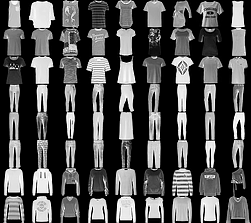
The MNIST handwritten digit recognition dataset has long been one of the touchstones for various machine learning algorithms. Recently, a new dataset has emerged to challenge it, called Fashion-MNIST, which consists of categories like clothing, shoes, and bags. To facilitate the migration of users to Fashion-MNIST, the authors made the dataset almost identical to the MNIST handwritten digit recognition dataset—the same number and size of images, the same 10 categories, and even the same data packaging and naming as MNIST. It seems that in order to replace MNIST, Fashion-MNIST has put in a lot of effort to make everything identical, minimizing the cost of use. This determination to challenge the status quo is quite firm.
The reason for the challenge is simple—many people complain that if an algorithm doesn’t work on MNIST, it definitely won’t work elsewhere, but if an algorithm works on MNIST, it doesn’t necessarily work on real-world problems. In other words, this dataset is too simple and not representative enough.
Fashion-MNIST GitHub: https://github.com/zalandoresearch/fashion-mnist/
Introduction article: "Replacing
MNIST? Scientists in the German Fashion Circle Launch a Benchmark
Dataset, All Clothes, Pants, Shoes, and Bags"
Fashion-MNIST has 10 classes: T-shirt/top, Trouser, Pullover, Dress, Coat, Sandal, Shirt, Sneaker, Bag, and Ankle boot. Many people are running experiments to see how models that were originally effective on MNIST perform when directly moved to this new dataset. Some benchmarks can be found here.
I also joined the fun and ran the WGAN-GP code (see "The Art of Mutual Confrontation: From Zero to WGAN-GP") that was previously effective on MNIST on this dataset, and found that it still works. The usage is very simple; you only need to change the path.
Code: https://github.com/bojone/gan/blob/master/fashion_mnist_gangp.py
Usage Instructions
git clone https://github.com/zalandoresearch/fashion-mnist.git
cd fashion-mnist
wget https://raw.githubusercontent.com/bojone/gan/master/fashion_mnist_gangp.py
python fashion_mnist_gangp.py
Compared to the original file, only the path was changed. In the
out directory under the current folder, you can see the
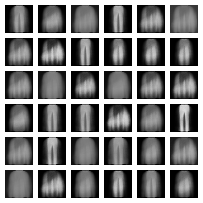
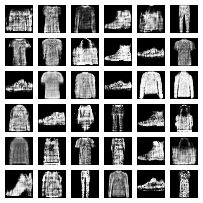
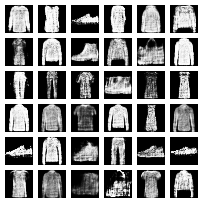
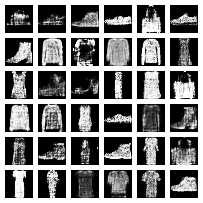
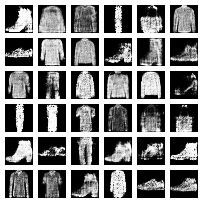
gradually generated samples, which become clearer and more diverse. Of
course, there is still a gap compared to the original images, likely due
to model capacity issues. You can experiment with it yourself; I am just
providing a starting point.
Partial generated samples (Order: left to right, top to bottom. You may notice that in the middle of the process, the images become blurrier than before, but afterward, the images become more diverse):

When reposting, please include the original address of this article: https://kexue.fm/archives/4540
For more detailed reposting matters, please refer to: "Scientific Space FAQ"