Partial Results
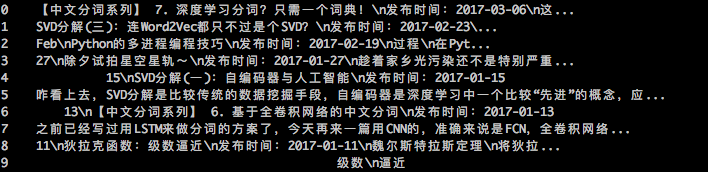
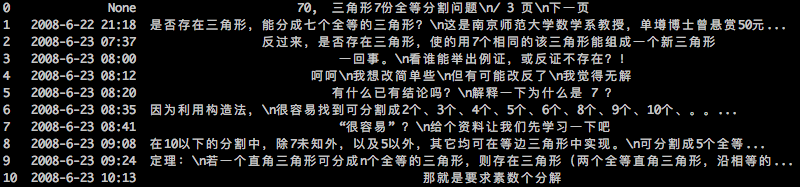
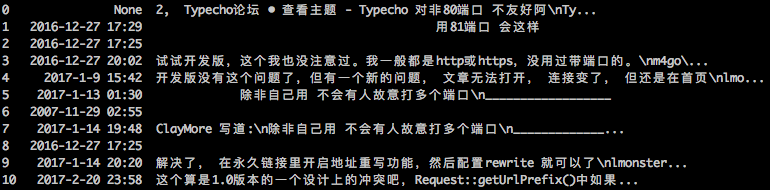
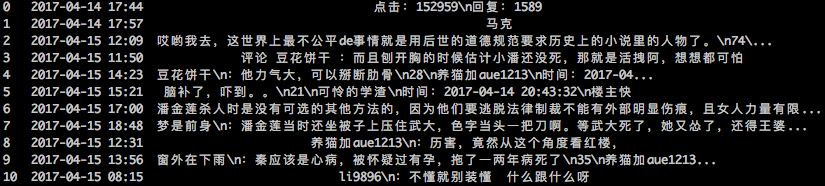
The following are the crawling results for some websites. Figure 1 shows the crawling effect of this blog, indicating that the solution is applicable to general websites. Figures 2 and 3 show the crawling effects of forums built with two open-source forum programs, indicating that open-source programs can be crawled normally. Figure 4 shows the crawling effect of the famous Tianya Forum, indicating that even forums developed internally by companies have good results.
Room for Improvement
Overall, this is a high-efficiency, unsupervised general website crawling solution that can adapt to different websites (not limited to forums) and is suitable for large-scale enterprise deployment.
Of course, this solution also has some areas for improvement:
1. To ensure efficiency and stability, universality is sacrificed. For example, when selecting content, it is judged directly based on the proportion of Chinese characters, without using more precise language model solutions;
2. The room for further improvement is small because the solution based on standard template comparison extracts effective text in a hybrid way, losing position and hierarchical information. Although this situation can be further resolved through clustering, there are still websites where it fails, and there is little room for improvement based on the original method;
3. Visual information is not utilized. For example, the username cannot be accurately located because we do not know where it counts as a username. However, if viewed by the naked eye, it is relatively easy to judge. That is to say, visual information is an important indicator. If higher precision is required, we need to utilize visual information.
Looking forward to seeing better solutions.
Code
Python 2.7 code
General crawling framework:
#! -*- coding:utf-8 -*-

import requests as rq
import numpy as np
import re
from lxml.html import html5parser

class crawler:
    def __init__(self, standard_urls):
        self.title = ''
        self.emphase_mark = set(['p', 'br', 'em', 'strong', 'b', 'font', 'u', 'a', 'img', 'h1', 'h2', 'h3', 'h4', 'h5', 'sup', 'sub', 'blockquote', 'cite', 'code', 'pre'])
        self.standard_urls = standard_urls
        self.sess = rq.Session()
        self.standard_contents = []
        self.find_title = re.compile('<title>([\s\S]*?)</title>').findall
        if isinstance(standard_urls, list):
            self.standard_dom = self.create_dom(self.standard_urls[0])
            self.standard_contents = set([c[1:] for c in self.traverse_dom(self.standard_dom)[1]])
            for url in self.standard_urls[1:]:
                self.standard_dom = self.create_dom(url)
                self.standard_contents = self.standard_contents & set([c[1:] for c in self.traverse_dom(self.standard_dom)[1]])
        else:
            self.standard_dom = self.create_dom(self.standard_urls)
            self.standard_contents = set([c[1:] for c in self.traverse_dom(self.standard_dom)[1]])
        self.find_zh = re.compile(u'[\u4e00-\u9fa5]').findall
        self.find_zh_en = re.compile(u'[a-zA-Z\d_\u4e00-\u9fa5]').findall
        # Regex for matching dates and common time-related Chinese keywords
        self.find_date = re.compile(u'.*?Year.*?Month.*?Day|Release Time|\d{4}\-\d{1,2}\-\d{1,2}|Yesterday|The day before yesterday|Today|hours ago|\d{1,2}:\d{2}').findall
    def create_dom(self, url):
        r = self.sess.get(url)
        return html5parser.fromstring(r.content)
    def traverse_dom(self, dom, idx=0, tag=''):
        content = []
        if len(dom) > 0:
            tag += (str(dom.tag)+'_')
            if dom.tag not in self.emphase_mark:
                idx += 1
            idx_ = idx
            if dom.text and dom.text.strip():
                content.append((idx_, tag, dom.text.strip()))
            for d in dom:
                idx, content_ = self.traverse_dom(d, idx, tag)
                content.extend(content_)
            if dom.tail and dom.tail.strip():
                content.append((idx_, tag, dom.tail.strip()))
        elif dom.tag != 'head':
            if dom.text and dom.text.strip():
                content.append((idx, tag, dom.text.strip()))
            if dom.tail and dom.tail.strip():
                content.append((idx, tag, dom.tail.strip()))
        if (isinstance(dom.tag, str) or isinstance(dom.tag, unicode)) and 'title' in dom.tag and not self.title:
            self.title = dom.text.strip() + dom.tail.strip()
        return idx, content
    def peak(self, d):
        r = []
        if d[0] > d[1]:
            r.append(0)
        for i in range(1, len(d)-1):
            if d[i] > max(d[i-1], d[i+1]):
                r.append(i)
        if len(d) >= 3 and d[-1] > d[-2]:
            r.append(len(d)-1)
        return r
    def keep_proba(self, s):
        if len(self.find_zh_en(s)) == len(s):
            return 1
        else:
            c0 = len(''.join(self.find_date(s)))
            return 1.*(len(self.find_zh(s))+c0)/(len(s))
    def crawl_url(self, url, cluster_times=2):
        self.title = ''
        dom = self.create_dom(url)
        content = self.traverse_dom(dom)[1]
        content_ = []
        for c in content:
            if c[1:] not in self.standard_contents:
                content_.append(list(c))
        content = [content_[0]]
        for c in content_:
            if c[0] == content[-1][0]:
                content[-1] = [c[0], c[1], content[-1][2]+'\n'+c[2]]
            else:
                content.append(c)
        content = [c for c in content if self.keep_proba(c[2]) >= 0.25]
        for _ in range(cluster_times):
            content_ = content[:]
            if len(content_) >= 3:
                idxs = [c[0] for c in content_]
                idxs = set([idxs[i+1] for i in self.peak(np.diff(idxs))])
                content = [content_[0]]
                cc = 1
                for i in range(1, len(content_)):
                    if content_[i][0] in idxs:
                        content[-1][0] = int(content[-1][0]/cc)
                        content.append(content_[i])
                        cc = 1
                    else:
                        content[-1] = [content[-1][0]+content_[i][0], content[-1][1], content[-1][2]+'\n'+content_[i][2]]
                        cc += 1
        return [c[2] for c in content]
Implementation for forums:
def find_datetime(s):
    r = []
    for t in s.split('\n'):
        l = len(t)*1.
        d = re.findall('\d+\-\d+\-\d+ +\d+:\d+', t)
        if d and len(d[0])/l > 0.5:
            r.append(d[0])
        else:
            # Matching Chinese date formats
            d = re.findall(u'\d+Year *\d+Month *\d+Day +\d+:\d+', t)
            if d and len(d[0])/l > 0.5:
                d = re.findall(u'(\d+)Year *(\d+)Month *(\d+)Day +(\d+):(\d+)', t)
                r.append('%s-%s-%s %s:%s'%d[0])
            else:
                r.append(None)
    return r

def extract_info(b,c):
    r = []
    for t in b:
        dts = find_datetime(t)
        t = t.split('\n')
        dt = max(dts)
        if dt:
            idx = dts.index(dt)
            r.append((dt, '\n'.join(t[:idx]), '\n'.join(t[idx+1:])))
        else:
            r.append((None, '\n'.join(t), '\n'.join(t)))

    idx = 1 + (sum([c.keep_proba(i[1]) for i in r]) < sum([c.keep_proba(i[2]) for i in r]))
    r = [(i[0], i[idx]) for i in r if i[idx]]
    if not r[0][0]:
        r = r[1:]
    rr = [r[0]]
    for a,b in r[1:]:
        if not a:
            rr[-1] = rr[-1][0], rr[-1][1]+'\n'+b
        else:
            rr.append((a,b))
    return rr

if __name__ == '__main__':

    c = crawler(['http://bbs.emath.ac.cn/thread-9531-1-1.html', 'http://bbs.emath.ac.cn/thread-2749-1-1.html'])
    b = c.crawl_url('http://bbs.emath.ac.cn/thread-9538-1-1.html')

    title = c.title
    r = extract_info(b,c)
    keys = ('publish_date', 'content', 'title', 'author')
    final = {}
    final['post'] = dict(zip(keys, (r[0][0], r[0][1], title, '')))
    final['replys'] = [dict(zip(keys, (i[0], i[1], title, ''))) for i in r[1:]]

    import pandas as pd
    pd.DataFrame(r)
When reprinting, please include the original link: https://kexue.fm/archives/4430
For more detailed reprinting matters, please refer to: "Scientific Space FAQ"