I remember when Scientific Space first started, there wasn’t much original content. For a while, I was translating APOD (Astronomy Picture of the Day) images. Later, I gradually focused on original content and stopped translating. This time, I’m sharing another image: the Geminid meteor shower over Xinglong Mountain, captured by domestic enthusiast Steed Yu and featured by APOD.
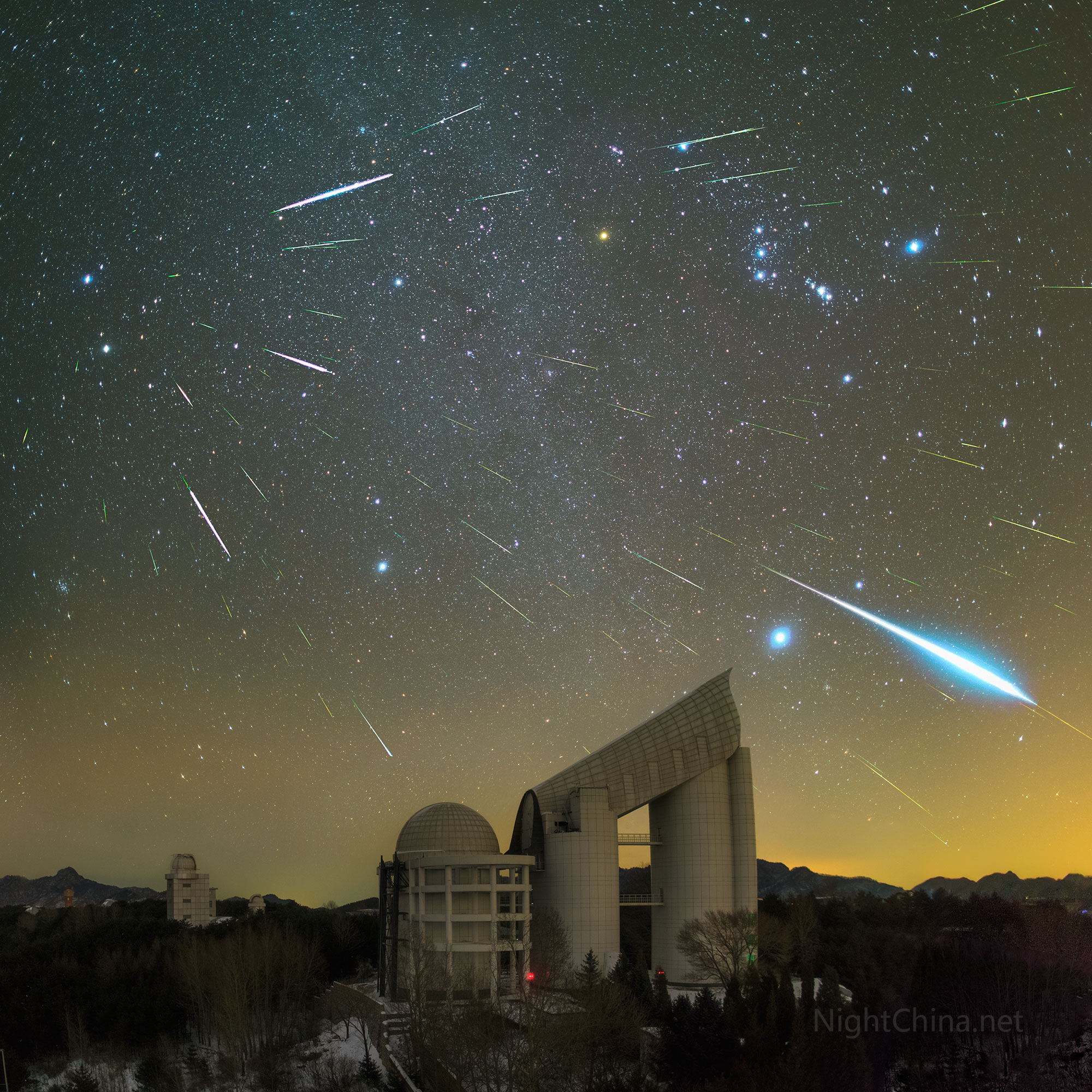
Image Description: Where do Geminid meteors come from? In this wonderful composite image, you can find the Geminid meteor shower formed by these sand-sized rocks, with the radiant point of the meteor trails located in the constellation Gemini. The trajectories of these meteors in the solar system point to their parent body—Asteroid 3200 Phaethon. However, this conclusion is still debatable because this unusual object is usually dormant. Perhaps Asteroid 3200 Phaethon experienced dust-release events more intense than we know, but even so, what happened and why such a violent eruption occurred remains an unsolved mystery. During the peak of the meteor shower last week, more than 50 meteors, including bright fireballs, streaked across the sky over China’s Xinglong Observatory. Since the December Geminid meteor shower is one of the most accurately predicted and active meteor showers, research into its origin is likely to continue.
Scientific Space is supported by the Cosmos Station project of the National Astronomical Observatories. Xinglong Observatory is the main observation station of the National Astronomical Observatories. I have visited the observatory on Xinglong Mountain twice, so I have a special affection for Xinglong (of course, the server for Cosmos Station is not on Xinglong Mountain ). As for meteor showers, during high school, I also used to get up in the middle of the night to watch the Leonid meteor shower, or stay up in mid-August to watch the Perseid meteor shower, and so on. Those are very beautiful memories. I also vividly remember the time we observed together in the cold wind in Ningxia while participating in the Astronomy Olympiad. Now, every clear night, I still look up at the sky, look at the stars, and see if there are any sudden meteors.
Please include the original address when reposting: https://kexue.fm/archives/3580
For more detailed reposting matters, please refer to: Scientific Space FAQ