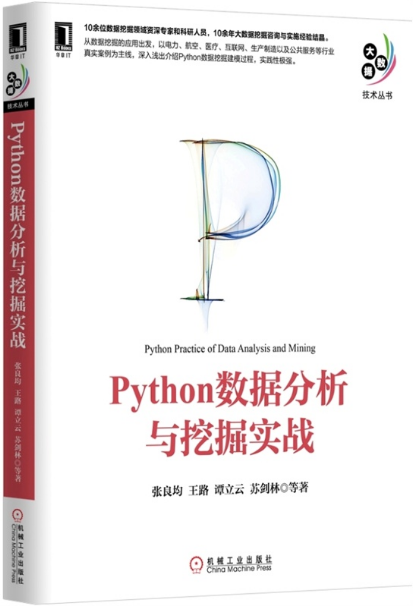
During the summer vacation, at the invitation of TipDM, I wrote a sister volume to their book MATLAB Data Mining and Practice titled Python Data Analysis and Mining in Action (there is also an R language version). My main task was to write the introduction to Python and translate the MATLAB code from the original book into Python. I gladly accepted this task, as it allowed me to earn some pocket money through part-time work, systematically train my own Python programming skills, and experience a "grand showdown" between MATLAB, R, and Python. The book has now been officially released and can be found on Amazon, Dangdang, JD.com, and Taobao. I am honored to be listed as one of the authors, making this the first book I have published.
This article might be suspected of being an advertisement. While it is indeed an advertisement, I am not here to sell the book, but rather to "sell" Python. Regarding the book, I am confident that the Python scripts within it—whether in terms of the conciseness of the code itself or its execution efficiency—will not lose to MATLAB or the R language. Furthermore, while the cases in the book generally involve only a few hundred data points, I designed the code to handle the analysis of tens or even hundreds of thousands of data points. In terms of practical application, in my current part-time job at a company, I use Python to perform data analysis on tens of millions of articles. It is evident that Python’s performance is impressive across the board. No wonder some people exclaim: Life is short, I use Python!
That’s right. Life is short, I use Python! Even if you do not work as a programmer or data analyst in the future, you can still learn Python. It will bring great convenience to your original work, whether you are a student, teacher, researcher, or an office worker.
Returning to the book MATLAB Data Mining and Practice, I will add a few more lines of advertisement so this article doesn’t seem too short. In fact, most of the cases in this book originate from three data mining competitions hosted by TipDM. The competition problems themselves have very clear practical backgrounds; therefore, the cases in the book are highly practical and cover a wide range of topics. From a task perspective, it includes basic content such as data processing, classification, clustering, association analysis, and natural language processing. From a model perspective, it covers common models like Logistic Regression, SVM, Decision Trees, and Neural Networks. This book may not necessarily be a "great" book, but it is certainly a very "diligent" book. (At least the author’s code translation was done with great care, and the introduction to Python in Chapter 2 was completely rewritten by me, which I will share with everyone later. ^_^)
When reposting, please include the original address of this article: https://kexue.fm/archives/3546
For more detailed reposting matters, please refer to: Scientific Space FAQ