The theme of this article is parallel lines. Friends who are familiar with mathematics might think I am going to write about non-Euclidean geometry. But that is not the case this time. The content of this article is purely the Euclidean geometry we have studied since childhood, based on "Euclid’s Fifth Postulate" (also known as the Parallel Postulate). However, even within the Euclidean geometry of parallel lines that we learn from a young age, there are perhaps many problems that we have not thought through clearly. Because parallelism is a very fundamental situation in geometry, when discussing such basic propositions, it is quite easy to encounter circular reasoning or even putting the cart before the horse.

From middle school, we are indoctrinated with rules for judging parallel lines such as "if corresponding angles are equal, the two lines are parallel" and "if alternate interior angles are equal, the two lines are parallel." Of course, there is also the indispensable "through a point outside a line, only one line can be drawn parallel to the given line." However, among these contents, how many are fundamental axioms, and how many can be proven? How should they be proven? I think many people do not understand this clearly, and I myself did not have a very good answer for a long time. Even the teachers who teach parallel lines in middle school probably don’t have many who can explain it clearly. Later, I discovered that I actually did not know how to prove "if corresponding angles are equal, the two lines are parallel." It seems "Euclid’s Fifth Postulate" does not directly tell us this judgment rule. So, I flipped through a middle school mathematics textbook and found that the rule "if corresponding angles are equal, the two lines are parallel" was originally given to us to accept without proof. No wonder I could never think of a simple proof for this rule...
Therefore, I wanted to write this article to provide a reference for understanding the entire logic of parallel lines.
Finding Parallel Lines
At the outset, we declare that we are only discussing Euclidean geometry. Therefore, we accept the following axiom:
Through a point outside a line, only one line can be drawn parallel to the given line.
Of course, in Euclid’s Elements, the following four postulates are more fundamental:
1. A straight line segment can be drawn joining any two points.
2. Any straight line segment can be extended indefinitely in a straight line.
3. Given any straight line segment, a circle can be drawn having the segment as radius and one endpoint as center.
4. All right angles are equal to one another.
In fact, the first axiom also implies that only one straight line can be drawn through two points, and the second axiom implies that the length of all straight lines is infinite. Without these "implications," the above axioms would not be sufficient to constitute the foundation of Euclidean geometry. Additionally, it is not difficult to prove that "only one straight line can be drawn through two points" is equivalent to saying "two distinct lines in a plane can have at most one intersection point."
The above content is the basis of this article and, of course, the basis of Euclidean geometry. First, the Fifth Postulate says there is only one parallel line, so let us first find it. The method of finding it is as follows:
The green line is the known line, the purple point is the known point. Draw a perpendicular line to the known line through the purple point.
Note that for every step we take, we must consider the basis to avoid putting the cart before the horse. Why can we construct a perpendicular to a known line? First, we draw an arbitrary line through the purple point that intersects the green line, obtaining two angles \angle A and \angle B, where \angle A - \angle B > 0. When the line rotates to the right around the purple point as the center, there must eventually be a position where \angle A - \angle B < 0. Thus, there must be a position where \angle A = \angle B. Since \angle A + \angle B = 180^\circ, we have \angle A = \angle B = 90^\circ. This is essentially the Intermediate Value Theorem for continuous functions—content from Mathematical Analysis! You read that right; it is Mathematical Analysis. Even such a simple problem requires its use. If geometry is to be strictly formalized, it must rely on the tool of algebra!
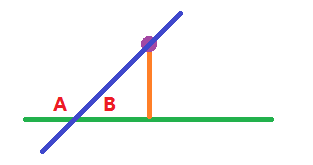
Next, through the purple point, we draw a line (the blue line below) perpendicular to the orange line constructed in the previous step.

Next, we can prove that the blue line is parallel to the green line. The idea of the proof is very simple: the entire figure is symmetric about the orange line. If the blue line and the green line intersect on one side, they must also intersect on the other side, resulting in two intersection points—this contradicts the axiom "two distinct lines in a plane can have at most one intersection point." Therefore, the two can only be parallel.
Now we have found one parallel line, and according to the Fifth Postulate, there is only one such line, so this line is the unique one.
“If alternate interior angles are equal, the two lines are parallel”
Now let us prove "if alternate interior angles are equal, the two lines are parallel." Personally, I think this is not simple at all...
First, we have two parallel lines: the blue line and the green line. The yellow line is a line intersecting the parallel lines, resulting in two alternate interior angles C and D. Next, through the intersection point at angle C, draw a pink line perpendicular to the blue line. Then it can be proven that the pink line is also perpendicular to the green line. This step is obvious but also requires proof. If the pink line were not perpendicular to the green line, then according to the previous method, another line could be drawn through the same point that is parallel to the blue line, resulting in two different lines through the same point parallel to the blue line, a contradiction. Incidentally, we can easily prove that the red line is parallel to the pink line.
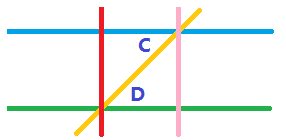
Now we have obtained a rectangle—a figure where all four interior angles are 90^\circ. We can then use the symmetry of the rectangle to prove that two triangles are congruent (specifically, two triangles with three corresponding sides equal are congruent), thereby proving that the alternate interior angles are equal. This judgment rule stems from the stability of triangles—which is also a geometric axiom.
But don’t forget, we haven’t proven that the opposite sides of a rectangle are equal!! The rectangle here is defined as a quadrilateral with four 90^\circ interior angles, so it does not inherently include the condition that opposite sides are equal; we need to prove it. Of course, it is not difficult. Using symmetry, fold the rectangle over. According to our method of constructing parallel lines (two perpendiculars), the parallel line at the midpoint is the axis of symmetry. Therefore, they coincide after folding. (This is stated colloquially; it can be written in mathematical language—readers are encouraged to try it themselves; symmetry is the key.)
A Brief Summary
To explain the matter of parallelism, we have spent so much space, and I still don’t know if it has been explained clearly. Therefore, when involving these fundamental issues, one needs to question every step and proceed with caution to avoid falling into logical contradictions. Of course, whether it is necessary to do this is a matter of opinion.
There may be places where my reasoning is not clear or where logical contradictions appear. I hope readers will not hesitate to criticize if they find any.
When reposting, please include the original address of this article: https://kexue.fm/archives/3243
For more detailed reposting matters, please refer to: Scientific Space FAQ