The Poisson distribution is suitable for describing the probability distribution of the number of times a random event occurs within a unit of time, such as the number of service requests received by a service facility within a certain period, or the number of passengers waiting at a bus stop, etc. [Wikipedia] The Poisson distribution can also serve as an approximation for the Binomial distribution when the probability is small. Its derivation process is covered in most standard probability theory textbooks. However, the proofs provided in general textbooks are not always aesthetically pleasing; for example, the proof process given on page 98 of A Course in Probability and Mathematical Statistics (2nd Edition, edited by Mao Shisong et al.). So, which derivation process is more praiseworthy? In my opinion, it is the one using generating functions.
The probability generating function of the Binomial distribution is: (q+px)^n,\quad q=1-p
When the number of trials n is very large and the probability p is very small, we can consider its approximation. In this case, \lambda=pn is a moderately sized number, and p=\frac{\lambda}{n} is very small. According to the probability formula, we have: (q+px)^n=\left(1+\frac{\lambda}{n}(x-1)\right)^n
Since \lim_{n\to\infty}\left(1+\frac{x}{n}\right)^n=e^x
When n is quite large but not infinite, the difference between the above expression and e^x is very small. Thus, we have the approximation: \left(1+\frac{\lambda}{n}(x-1)\right)^n\approx e^{\lambda x-\lambda}
This is the generating function of the Poisson distribution.
It is important to note that e^{\lambda x-\lambda}|_{x=1}=1. This is a condition that a probability generating function must satisfy, and it is a very elegant coincidence. Because we made an approximation, the function before the approximation was indeed a probability generating function, but the function after the approximation also happens to be exactly another probability generating function (without requiring any correction). It must be said that this is a very beautiful coincidence.
Expanding it directly into a power series, we obtain the probability for each term: e^{\lambda x-\lambda}=e^{-\lambda}\sum_{k=0}^{\infty}\frac{\lambda^k}{k !}x^k
That is to say: P(X=k)=e^{-\lambda}\frac{\lambda^k}{k !}
Thus, we have obtained the probability formula for the Poisson distribution.
Below is a chart I recently found showing the relationships between various probability distributions, which I would like to share with the readers.
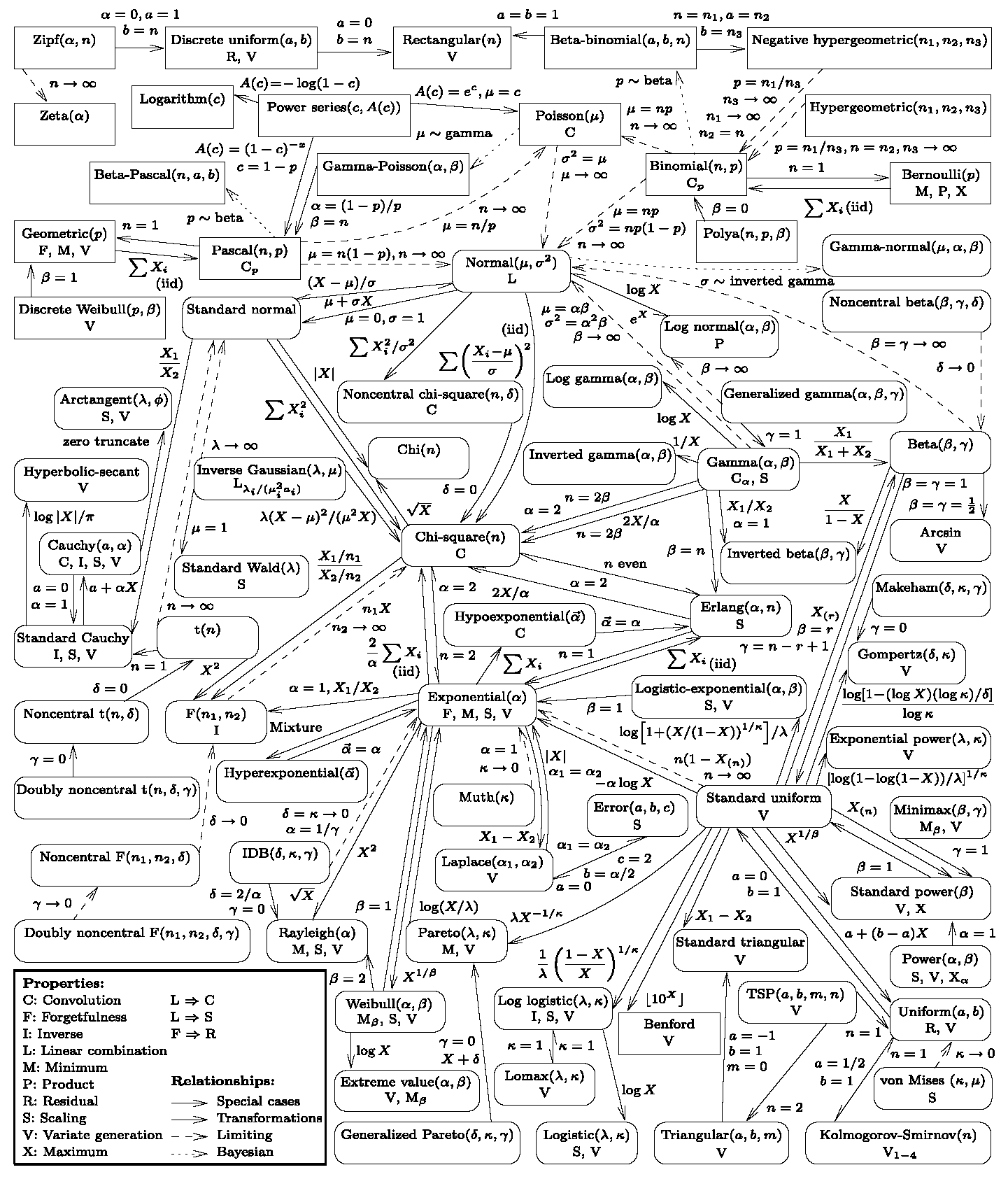
The original image is from: http://www.math.wm.edu/ leemis/2008amstat.pdf
When reposting, please include the address of this article: https://kexue.fm/archives/3188
For more detailed information regarding reposting, please refer to: Scientific Space FAQ