For me, this semester’s mathematical modeling course has basically been a process of practicing paper writing and Python skills. Whether I am writing a paper or a blog post, I am committed to creating works that align with my own aesthetic standards. This is why I choose LaTeX and why I choose Python. Scientific papers written in LaTeX are recognized as having a standard and beautiful format, and Python can indeed produce beautiful plots and concisely complete the required numerical calculations. I am increasingly finding that in mathematical modeling and writing, apart from the indispensable symbolic derivation part (which can only be done with Mathematica), I can no longer do without Python.
Why strive for beauty? Isn’t the content enough? Indeed, content is the primary concern, but if the presentation can be beautified without requiring significantly more effort, then why not do it?
Using only LaTeX and Python is enough to complete a decent paper. Of course, relying solely on these two can sometimes feel slightly insufficient. After a month of exploration, I have selected the following software combination as my paper-writing suite:
LaTeX: On Windows, I use CTeX directly as the tool for document compilation and editing.
Python: I prefer using version 3.4, along with several extension modules. It can easily complete numerical calculation tasks (I mean “completing them easily,” not “completing easy tasks”) and produce beautiful plots (all images are saved as PDF vector graphics). Crucially, it is free and lightweight.
Mathematica: For symbolic computation. This goes without saying. I tried using Python’s SymPy for similar work, but unfortunately, it was too slow (mainly testing the symbolic integration function).
Excel/Excel2LaTeX: This is how I use Excel: I organize the data in Excel and then use Excel2LaTeX to convert it into LaTeX code for use in my documents. This saves a lot of effort in drawing tables when there is a large amount of data.
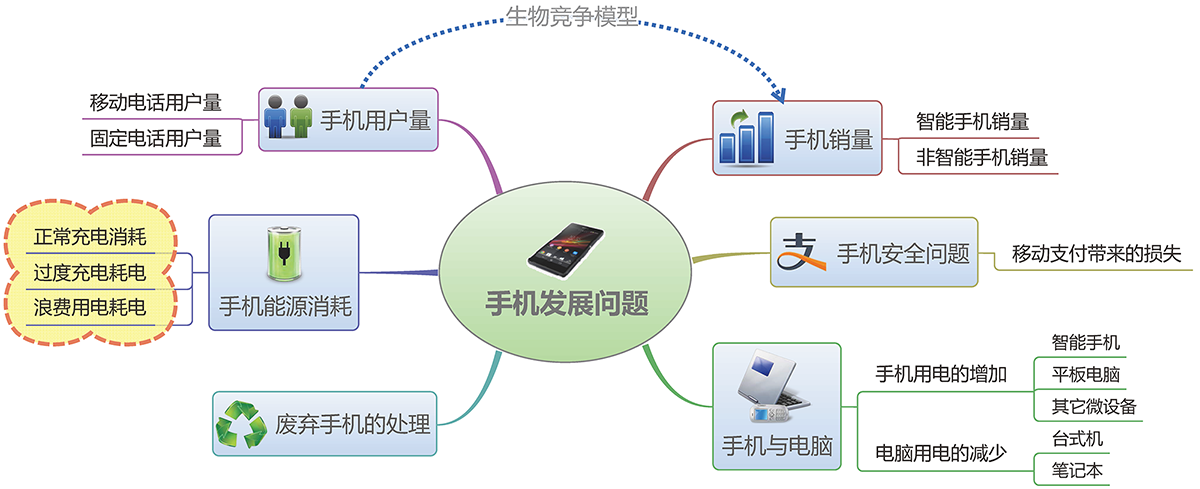
XMind: For drawing mind maps. I tested several mind-mapping software programs, such as XMind, MindManager, and iMindMap, and I feel that the results produced by XMind best meet my aesthetic standards.
Adobe Acrobat: This is mainly used for editing PDFs and for its built-in PDF printer function. Since PDFs generated automatically by software are not always perfect—for example, Python-generated plots might have excessively large white margins, or XMind-generated maps might have icons that are unattractive or unwanted—I use Acrobat to edit and modify them.
The above is basically my software suite for paper writing. If readers have better software suggestions, feel free to propose them. I am dedicated to creating beautiful papers (though, of course, beautiful content is the most important part).
When reprinting, please include the original address of this article: https://kexue.fm/archives/3171
For more detailed reprinting matters, please refer to: Scientific Space FAQ