In this series of articles, we have explored some basic knowledge of rings and fields, and used the theory of integral domains and unique factorization to prove Fermat’s Last Theorem for the cases n=3 and n=4. Using knowledge related to the Gaussian integer ring or the Eisenstein integer ring belongs to relatively modern and "high-end" algebraic content (Gauss was born in 1777, Eisenstein in 1823; however, Eisenstein died young in 1852, while Gauss lived until 1855). If things go "smoothly," we can use these "high-end" tools to prove the non-existence of solutions or to find a general solution (if one exists).
However, for elementary number theory, the threshold for knowledge of complex rings and fields is somewhat high. Secondly, rings and fields are relatively "strong" tools. Here, "strong" carries a sense of being "assertive," meaning: if it succeeds, it can "take the city in one blow," finding all general solutions (or proving their non-existence); if it fails, it often fails to find even a single non-trivial solution. Yet, for some problems, finding even a portion of the solutions is very difficult, let alone the general solution (we will experience this deeply later when studying the integer solutions of x^4+y^4 = z^4 + w^4). Therefore, for these problems, the idea of rings and fields alone is unlikely to provide us with (at least some) solutions. (Of course, the question of what counts as "alone" is hard to define. This commentary is quite rough.)
What this article introduces is a geometric method that can effectively help us find rational points for certain Diophantine equations. Surprisingly, this method is not new; it is even quite "ancient," as research suggests that Diophantus—the "father of Diophantine equations"—used it. It is a geometric technique for finding rational points on curves. As we have seen, many problems regarding integer solutions of Diophantine equations can be transformed into corresponding rational solution problems, making this method effective. Without further ado, let us look at this method. (The ideas in this article come from Mathematics and Its History.)
Rational Points on a Circle
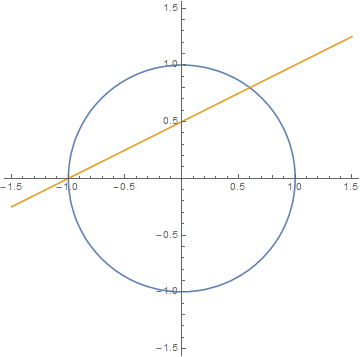
First is the secant method. I believe the best example to introduce the secant method is the problem of Pythagorean triples. Finding integer solutions to the Diophantine equation a^2+b^2=c^2 is equivalent to finding rational points on the unit circle x^2+y^2=1. Obvious rational points are (\pm 1,0). The purpose of the secant method is to find a family of non-trivial rational points based on these obvious ones. The idea is not difficult, primarily utilizing the relationship between the roots and coefficients of algebraic equations—Vieta’s formulas!
We draw a line through the point (-1,0) with a slope k. Its equation is: y=k(x+1) This line already intersects the circle x^2+y^2=1 at (-1,0), so it must have another intersection point with the unit circle. The question to consider now is: is the other intersection point a rational point? According to Vieta’s formulas, it is not hard to find that as long as k is a rational number, the other intersection point must also be a rational point. This is because after substituting the line equation, we get a quadratic equation in one variable: 1=x^2+k^2 (x+1)^2=(1+k^2)x^2 + 2k^2 x +k^2 As long as k is rational, the coefficients of the equation are rational. According to Vieta’s formulas, x_1 + x_2=-\frac{2k^2}{1+k^2}. Since one root is x_1=-1, the other root must also be rational: x_2=\frac{1-k^2}{1+k^2}. Thus, the other point is the rational point \left(\frac{1-k^2}{1+k^2},\frac{2k}{1+k^2}\right). With a little rearrangement, one can derive the general formula for Pythagorean triples from this.
Rational Points on Cubic Curves
We previously considered the problem of integer solutions for x^3+y^3=z^3+w^3. If we view it as an equation in x and y, it is cubic, with z and w as rational parameters. It has a trivial rational point (x,y) = (z,w).
Analogous to the method for rational points on a circle, if two rational points on a cubic curve are known, then drawing a secant through these two points will intersect the cubic curve at a third point, which must also be a rational point. However, in most cases, we only know one rational point of the equation. Is there a way to find other rational points based on only one? There is a way: we let those two known rational points infinitely coincide, so the secant becomes a tangent—in other words, given one rational point, we draw the tangent to the original curve at this point. By solving the tangent and the original curve equations together, we obtain a cubic equation in one variable with rational coefficients. At this point, the known rational point is a double root of the cubic equation! Therefore, the remaining third root must be rational. Below, taking the search for a family of solutions for x^3+y^3=z^3+w^3 as an example, we specifically demonstrate the technique of the tangent method.
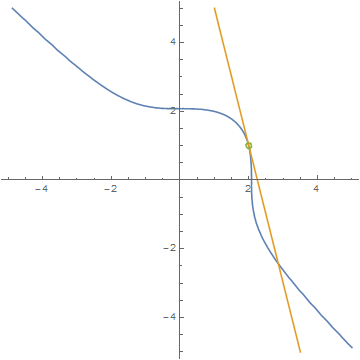
By differentiating both sides, we get: 3 x^2+ 3 y^2 \frac{dy}{dx}=0 From this, we can find that at the point (z,w), \frac{dy}{dx}=-\frac{z^2}{w^2}. Consequently, the equation of the tangent line passing through this point is: y=-\frac{z^2}{w^2}(x-z)+w Substituting this into the original equation gives: x^3+\left[-\frac{z^2}{w^2}(x-z)+w\right]^3=z^3+w^3 The third root is found to be (the two double roots are x=z): x=\frac{2 w^3 z+z^4}{z^3-w^3} Correspondingly: y=\frac{w^4+2 w z^3}{w^3-z^3} Thus, we have found a two-parameter rational solution: \left(\frac{2 w^3 z+z^4}{z^3-w^3}\right)^3+\left(\frac{w^4+2 w z^3}{w^3-z^3}\right)^3=z^3+w^3 Of course, this parametric solution cannot generate all rational solutions, which is evident from its two parameters: a complete rational solution would contain at least three parameters. This is a characteristic of the tangent method: it is usually effective but incomplete. Many cubic curve problems can similarly yield a family of rational solutions (provided, of course, that rational solutions exist and at least one special rational solution is known). A more general equation is y^2=ax^3+bx^2+cx+d, where a,b,c,d are all rational numbers.
Tangent Results for y^2=ax^3+bx^2+cx+d
For the convenience of later applications, we provide the results for y^2=ax^3+bx^2+cx+d without derivation. Interested friends can derive it themselves; the method is the same as above, just with more steps, while the complexity remains basically the same; or refer to the reference books at the end of the article. Given that the cubic curve passes through (x_1,y_1) and (x_2,y_2), the third point found using the secant method is: x_3=-(x_1 + x_2)-\frac{b-[(y_2-y_1)/(x_2-x_1)]^2}{a} Considering the case with only one point (x_1,y_1), which means replacing \frac{y_2-y_1}{x_2-x_1} with the derivative \frac{dy}{dx} at that point, we have: \left\{\begin{aligned} &\frac{dy}{dx}=\frac{3ax_1^2+2bx_1+c}{2y_1}\\ &x_2=-2 x_1-\frac{b-[(3ax_1^2+2bx_1+c)/(2y_1)]^2}{a} \end{aligned}\right.
Mordell’s Theorem
We have found a batch of rational points on the cubic curve through the tangent method. Next, we can perform two steps:
Use these new rational points as points of tangency, draw tangents, and find another batch of solutions;
Arbitrarily select two rational points, draw a secant, and find new rational points.
These two steps can be repeated indefinitely. The question is, can we obtain all rational points this way?
The answer is yes. This was conjectured by Poincaré and proven by Mordell: All rational points can be generated by the construction of tangents and chords from a finite number of points. This reaffirms the value of the secant and tangent method. Of course, we do not yet know a generalized algorithm to obtain all rational points via tangents and secants.
About Diophantus

It is hard to imagine that the above techniques appeared nearly two thousand years ago, but such is the fact!
Diophantus (approx. 246–330 AD, inferred from calculations), an important scholar and mathematician of the late Alexandrian school in Ancient Greece, discussed many problems regarding rational points on quadratic and cubic curves in his work Arithmetica, but his methods were not passed down. More than a thousand years later, Fermat also studied the rational and integer points of curves and provided some assertions (or conjectures), but Fermat’s research methods were not widely circulated either. Newton, the founder of calculus and a contemporary of Fermat, provided the secant and tangent methods and believed that the methods used by Diophantus and Fermat were indeed the secant and tangent methods. Today, we believe this guess because, no matter how one looks at it, other methods for finding rational points on algebraic curves are more "high-end" than the secant and tangent method; relatively speaking, the secant and tangent method is a very "populist" tool. Furthermore, Ancient Greece was enthusiastic about geometric research, so it is very likely they arrived at the secant and tangent method to study rational point problems.
References
Mathematics and Its History, Author: John Stillwell, Publisher: Higher Education Press.
When reposting, please include the original address of this article: https://kexue.fm/archives/2996
For more detailed reposting matters, please refer to: Scientific Space FAQ