Many of my recent articles have focused on number theory, which falls into the realm of pure mathematics. This might have been a bit overwhelming for readers who are primarily interested in physics or applied mathematics. Today, let’s discuss something less abstract: kites, and analyze the mechanics of their flight.
Love is like flying a kite: the string shouldn’t be too tight, nor too loose. You only give the other person space to fly, and he/she will always return to your side, because there is a string connecting both parties.
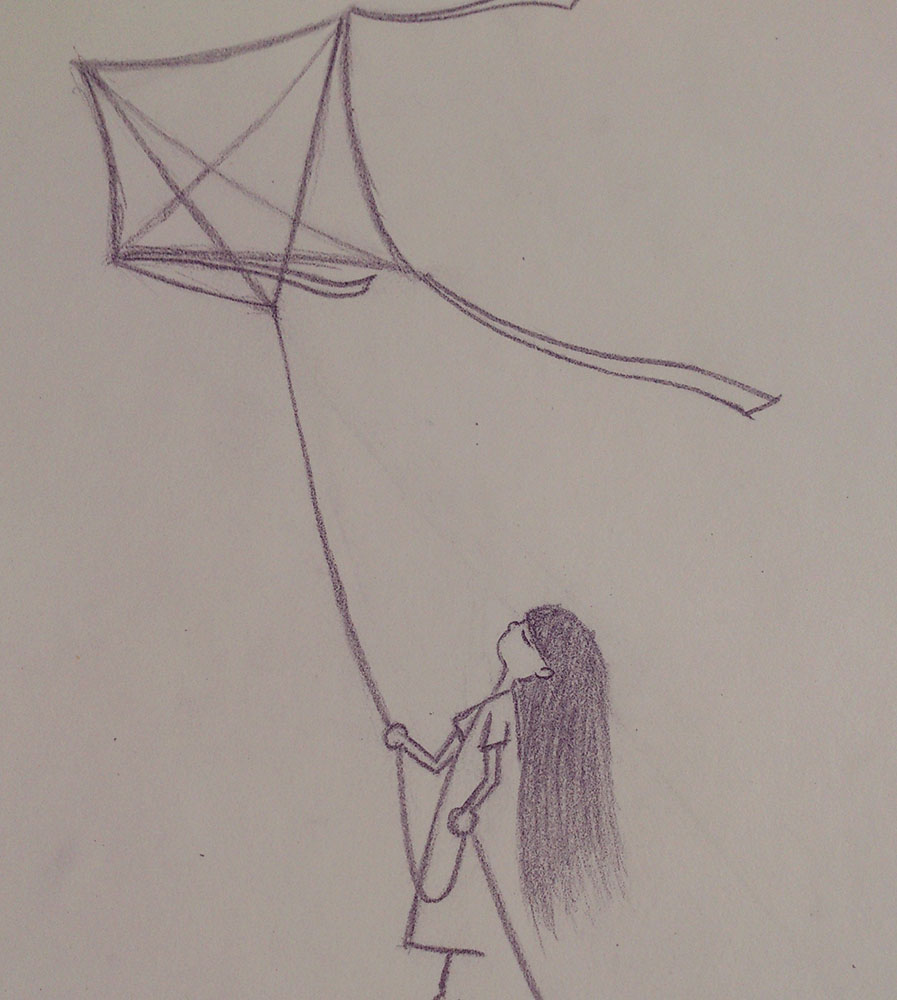
Kites, in our local area, are called zhiyuan (paper kites). I believe everyone must have flown one during their childhood. For me, the last time I flew a kite was before the fifth grade of elementary school. This summer, on a whim, I made a simple kite based on my childhood memories, and it actually flew! Amidst the excitement, I want to share this with everyone. Flying a kite again now, I truly feel there are many techniques involved; making a kite fly is not an easy task. It can be said that there is knowledge to be found everywhere in life. The metaphor about kites above is a true reflection of flying one.
Kites can be said to be humanity’s most primitive attempt to escape Earth’s gravity. Unlike rockets that launch spacecraft, kites rely on wind power to resist gravity. Strictly speaking, even modern airplanes cannot do without this principle (which we will discuss at the end). Simply put, a kite uses a light frame to stretch a light surface, then a line is attached. To make a simple kite, you only need a newspaper, two bamboo strips, and some clear tape; it can be completed within ten minutes. Of course, there are now all kinds of beautiful kites, even dragon-shaped ones, but making a simple one yourself is still quite fun.
Kites naturally fly with the help of wind, but why must a kite be held by a string to fly higher, and why does it fall when the string breaks? Why is it only suitable to fly a kite when there is enough wind? And how does an airplane fly? Let’s try to analyze these questions below.
Wind Rises, Kite Flies
First, let’s analyze how much wind is needed to make a kite fly. For the sake of qualitative analysis, we won’t derive it step-by-step using mechanical laws, but rather use dimensional analysis. We know that a kite relies on wind force to resist gravity, so let’s estimate what factors the wind force on a kite depends on. Assume the wind is blowing steadily in one direction, horizontally, and at a constant speed. The area S of the kite is one factor; the larger the area, the greater the wind force. The second obvious factor is the wind speed v; the stronger the wind, the easier it is for the kite to fly. The last factor is the air density \rho; for the same fluid at the same speed, the impact of water is much greater than that of air because the density of water is greater than that of air. Besides these, it shouldn’t depend on other factors.
The unit of wind force F is \mathrm{kg} \cdot \mathrm{m}/\mathrm{s}^2, the unit of area S is \mathrm{m}^2, the unit of wind speed v is \mathrm{m}/\mathrm{s}, and the unit of air density \rho is \mathrm{kg}/\mathrm{m}^3. Let F = \lambda \rho^{\alpha} v^{\beta} S^{\gamma} Since there are no other factors, the dimension of \lambda must be 1. The dimensions on both sides must be equal, so we get the following system of equations: \begin{aligned} \mathrm{kg}: & \quad \alpha = 1 \\ \mathrm{m}: & \quad -3\alpha + \beta + 2\gamma = 1 \\ \mathrm{s}: & \quad -\beta = -2 \end{aligned} Solving this, we get \alpha = \gamma = 1 and \beta = 2. Thus, F = \lambda \rho v^2 S What remains is the constant \lambda. According to dimensional analysis, we cannot determine this constant. It is related to the angle between the kite and the wind speed. Further calculations show that this constant is just a constant of order 1. Therefore, for qualitative analysis, we directly write F = \rho v^2 S. This wind force is used to resist gravity, so we only need to use F > mg to estimate the required wind speed, where m is the weight of the kite and g is the gravitational acceleration. Thus, we have: v > \sqrt{\frac{mg}{\rho S}} Let \kappa = \frac{m}{S} be the average surface density of the kite. The air density is approximately 1 \text{ kg/m}^3, and taking the gravitational acceleration as 10 \text{ m/s}^2, we have: v > \sqrt{10\kappa} The surface density of newspaper is about 0.006 \text{ kg/m}^2, so the average surface density of the kite is about 0.01 \text{ kg/m}^2. Substituting this in, we calculate: v > 0.31 \text{ m/s} This is just an order-of-magnitude estimate, but it shows that even a very light wind can make a kite fly. Of course, in practice, there are many other factors, such as the skill of the person flying the kite!
Why do we need a string to pull the kite? Because the string maintains a certain angle of attack for the kite. Without the string, the kite would tend to level out under the influence of gravity. In that case, the effective wind-receiving area of the kite would become zero, meaning it would have no upward lift and would slowly descend. While it wouldn’t drop instantly due to air buoyancy, it would eventually drift down. When pulled by a string, the kite maintains a certain angle of attack, ensuring the wind-receiving surface is always active, allowing the kite to fly.
Let the Plane Fly
Airplanes are too heavy; it’s estimated that even the strongest wind couldn’t blow them up. However, there is still a way—"if the wind doesn’t move, I move." Simply put, motion is relative. Since the wind doesn’t meet my requirements no matter how it blows, I will run myself. The airplane relies on its engine to rush forward at an extremely high speed. Relatively speaking, this means the air is rushing toward us at an extremely high speed, which is equivalent to generating a huge wind speed. Thus, this "giant kite" called an airplane flies.
Of course, the principles of airplane flight are much more complex, but we can still use the speed estimation formula above to estimate the necessary speed for an airplane to fly. Let’s estimate the weight of the airplane at 200 tons and the effective wind-receiving area at 100 \text{ m}^2 (airplanes are large, but not all of it is wind-receiving area). Thus, \kappa = 2000 \text{ kg/m}^2. Substituting this in, we get: v > 140 \text{ m/s} This is approximately 500 km/h. This estimate is on the high side; we only got the order of magnitude right. The actual takeoff speed is about half of this value.
Let the kite fly, and let the plane fly too~~
When reposting, please include the original address of this article: https://kexue.fm/archives/2891
For more detailed reposting matters, please refer to: Scientific Space FAQ