This article is honored to be recommended on WeChat by Editor Wang Chao of Higher Education Press (Sina Weibo @LandauAssembly). Many thanks.
Landau Assembly
Landau, Feynman, Schrödinger, Pauli, Dirac, Weinberg…the masters are waiting for you here. WeChat ID: ldjjhwx
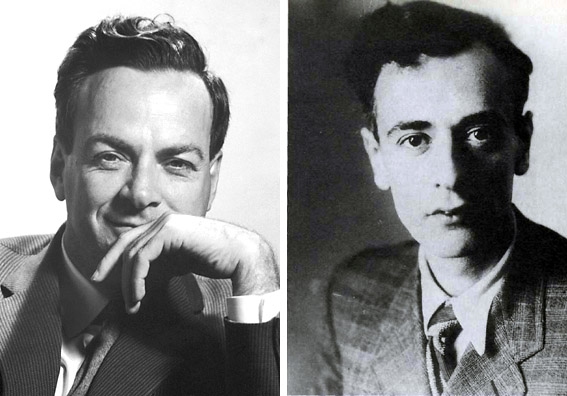
In fact, choosing this title feels a bit arrogant, like trying to teach a fish how to swim. One reason is that I am not a physics major myself, nor have I mastered physics. Furthermore, I haven’t read many of Feynman’s or Landau’s books myself. Since I cannot claim to have “saturated” myself in their works, how can I guide others?
However, combining my feelings while reading their works with my own process of learning science, I would like to share my views on their writings.
What is the Most Concise Way?
I believe many readers feel that Landau’s Course of Theoretical Physics is deeper than The Feynman Lectures on Physics, feeling that Landau’s books always contain a large number of mathematical formulas, while Feynman’s books seem more relaxed. I initially had the same feeling, but as I read further, I began to feel that Feynman’s books are even more difficult than Landau’s.
Before entering the discussion, let us first think: what is the most concise way to understand physics? Is it true that the more complex the mathematics, the worse it is?
Let’s first discuss classical mechanics. The first approach to classical mechanics is described by Newton’s three laws, which involve listing differential equations through force analysis and Newton’s second law, and then analyzing those equations. This is also what is taught in general physics. However, this model has significant drawbacks: first, the vector nature of force increases complexity; second, when constraints exist, force analysis becomes quite complicated. I believe many readers can derive the equation of motion for a simple pendulum, but if the pendulum consists of a string with non-negligible mass (essentially an infinite compound pendulum), force analysis likely fails. However, for the second approach to classical mechanics, there isn’t much difference between these two cases.
The second approach to classical mechanics is to describe physical laws through the “Principle of Least Action.” This method was developed by Euler, Lagrange, Jacobi, and others, and the basic mathematical tool is the calculus of variations. For beginners, this method may seem difficult because the mathematical calculations involved are very tedious. However, this is precisely the simplest way to understand classical mechanics today (I believe there is no other). The Principle of Least Action is based on the variation of an energy functional. Energy is a scalar and has simple additivity; writing an expression for the energy of a system is always simpler than performing force analysis on it. As for the mathematical complexity, it is actually just repeating some rather tedious calculations (note: tedious, not necessarily difficult).
(Note: Variation belongs to “higher” mathematics and is part of functional analysis. However, even in our functional analysis courses for math majors, variation is often not taught; instead, many abstract and useless things are discussed, so many math graduates have no concept of variation. But in fact, variation is not hard to learn; it just involves a few more steps than standard calculus.)
The benefits brought by this second approach are numerous. Most obviously, it provides a unified processing idea for a large number of different physical problems. In fact, the more complex the system, the more difficult force analysis becomes, and the simpler the Principle of Least Action approach appears. This is a case of “the more complex, the simpler.”
Feynman Lectures vs. Landau Course
Now we can talk about their respective tutorials. In choosing the way to describe physics, Landau and Feynman were consistent: they both chose the Principle of Least Action. It is no exaggeration to say that Feynman spent almost his entire life developing the Principle of Least Action; his famous “path integral formulation of quantum mechanics” is a generalization of it. As for Landau, his ten-volume series, starting from the first volume Mechanics, used the Principle of Least Action as the basic language.
Feynman
Personally, I have paid quite a bit of attention to Feynman. I have dabbled in many of his popular works (Surely You’re Joking, Mr. Feynman!, The Pleasure of Finding Things Out, etc.) and professional works (The Feynman Lectures on Physics, Quantum Mechanics and Path Integrals, Feynman Lectures on Gravitation, etc.). Feynman’s physics lectures give people a very comfortable feeling, truly making it feel as if he is communicating with you face-to-face. Even if you are just a layman, you can ignore the formula sections and appreciate the beauty of physics from his words.
Of course, this does not mean his textbooks are simple. In fact, Feynman’s textbooks are not easy and can even be quite profound. This is not hard to understand—just imagine, if Feynman were really talking to us face-to-face about physics, we might not necessarily understand him, right? Feynman was an out-and-out genius, and he worked hard to describe science in a visual and intuitive way. Indeed, we can often understand basic physical ideas from his descriptions, but to analyze details further, one must resort to complex mathematics. Feynman’s books do not contain many detailed mathematical processes; instead, they are overflowing with physical ideas and images.
Landau
Compared to Feynman, I know less about Landau, including his life and works. Among the ten volumes of Landau, the only ones I have read seriously are Volume 1 Mechanics and Volume 2 The Classical Theory of Fields, but these were enough to benefit me endlessly. The main starting point of these two books is the Principle of Least Action; Mechanics deals with the non-relativistic case, while The Classical Theory of Fields is relativistic.
It is said that the Russian mathematician Vladimir Arnold felt that Landau’s Mechanics was the only one he could understand. I had a similar feeling when reading Landau’s Mechanics and The Classical Theory of Fields. Because I already had some foundation in variation, reading Landau’s books felt very natural, and I could basically read through them without difficulty. To reach this level does not require rare genius or a deep mathematical foundation; you only need a preliminary understanding of variation and the idea of the Principle of Least Action.
Reading Landau’s books also gives you the feeling that almost everything is in there. Landau’s derivations are very detailed, so there are many mathematical formulas. Most readers are often unwilling to read books containing a large number of formulas, but Landau’s books are clear precisely because of their many formulas. Moreover, Landau’s books are very rich in content. After reading Landau, if you look at other theoretical physics textbooks, you will find that many of their examples and exercises come from Landau’s series.
Learning Physics Requires Love and Sweat
A reply from Sina Weibo user @Jiuhua commented on the two sets of textbooks very brilliantly:
Reading Landau’s books: first tears stream down your face (it’s too hard), then comes a knowing smile (feeling you can achieve great things); reading Feynman’s books: first a knowing smile (physics can be so simple), then tears stream down your face (feeling you hadn’t been learning physics on the right path before)!
Whether it is Landau’s ten volumes or Feynman’s lectures, they are both excellent physics textbooks. Feynman leans more towards physics, while Landau leans more towards mathematics. Reading Feynman’s books seems easy to understand, but that is only on the surface; once you understand the surface and want to go deeper, you have to put in the work yourself. Landau’s books are difficult to read at first simply because the reader is unfamiliar with the new way of description; once that hurdle is passed, everything follows naturally.
To put it bluntly, neither is simple. Or rather, physics is not simple, and science is not simple; otherwise, there wouldn’t be websites like the “Association of Science Squirrels” hoping to “crack the hard nut of science” for the public. Feynman is a recognized genius, but even such a genius spent many sleepless nights researching and calculating before showing his brilliance to the world. After Feynman won the Nobel Prize, a reporter asked him to describe his results in one sentence, and he said, “If I could explain it in one sentence, would it be worth a Nobel Prize?”
Therefore, I believe that to learn physics well, one must first have a love for physics, and secondly, perhaps add an appreciation for the authors of the textbooks you read. In this way, no matter how difficult the textbook is, we are willing to strive for it. Of course, the key point is that sweat is also necessary. Any reader who truly loves physics and hopes to study it can benefit greatly from both Landau’s ten volumes and Feynman’s lectures—the key is to put in the necessary effort. Spend some time and patience, read seriously, and you will find that much of the content is actually quite manageable.
When reposting, please include the original address: https://kexue.fm/archives/2498
For more detailed reposting matters, please refer to: Scientific Space FAQ