Besides mathematics, physics, and Chinese chess, I also enjoy spending my spare time cooking. Seeing various ingredients transformed into delicious dishes through my own processing is a beautiful experience. Sometimes, seeing how the same ingredients can be used to create different styles and flavors is even more delightful. As a Cantonese person, I am very proud of a certain saying: “Cantonese people eat everything—anything that flies in the sky except airplanes; anything that crawls on the ground except trains; and anything that swims in the water except submarines.” Although this is inevitably an exaggeration, it fully demonstrates the formidable culinary and cooking skills of the Cantonese people (or the Lingnan region in general). My kitchen skills come from my mother. When I was a child, she would cook at home using firewood, so I had to watch the fire in front of the stove. While tending the fire, I watched her cook, and over time, I learned some methods myself. Even now, my mother remains the master of the kitchen at home, while I occasionally step in to make things I like to eat. Thank you, my dear mother!
Steelmaking
This article is titled “Steelmaking vs. Cooking.” These two are basically unrelated, but I have discovered that they share some slightly similar techniques. I don’t remember exactly when, but in a natural science book, I once read about two techniques in steelmaking: quenching and annealing (later I found there are also normalizing, tempering, etc., with similar principles). Simply put, quenching involves heating a piece of steel until it is red-hot and then plunging it into cold water to cool it rapidly (i.e., heating to a certain temperature and then cooling quickly). By repeating this, the steel becomes harder, but also more brittle. Annealing is the exact opposite; it involves heating the steel until red-hot and then letting it cool naturally (if necessary, finding ways to slow down the cooling rate). As a result, the steel becomes softer and tougher. Normalizing and tempering are similar to annealing, differing only in the details. Through an appropriate combination of quenching and annealing, steel with the right balance of hardness and toughness can be produced.
Cooking
What does this have to do with cooking? Later, while learning to cook, I learned about a technique we have called “Guo Leng He” (Passing through the Cold River). The basic method is to put meat or vegetables into boiling water, bring it back to a boil, then scoop them out and immediately plunge them into cold water. This makes the meat or vegetables crisp and tender. Because I was exposed to quenching first, as soon as I learned this technique, I immediately thought of how similar “passing through the cold river” is to quenching! (Of course, the principles are completely different; “passing through the cold river” is merely thermal expansion and contraction, while quenching involves high-temperature phase transformation. However, the two achieve similar results through different means—truly wonderful!)
A typical use of “passing through the cold river” is when cooking noodles. It is said that passing noodles through the “cold river” makes them more refreshing and prevents them from becoming mushy. However, I don’t think I have tried this myself because I don’t particularly like eating noodles. When noodles are boiled, they expand and soften due to heat; when they immediately enter cold water, the body of the noodle shrinks instantly due to the cold. Because of this thermal expansion and contraction, the noodles become more resilient, elastic, and refreshing to the taste, resulting in a better flavor. Furthermore, the underlying principle is likely that noodles have better elasticity and chewiness when the internal and external humidity are inconsistent (this might also explain why teppanyaki fried noodles taste better than ordinary fried noodles). The key to passing noodles through the “cold river” is that they must be scooped out after only a brief blanching in boiling water; the cooking time must be very short. If they are boiled slowly and then passed through the cold river, the noodles will have soaked in the water for too long, and the internal and external humidity will equalize, losing the chewiness. To maintain chewiness, the focus is on increasing the cooling speed and reducing the time spent in the cold river. Replacing cold water with ice water, or even spraying them with a liquid carbon dioxide fire extinguisher, might be good ideas. ^_^
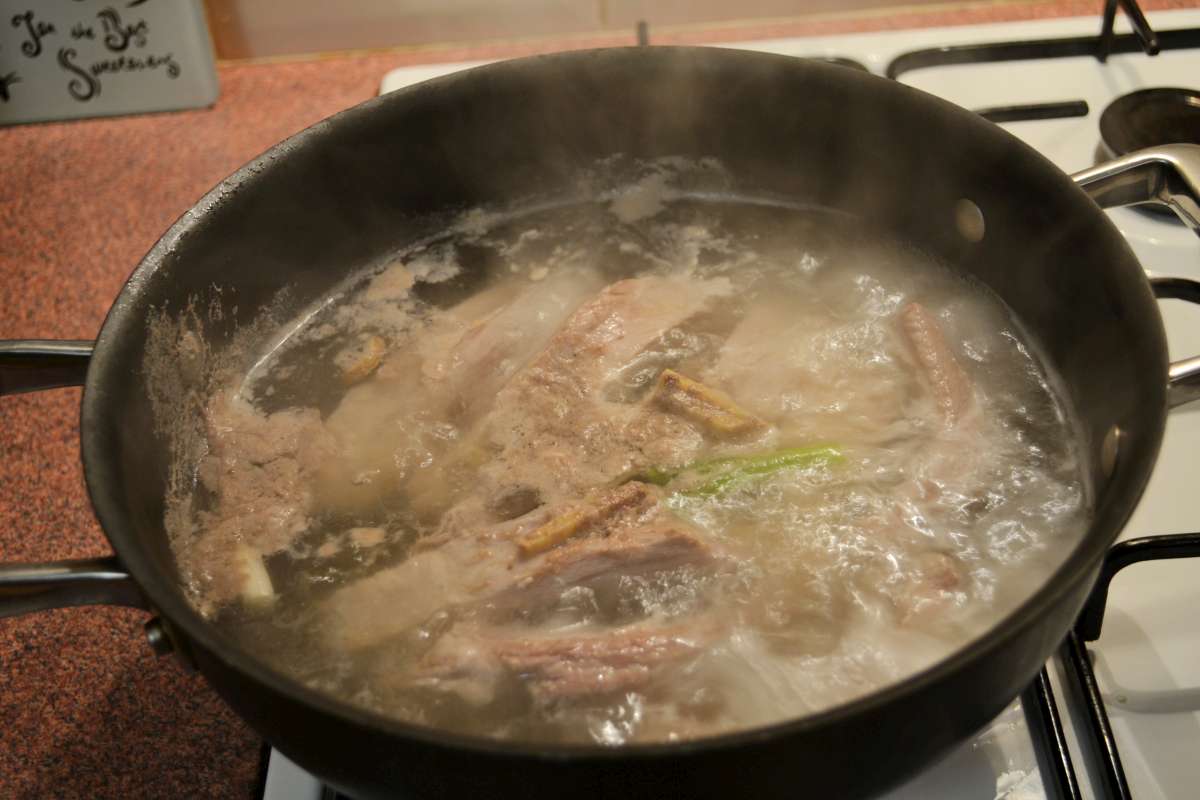
However, I know of another use: stir-frying pig intestines, squid, or beef brisket. Taking pig intestines as an example, anyone who has eaten them knows they are very tough and difficult to bite through. Therefore, we use the “cold river” method to make the intestines crispier. Usually, we boil water, add the intestines and a bit of wine (to remove the odor), bring it back to a boil, then scoop them out and put them into cold water (if possible, it is best to use water with ice cubes; remember, the faster the better, the colder the better, and if necessary, rinse continuously with cold water). After repeating this a few times, the odor of the intestines is removed, and they become crisp. Other meats that need to be crisp can be treated similarly. In particular, when fatty meat is braised after “passing through the cold river,” it can achieve the effect of being “rich but not greasy.” ^_^
Of course, “passing through the cold river” is not a panacea; it is a quite flexible technique. When used appropriately, it is like a stroke of genius; when used incorrectly, it can make the food even softer and mushier. This requires friends who like cooking to experiment more; it is no simpler than scientific research.
Some readers might wonder: since “passing through the cold river” is similar to “quenching,” is there a cooking technique similar to “annealing”? Regarding this... please forgive my limited knowledge, but I have not yet discovered such a technique. However, there is a similar phenomenon: if a plate of cooked vegetables cools down slowly, it will gradually become soft. But this is a bit of a stretch; please just take it as a lighthearted remark.
(The views in this article may not be entirely correct; please test them before use. ^_^)
When reposting, please include the original address of
this article:
https://kexue.fm/archives/2374
For more detailed information regarding reposting, please
refer to:
“Scientific Space FAQ”