Common Tangent Circles of Three
Mutually Tangent Circles
Translated by DeepSeek V4 Pro. Translations can be inaccurate, please refer to the original post for important stuff.
Jianlin SuJanuary 27, 2014#2320
While I was learning to drive, my
elder cousin once asked me a question about constructing circles:
The circumscribed and inscribed circles of the three circles
(1)
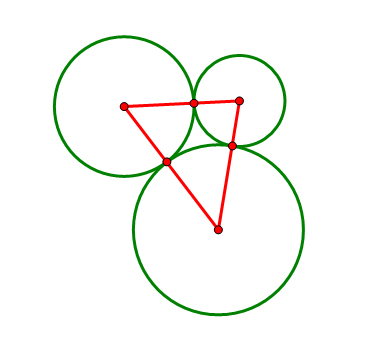
Given three mutually tangent circles and their centers on a plane,
construct a circle tangent to all three (using only a compass and
straightedge).
If approached from a purely geometric perspective, it is even
difficult to determine whether such a circle exists. However, I seemed
to have encountered similar problems before, so I quickly thought of a
term: inversion. Inversion can map a circle to a line (if the circle
passes through the center of inversion) or to another circle (if it does
not), while preserving relationships such as tangency and intersection.
Applying the same inversion to the resulting figure restores the
original configuration. The difficulty of this problem lies in the
number of circles; using inversion, we can transform it into a problem
involving two lines and one circle.
Assuming the reader already has basic knowledge of inversion; if not,
please go to Inversive
Geometry to read the relevant content.
Below are the construction steps:
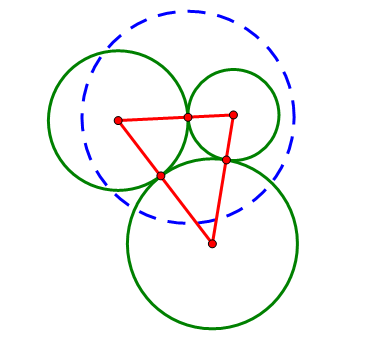
(1) Select a point of tangency and draw a circle centered at that
point (with an arbitrary radius);
The circumscribed and inscribed circles of the three circles
(2)
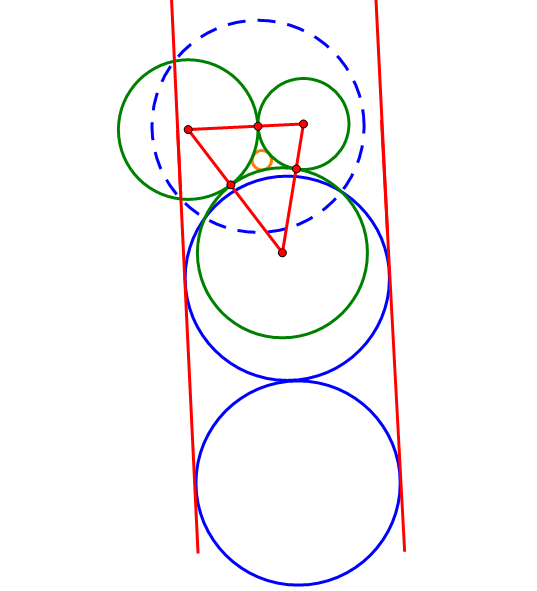
(2) Using the circle drawn in step (1) as the reference circle,
construct the inverted images of the three given circles. Two of the
circles will transform into two parallel lines, while the third circle
will still be inverted into a circle, tangent to both lines.
The circumscribed and inscribed circles of the three circles
(3)The circumscribed and inscribed circles of the three circles
(4)
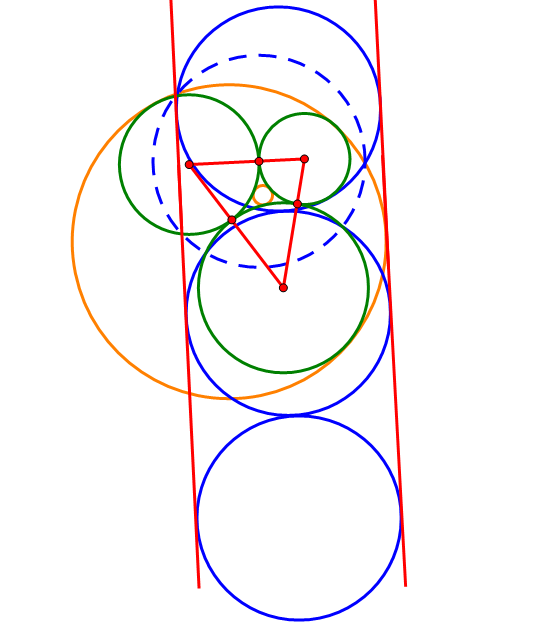
(3) The following steps are straightforward: clearly, we can
construct two circles that are tangent to both the circle and the two
lines in the inverted image. After constructing these two circles, use
the circle from step (1) as the reference circle again to invert them
back. This yields the desired circles, corresponding to the
circumscribed and inscribed circles of the three original circles.
The circumscribed and inscribed circles of the three circles
(5)The circumscribed and inscribed circles of the three circles
(6)