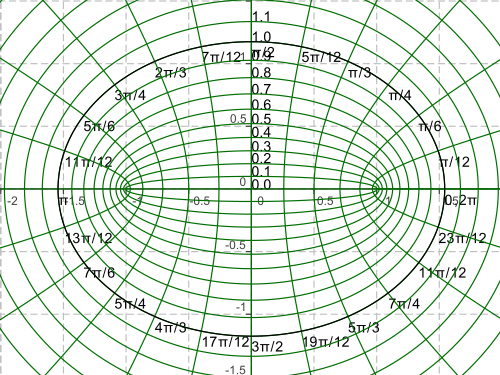
The elliptic coordinate system is a two-dimensional orthogonal coordinate system. The transformation relationship with Cartesian coordinates is: \begin{aligned} x &= a \cosh \mu \cos \nu \\ y &= a \sinh \mu \sin \nu \end{aligned}
Where (-a,0) and (a,0) are the two foci.
See: http://en.wikipedia.org/wiki/Elliptic_coordinate_system
Click
to view original SVG image: Elliptical_coordinates_grid
(SVG format not supported by pdflatex)
Additionally, consider \sin z, where z=x + iy: \sin z = i \cos x \sinh y + \sin x \cosh y
Proof:
2i \sin z = e^{iz} - e^{-iz} = e^{ix-y} - e^{-ix+y} \begin{aligned} &= e^{ix-y} - e^{ix+y} + e^{ix+y} - e^{-ix+y} \\ &= e^{ix} (e^{-y} - e^y) + e^y (e^{ix} - e^{-ix}) \\ &= -2 e^{ix} \sinh y + 2i e^y \sin x \\ &= -2 (\cos x + i \sin x) \sinh y + 2i (e^y) \sin x \end{aligned}
Then multiply by -\frac{1}{2}i: \begin{aligned} \sin z &= i (\cos x + i \sin x) \sinh y + (e^y) \sin x \\ &= i \cos x \sinh y - \sin x \sinh y + e^y \sin x \\ &= i \cos x \sinh y - \sin x (\sinh y - e^y) \\ &= i \cos x \sinh y - \left(\frac{e^y - e^{-y} - 2e^y}{2}\right) \sin x \\ &= i \cos x \sinh y + \left(\frac{e^y + e^{-y}}{2}\right) \sin x \\ &= i \cos x \sinh y + \sin x \cosh y \end{aligned}
Source of proof: http://au.answers.yahoo.com/question/index?qid=20100418003726AAyRTR8
Similarly: \begin{aligned} \cos z &= -i \sin x \sinh y + \cos x \cosh y \\ \sinh z &= i \sin y \cosh x + \cos y \sinh x \\ \cosh z &= i \sin y \sinh x + \cos y \cosh x \\ &\quad \text{(Corresponds to elliptic coordinates)} \end{aligned}
Amazing similarity to elliptic coordinates!
Some other interesting points: \begin{aligned} \sin iz &= i \sinh z \\ \sinh iz &= i \sin z \\ \cos iz &= i \cosh z \\ \cosh iz &= i \cos z \\ |\sin z| &= \sqrt{\sin^2 x + \sinh^2 y} \\ |\cos z| &= \sqrt{\cos^2 x + \sinh^2 y} \\ |\sinh z| &= \sqrt{\sinh^2 x + \sin^2 y} \\ |\cosh z| &= \sqrt{\cosh^2 x - \sin^2 y} \end{aligned}
Reference book: Applied complex variables for scientists and engineers
When reposting, please include the address of this article: https://kexue.fm/archives/1314
For more detailed reposting matters, please refer to: Scientific Space FAQ