Explanation:
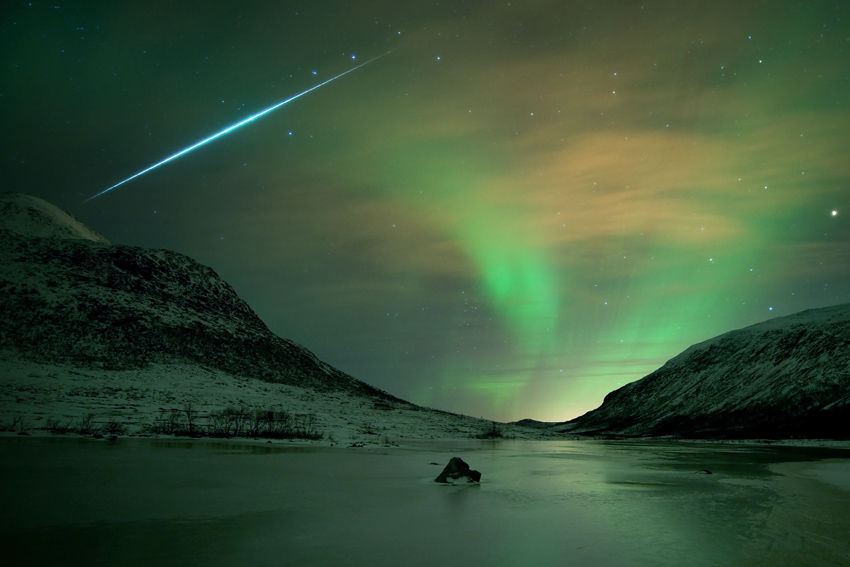
Aurora, Meteor, and Snowy Night.
On December 13 of this year, the Northern Lights (also known as Aurora Borealis) danced in the night sky near Tromsø on the island of Kvaløya, Norway. This 30-second long-exposure image captures the faint and gracefully swaying aurora over this wintry coastal scene. In contrast, the image also captured a meteor from this December’s spectacular Geminid meteor shower as it suddenly streaked across the sky. This meteor passed by the handle of the Big Dipper, and its trail points back toward the constellation Gemini, which is located just outside the top of the image. Both auroras and meteors are phenomena occurring at an altitude of about 100 kilometers in Earth’s atmosphere. However, auroras are excited by high-energy particles from the magnetosphere, while meteors are the trails left by cosmic dust passing through the atmosphere.
NASA Website:
http://antwrp.gsfc.nasa.gov/apod/astropix.html