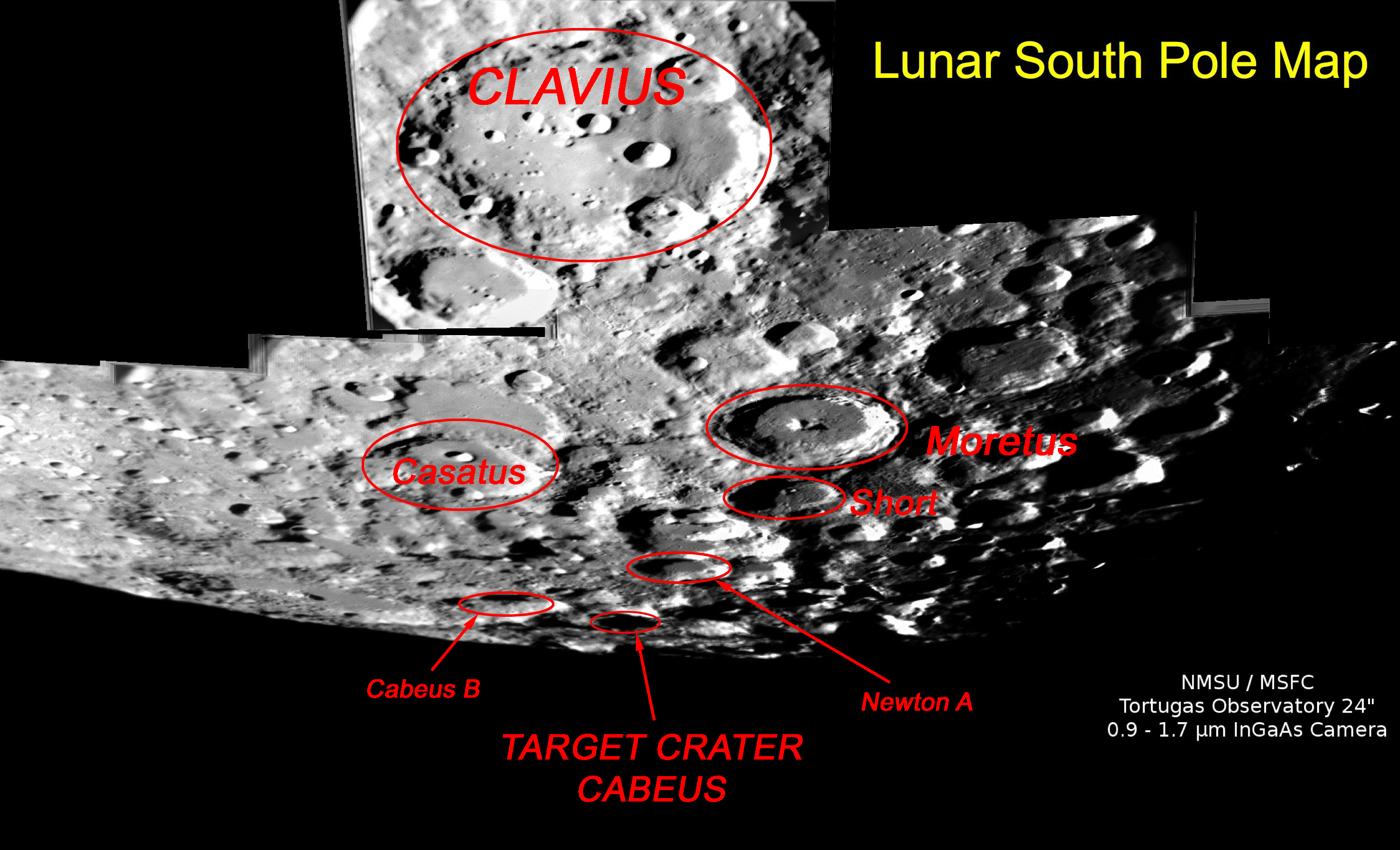
(Image Description: Cabeus Crater, Copyright: NMSU/MSFC Tortugas Observatory)
Description:
This is NASA’s lunar probe impact target—Cabeus crater.
Tomorrow, NASA’s two LCROSS lunar probes will impact the 100km-wide Cabeus A crater, located approximately 100km from the lunar south pole. The impact is scheduled for October 9 at 7:30 AM EDT (19:30 Beijing time). NASA will broadcast the entire process live starting from 6:15 AM EDT on October 9.
According to the impact site announced by the space agency, LCROSS will crash into the Cabeus A crater. This target crater was finalized after evaluating regions at the lunar south pole most likely to contain water ice. Anthony Colaprete, LCROSS project scientist and lead researcher at NASA’s Ames Research Center, stated: “The selection of Cabeus A was the result of intense discussion within the lunar science community. Before choosing this target crater, we evaluated data obtained from ground-based observatories, the Kaguya mission, Chandrayaan-1, and the Lunar Reconnaissance Orbiter. The LCROSS mission team hopes that this unique impact mission will provide a wealth of information.”
On October 9, the Centaur upper stage rocket of LCROSS will impact the permanently shadowed region of Cabeus A. LCROSS will use this impact to study lunar water ice. According to analysis, water on the moon may exist in the form of ice. Following this, LCROSS will fly into the resulting ejecta plume, analyze the properties of the debris cloud, and then impact the lunar surface itself.
The LCROSS mission team chose Cabeus A because the crater meets a series of criteria, including high illumination of the resulting ejecta plume, which can be observed from Earth, allowing astronomers to closely monitor the entire process. Additionally, Cabeus A contains a high concentration of hydrogen (a key element of water) and possesses the most suitable terrain for a target crater, such as a relatively flat bottom, low slopes, and the presence of large boulders.
At that time, professional astronomers will use the world’s most advanced observatories to monitor the impact. These observatories include the Infrared Telescope Facility (IRTF) and Keck Telescope in Hawaii, the Magdalena Ridge and Apache Ridge Observatories in New Mexico, the MMT (Multi-Mirror Telescope) Observatory in Arizona, the newly repaired Hubble Space Telescope, the Lunar Reconnaissance Orbiter, and other observatories. In addition to professional astronomers, amateur astronomers can also monitor the LCROSS impact process.
Jennifer Heldmann, LCROSS observation mission lead at Ames Research Center, stated: “Telescopes participating in the LCROSS observation mission will use different types of measurement techniques from various vantage points to observe the impact, thereby providing a wealth of observational data. These data will be combined with the data obtained by LCROSS itself to help us determine if water ice exists in Cabeus A.”
ScienceNet: http://www.sciencenet.cn/htmlnews/2009/9/223330.shtm
NASA Website:
http://antwrp.gsfc.nasa.gov/apod/astropix.html
http://antwrp.gsfc.nasa.gov/apod/ap091009.html
Please include the address of this article when reposting: https://kexue.fm/archives/178
For more detailed reposting matters, please refer to: Scientific Space FAQ