Explanation:
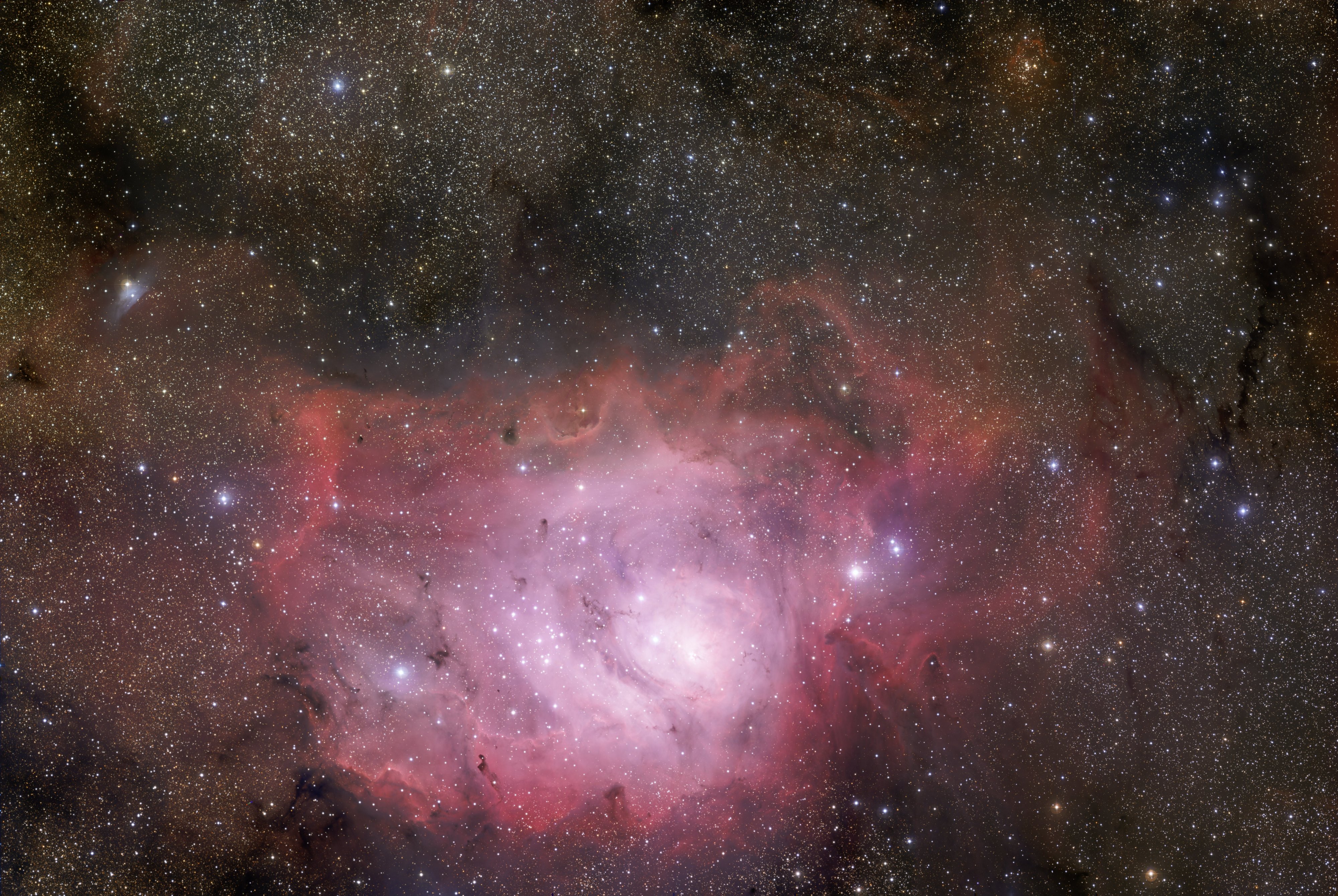
The Lagoon Nebula as captured by the GigaGalaxy Zoom project.
This massive Lagoon Nebula is home to many young stars and hot gas. The image spans 100 light-years, and the nebula is approximately 5,000 light-years away. The size and brightness of the Lagoon Nebula are sufficient to be observed without a telescope; it can be found directly in the constellation Sagittarius. The bright stars within the open cluster NGC 6530 were born from this nebula millions of years ago. This large nebula is also known as M8 or NGC 6523, named “Lagoon” due to the dust lane features to the right of the open cluster, while the bright dust and gas at the center of the nebula is the famous Hourglass Nebula. This spectacular image was recently released by the GigaGalaxy Zoom project, featuring M8 stitched from images taken by the Wide Field Imager mounted on the MPG/ESO 2.2-meter telescope at the La Silla Observatory in Chile. This image covers approximately the width of three moons (\sim1.5 degrees), and the high-resolution version exceeds 350 megapixels. Many “globules” (Bok globules) have been witnessed in the Lagoon Nebula, proving that new stars are constantly being born there.
Translation from: http://www.skylook.org/apod/astropix.html
NASA Website: http://antwrp.gsfc.nasa.gov/apod/astropix.html http://antwrp.gsfc.nasa.gov/apod/ap091006.html
When reposting, please include the address of this article: https://kexue.fm/archives/158
For more detailed reposting guidelines, please refer to: Scientific Space FAQ