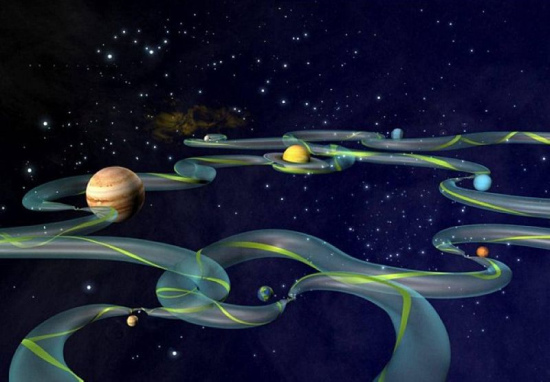
Sina Tech News, September 11 — According to a report by the British Daily Mail, US scientists stated on the 10th that "gravity corridors" can help spacecraft traverse the solar system, similar to how ships utilize ocean currents. Currently, American scientists are attempting to map the winding tubes shown in the images, which could significantly reduce the costs of space flight.
Each tube acts as a gravitational "gulf stream," formed by the complex gravitational interactions between planets and moons. As shown in the computer-generated diagrams, these spaghetti-like channels loop around the planets within the solar system and meander between them. Figuratively speaking, these channels form a "Space Highway."
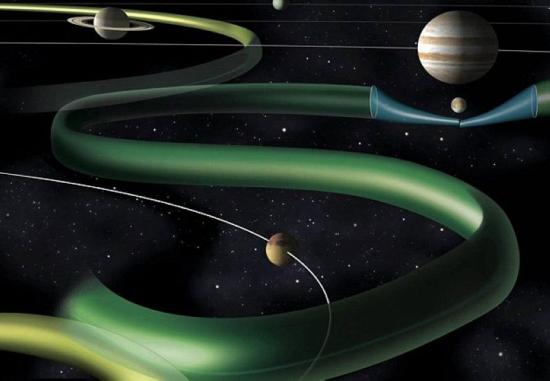
The locations connected by the Space Highway are known as "Lagrange points," where gravitational forces cancel each other out. Professor Shane Ross of Virginia Tech stated: "Basically, the idea is to create low-energy channels that wind between planets and moons, which can reduce the fuel used in the process of exploring the solar system. These free-fall channels in space surround celestial bodies and meander among them. A spacecraft traveling within a tube does not ’fall down’ in the traditional sense, but rather falls along the tube, just as it would on Earth. Each tube starts out relatively narrow; as they continue to wind forward, they become wider and may also split."
Ross said: "I like to think of them as something similar to ocean currents, but they are essentially gravitational flows. If you are in a temporary parking orbit around the Earth, one of these tubes will intersect your orbit. You would need just enough fuel to change your velocity and then enter a new orbit, and this new orbit is ’free’."
He explained that using gravitational flows to travel through space is different from the "slingshot effect" (gravity assist) generated by the gravity of planets or moons, which is a commonly used technique in space flight. Ross noted: "Gravitational flows are different from the slingshot; the latter will not send you into a moon’s orbit, whereas the former can achieve that."
To date, only one US space mission has utilized this method: the "Genesis" spacecraft mission. Launched in 2004, Genesis was tasked with capturing solar wind particles and returning them to Earth. Flying along gravity channels allowed the probe to carry ten times less fuel than would otherwise be required. However, due to a parachute failure during the descent, the Genesis mission ultimately ended in a crash landing.
Speaking at the British Science Festival held at the University of Surrey in Guildford, Ross stated that "gravity corridors" are particularly useful for travel between the moons of a planet. He said: "Once you enter another planet that has its own gravity tubes, you can use those tubes to explore the planet’s moons. You can travel between Jupiter’s moons at will, and at that point, the space journey is basically free. All you need is a small amount of fuel to change direction."
He pointed out that the downside is the long duration required. Traveling within Jupiter’s moon system would take several months. While traveling between moons requires very little fuel, traveling between planets still consumes a relatively large amount. Finding a "free" gravity channel between Earth and Mars would take thousands of years. (Reported by Qiu Ling)
When reposting, please
include the original address of this article:
https://kexue.fm/archives/121
For more detailed reposting
matters, please refer to:
"Scientific Space
FAQ"