Since I last wrote about learning limits in calculus, it has been a long time since we discussed calculus together (I estimate it has been about 20 days). Actually, I only started systematically studying calculus in late September of this year, so it has only been about a month. The topics I have studied include: sets, functions, limits, derivatives, differentials, and integrals. However, these are all single-variable calculus; multi-variable calculus is currently under intensive study...
Now, I would like to discuss with everyone the most fundamental content in calculus—the study of "Derivatives."
In fact, to put it in the simplest terms, if a function f(x) exists, then its derivative (first-order derivative) is: \lim_{\Delta x \to 0} f'(x) = \frac{f(x+\Delta x) - f(x)}{\Delta x}
Wherein \lim_{\Delta x \to -0} f'(x_0) = \frac{f(x_0+\Delta x) - f(x_0)}{\Delta x} is called the "left derivative" of the function f(x) at x_0, and \lim_{\Delta x \to +0} f'(x_0) = \frac{f(x_0+\Delta x) - f(x_0)}{\Delta x} is called the "right derivative" of the function f(x) at x_0.
Only when the "left derivative = right derivative" can we say that the function f(x) is "differentiable" at x_0.
Applied Significance of Derivatives (First-order Derivatives):
(I) Instantaneous Velocity and Instantaneous Rate of Change
If in linear motion, the relationship between distance s and time t is s=f(t), then the distance covered between t seconds and (t+\Delta t) seconds is f(t+\Delta t) - f(t). The average velocity during this period is \frac{f(t+\Delta t) - f(t)}{\Delta t}. By making \Delta t as small as possible (i.e., \Delta t \to 0), the resulting value (i.e., f'(t)) is the instantaneous velocity at time t.
(II) Slope of the Tangent Line to a Curve
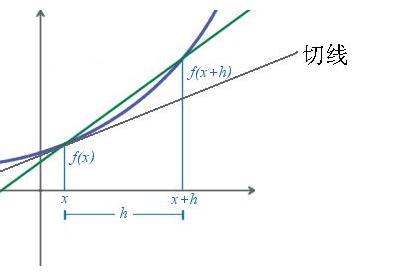
As shown in the figure, on the curve f(x), the slope (tangent value) of the line determined by the point (x, f(x)) and the point (x+h, f(x+h)) is: \frac{f(x+h) - f(x)}{h}
The smaller h is, the closer this line gets to the tangent line of the curve at x. Correspondingly, \frac{f(x+h) - f(x)}{h} also gets closer to the slope of the tangent line. Thus, when h \to 0, the line infinitely approaches the tangent line, and \frac{f(x+h) - f(x)}{h} = f'(x) is the value of the slope of the tangent line to the curve f(x) at x.
Methods of Differentiation:
1. Basic Differentiation
Formulas
http://web.nuist.edu.cn/courses/gdsx/calculus1/chap2/section2/2.2.4.1.HTM
Among these, I would like to discuss the derivation process of several basic differentiation formulas.
1.1 (a^x)' = a^x \ln a \quad (a > 0, a \neq 1)
(a^x)' = \lim_{\Delta x \to 0} \frac{a^{x+\Delta x} - a^x}{\Delta x} = a^x \lim_{\Delta x \to 0} \frac{a^{\Delta x} - 1}{\Delta x}
Let a^{\Delta x} - 1 = \beta \iff a^{\Delta x} = \beta + 1. Taking the logarithm of both sides, we have \Delta x = \frac{\ln(\beta+1)}{\ln a}. Therefore, the original expression becomes:
\begin{aligned} (a^x)' &= a^x \lim_{\beta \to 0} \frac{\beta \ln a}{\ln(1+\beta)} \\ &= a^x \ln a \lim_{\beta \to 0} \frac{1}{\frac{1}{\beta} \ln(1+\beta)} \\ &= a^x \ln a \lim_{\beta \to 0} \frac{1}{\ln(1+\beta)^{\frac{1}{\beta}}} \end{aligned}
Since \lim_{\beta \to 0}
(1+\beta)^{\frac{1}{\beta}} = e, then \lim_{\beta \to 0}
\frac{1}{\ln(1+\beta)^{\frac{1}{\beta}}} = 1.
Thus, (a^x)' = a^x \ln a.
1.2 (\log_a x)' = \frac{1}{x \ln a}
\begin{aligned} (\log_a x)' &= \lim_{\Delta x \to 0} \frac{\log_a (x+\Delta x) - \log_a x}{\Delta x} \\ &= \lim_{\Delta x \to 0} \frac{\log_a (1 + \frac{\Delta x}{x})}{\Delta x} \\ &= \lim_{\Delta x \to 0} \log_a (1 + \frac{1}{x} \cdot \Delta x)^{\frac{1}{\Delta x}} \\ &= \log_a e^{(1/x)} = \frac{\log_a e}{x} \end{aligned}
By changing the base, we get (\log_a x)' = \frac{1}{x \ln a}.
From the above methods, it can be seen that "differentiation" is actually a type of limit calculation. If we derive the derivative from the most basic definition, we need to use the variable \Delta x and let it approach zero. At the same time, we must strive to transform it into familiar limits (such as e), which requires us to understand some basic limit formulas.
Of course, this is far from enough. Because calculating derivatives from the definition is extremely cumbersome, we must find some rules that facilitate differentiation.
The specific details are skipped here. Readers should have a certain foundation in calculus, and it is suggested that beginners do not immediately read the calculus content on Wikipedia.
In addition, what we discussed above are all "first-order derivatives." In fact, there are also "second-order derivatives," "n-th order derivatives," etc. The definition is also very simple: the "derivative of the (n-1)-th order derivative" of a function is called the "n-th order derivative" of that function. The n-th order derivative of f(x) is denoted as f^{(n)}(x).
When reprinting, please include the original address of this article: https://kexue.fm/archives/118
For more detailed reprinting matters, please refer to: "Scientific Space FAQ"