Qixi Romance | Finding the Cowherd and
the Weaver Girl
Translated by DeepSeek V4 Pro. Translations can be inaccurate, please refer to the original post for important stuff.
Jianlin SuAugust 23, 2009#93
The
2009 Qixi Festival is approaching. This year’s Qixi falls on August 26
(Wednesday). Scientific Space wishes everyone a happy Qixi Festival, and
may all lovers in the world eventually become
spouses!
Qixi Story
In our country, the night of the seventh day of the seventh lunar
month, when the weather is warm and the plants are fragrant, is commonly
known as the Qixi Festival. Some also call it the “Begging for Skills
Festival” or “Daughters’ Festival.” This is the most romantic of
traditional Chinese festivals and was the most important day for young
women in the past.
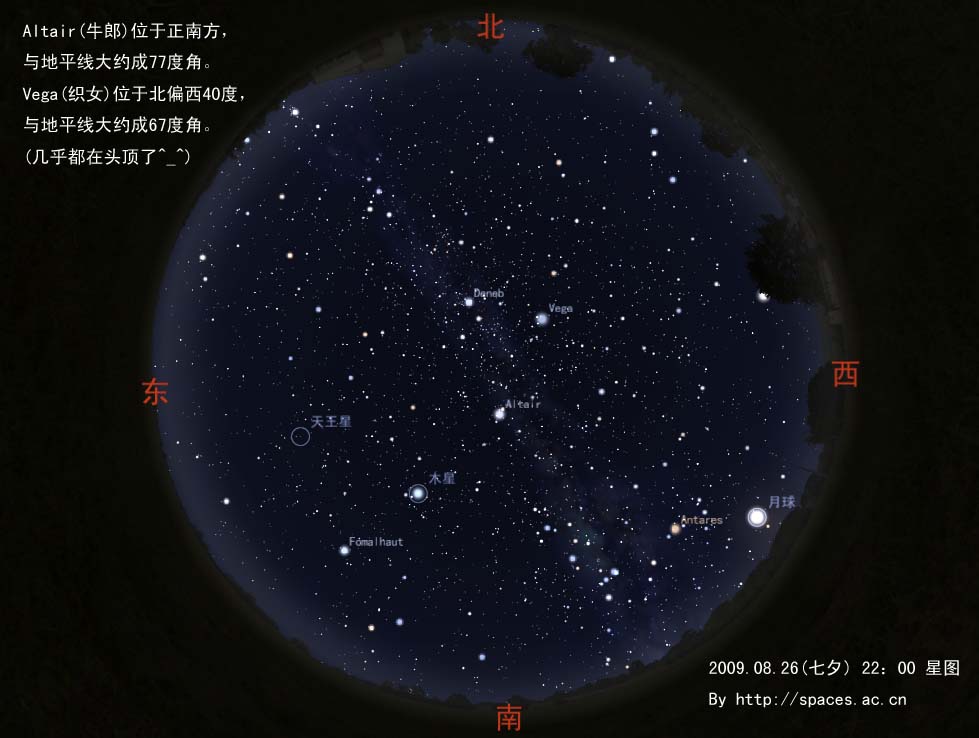
On clear summer and autumn nights, the stars shine brightly in the
sky, and a white Milky Way spans from north to south. On the east and
west banks of the river, there is a bright star on each side, looking at
each other from across the river. Those are Altair (the Cowherd) and
Vega (the Weaver Girl).
Sitting and watching Altair and Vega on Qixi is a folk custom.
According to legend, on this night every year, the Weaver Girl and the
Cowherd meet on the Magpie Bridge. The Weaver Girl is a beautiful,
intelligent, and skillful fairy. Mortal women pray to her on this night
for wisdom and craftsmanship, as well as for a happy marriage.
Therefore, the seventh day of the seventh lunar month is also called the
Begging for Skills Festival.
The story is well-known; those interested in learning more can refer
to the following websites:
Vega is located in the constellation Lyra and is a bright star,
scientifically known as \alpha Lyrae.
It is one of the most famous bright stars in the summer night sky.
Usually, people call it the Weaver Girl star. In the West, it is called
Vega, meaning the Queen of the Summer Night.
Vega’s diameter is 3.2 times that of the Sun, its volume is 33 times
that of the Sun, and its mass is 2.6 times that of the Sun. Its surface
temperature is 8900^\circ\text{C}, and
it appears bluish-white. It is one of the three brightest stars in the
Northern Hemisphere’s sky, located approximately 26.5 light-years from
Earth.
More than 13,000 years ago, Vega was located at the position of the
North Star. Due to the precession of the Earth’s axis, the current North
Star is \alpha Ursae Minoris (Polaris).
However, in another 12,000 years, Vega will return to the prominent
position of the North Star.
As for the “Cowherd,” in astronomy it is called “Hegu II,” the second
star of the Hegu asterism, which is “Altair” (\alpha Aquilae). It is also called “Qianniu”
or the “Great General.” It is the twelfth brightest star in the sky,
white, with a magnitude of 0.77, and is 16.3 light-years away. Its
luminosity is about 8 times that of the Sun, and its surface temperature
is about 7000^\circ\text{C}. The line
connecting it with \beta and \gamma Aquilae points directly toward
Vega.
It sits opposite Vega across the Milky Way. Ancient legends say the
Cowherd and the Weaver Girl meet on the Magpie Bridge on the seventh day
of the seventh month. In reality, they are 16 light-years apart. Even
with the most powerful modern rockets, they would not meet even after
hundreds of years. The two dimmer stars on either side of Altair are the
Cowherd’s son and daughter—Hegu I and Hegu III. Legend has it that the
Cowherd is chasing the Weaver Girl while carrying his son and daughter
on a shoulder pole. In summer, it forms the “Summer Triangle” with Vega
and Deneb. Altair is located at the southern end of the triangle.
Based on the current situation, the
weather on the night of Qixi looks good, with clear skies in most
places. It is suitable for astronomical observation.
Starry sky on the night of Qixi, observed from Xinxing
County, Yunfu City, Guangdong Province