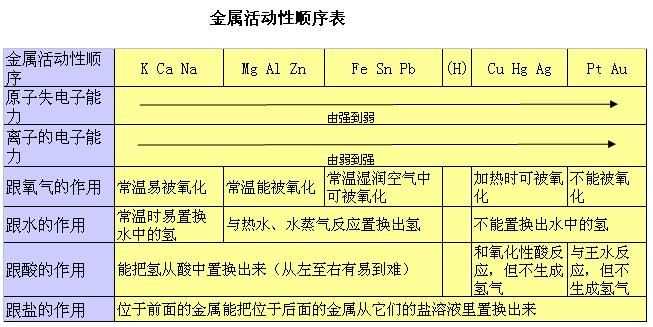
It is said that in a metal kingdom, there live many metal boys: Potassium, Calcium, Sodium... Their personalities and tempers vary. Consequently, humans who visited the metal kingdom, after careful investigation, clarified their temperaments and compiled them into the “Metal Activity Series.”
How should one read this table? Metals ranked earlier have active and easy-going temperaments, making friends with others very easily; metals ranked later have eccentric and reclusive temperaments, unwilling to associate with others. Thus, when certain substances are brought near different metals, different phenomena occur.
For example: if you bring the “Oxygen girl” to Potassium, Potassium will immediately merge with Oxygen, never to part (forming K_2O); if you bring Oxygen to “Big Brother Gold,” however, Big Brother Gold is noble and not easily tempted; no matter whether one uses “soft or hard tactics,” he won’t even spare Oxygen a glance.
The more easy-going a metal is, the more resilient its emotional bond with other substances. Once Potassium and Oxygen combine, it is difficult to separate them; conversely, for those metals that are not easy-going, even if they are forced to be with others, there will be no stable result. For instance: we might work hard to bring Silver and Oxygen together (Ag_2O), but they will separate at the slightest hint of heat (2Ag_2O \rightarrow 4Ag + O_2\uparrow).
In the world of matter, there are also some “ions” that possess a similar “activity”; these are the acid radical ions. Generally speaking, NO_3^- is more active than SO_4^{2-}, so their corresponding acids also have different levels of activity. For example, HNO_3 can react with silver.
If the most active metal is combined with the most active ion, they will be “together for lifetimes, never to part” (KNO_3 is extremely difficult to decompose).
Please include the address
of this article when reposting:
https://kexue.fm/archives/89
For more detailed
reposting matters, please refer to:
Scientific Space
FAQ