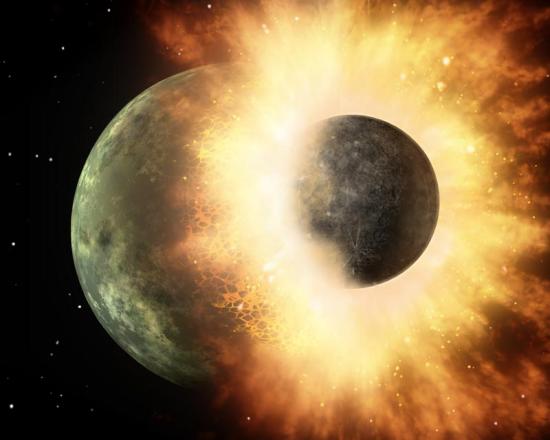
Sina Technology News — According to reports from NASA’s Space.com on August 11, astronomers using the Spitzer Space Telescope have discovered two planets orbiting a young star that collided with each other thousands of years ago.
In recent observations, NASA’s Spitzer Space Telescope detected plumes formed by vaporized rock and lava residue resulting from this collision. Although the collision between these two planets occurred thousands of years ago or even earlier, it is still considered a relatively recent event in cosmic terms. According to computer simulations, the smaller planet, which was approximately the size of Earth’s Moon, was apparently completely destroyed in the impact. The other planet, roughly the size of Mercury, survived but was left with a massive dent.
Carey Lisse of the Johns Hopkins University Applied Physics Laboratory in Maryland, who is the lead author of a paper detailing these findings to be published in the August 20 issue of The Astrophysical Journal, stated: “These two planets must have collided at a staggering speed, as the rocks produced were vaporized and melted.”
Researchers believe that the two planets were traveling at a speed of approximately 22,400 miles per hour (10 kilometers per second) before the collision. The violent impact released amorphous silica rock (also known as molten glass) and hardened chunks of lava called tektites. The Spitzer Space Telescope also detected large clouds of rotating silicon monoxide gas, which were produced by the vaporization of rock.
Lisse said: “This is a very rare, short-lived event that is crucial to the formation of terrestrial planets and moons. We feel very fortunate to have observed it so soon after it occurred.” Infrared detectors on the Spitzer Space Telescope found signs of fragmented rock and re-solidified lava still in the early stages of planetary formation around the young star designated HD 172555. This system is located approximately 100 light-years from Earth. A light-year is the distance light travels in one year, which is about 6 trillion miles (approximately 9.7 trillion kilometers).
It is believed that Earth’s Moon was formed during a collision event 4 billion years ago when a Mars-sized object struck the Earth. Geoff Bryden, a co-author of the paper from NASA’s Jet Propulsion Laboratory in California, said: “The impact that formed the Moon must have been incredibly violent, enough to melt the Earth’s surface. Most of the debris from the impact entered a disk orbiting the Earth, eventually forming the Moon. The scale of this collision might be similar to what we are seeing through the Spitzer telescope, although we do not yet know if this recent impact will result in the formation of a moon. However, we do know that the surface of a rocky body became red-hot, melted, and deformed.”
In fact, during the early stages of our solar system, such violent collision events were very common. For example, it is believed that a massive impact stripped away the outer layers of Mercury, caused Uranus to tilt on its side, and prompted Venus to rotate in the opposite direction. Just last month, a small space rock struck Jupiter, leaving a black scar on it. Typically, when small rocks collide and merge, rocky planets like Earth combine with them and slowly grow larger. Compared to our 4.5-billion-year-old solar system, the system surrounding HD 172555 is relatively young, at only 12 million years old. (By Qiu Ling)
When reposting, please
include the original address of this article:
https://kexue.fm/archives/69
For more detailed information
regarding reposting, please refer to:
Scientific Space
FAQ